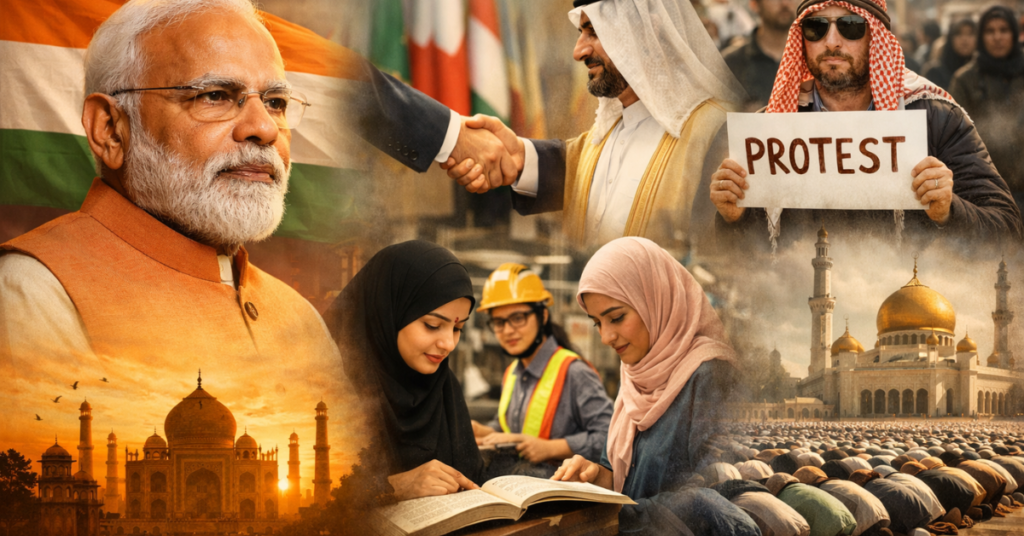
- From Appeasement to Empowerment, from Identity Politics to Opportunity
Summary
- Over the past 11 years, under the leadership of Narendra Modi and the Bharatiya Janata Party, perceptions among Muslims—within India and across the world—have evolved in complex but increasingly pragmatic ways.
- While social media often amplifies fear-based narratives, on-ground experiences reveal legal reforms that improved dignity, development-first policies that expanded opportunity, and global recognition from Muslim-majority countries.
- Many Muslims openly state that India is among the best places in the world for Muslims—a view shaped by freedom, institutions, and economic mobility.
- Negative commentary persists, but it is largely political, ideological, or fringe-driven, rather than reflective of everyday lived reality.
A Grounded, Outcome-Based Assessment
I. A Growing Sentiment: “India Is One of the Best Places for Muslims”
Across regions, professions, and generations, many Indian Muslims articulate a comparative, experience-based conclusion:
- Freedom of faith: Diverse Islamic practices without state control or clerical monopoly.
- Democratic safeguards: Courts, constitutional remedies, and electoral accountability.
- Economic mobility: Access to education, entrepreneurship, global careers, and capital.
- Pluralism: Citizenship and opportunity without theocratic constraints.
Professionals, entrepreneurs, women, and globally exposed youth often note that religious identity alone does not guarantee dignity—institutions and freedoms do.
II. Legal Dignity Through Reform: A Turning Point
1) Ban on Instant Triple Talaq
A landmark reform that:
- Ended arbitrary divorce harming Muslim women.
- Aligned personal law with constitutional equality and gender justice.
- Addressed a long-criticized practice earlier governments avoided due to vote-bank politics.
Impact: Broad appreciation among Muslim women and reform-oriented families who viewed it as long-overdue justice, not interference.
2) Judicial Scrutiny of Regressive Practices (e.g., Nikah Halala)
- Clear message that human dignity is non-negotiable.
- Reform can occur within the Constitution, without targeting faith.
Strengthened confidence among youth that religion and reform can coexist.
III. From Street Politics to Economic Aspirations
1) Jobs, Skills, and Mainstreaming Youth
Policy emphasis shifted from appeasement to development without religious filters:
- Skill development, startups, MSMEs, digital platforms.
- Direct Benefit Transfers reducing intermediaries and manipulation.
- Incentives to choose education, employment, and entrepreneurship.
- Uniform application of policies and availability of benefits.
Outcome: Declining appeal of street-level identity politics among aspirational youth; preference for stability and opportunity over confrontation.
2) Quality-of-Life Gains
Households report:
- Better housing, sanitation, healthcare access.
- Improved connectivity and mobility.
- Greater participation in the formal economy.
These everyday gains shape perception more than televised debates.
IV. The “Quiet Majority”: Pragmatic and Outcome-Oriented
A large segment:
- Engages the state for welfare, education, and business.
- Avoids polarizing politics; judges governance by delivery.
- Values law-and-order, stability, and upward mobility.
This majority trends rarely vouch these online—but anchors social stability.
V. Global Muslim Perception and Diplomatic Validation
- Highest Civilian Honors from Muslim-Majority Countries
Prime Minister Modi has received top civilian awards from multiple Muslim-majority nations, reflecting:
- Recognition of India’s inclusive governance of one of the world’s largest Muslim populations.
- Respect for India’s balance of faith, democracy, and development.
- Trust in India as a stable, respectful partner across the Islamic world.
Regional views:
- Gulf/Middle East: Largely pragmatic-positive; focus on diaspora safety, jobs, trade, and stability.
- South Asia: More negative due to regional rivalries and domestic politics.
- West: Polarized—activist/NGO criticism vs. diaspora professionals’ mixed but pragmatic assessments.
VI. Where Persistent Negativity Comes From
1) Political and Ideological Opposition
- Opposition parties invested in identity mobilization.
- Activist ecosystems detached from local outcomes.
- Selective amplification of incidents; omission of reforms.
2) Radical/Extremist Fringes
- Resist reform because it weakens control over narratives.
- Oppose action against radicalization, illegal funding, and terror networks.
- Not representative of Indian Muslims, but disproportionately amplified online.
VII. Points of Broad Consensus (Often Overlooked)
Across viewpoints, most Muslims—like all Indians—prioritize:
- Safety and equal application of law.
- Education and jobs for children.
- Economic stability and dignity.
These goals align with development-first governance, not appeasement.
VIII. The Long View: From Appeasement to Empowerment
- Pre-2014: Policy paralysis, corruption, weak global standing, appeasement.
- Post-2014: Decisive governance, legal dignity, economic inclusion, global credibility.
Many believe that without the course correction, India risked Pakistan-like failure or Bangladesh-style instability. The shift restored confidence.
A Quiet, Structural Shift
After 11 years, Muslim perceptions of the Modi government are far more nuanced and, in more positive than what social media reflects due to false propoganda:
- Many openly say India is among the best places for Muslims.
- Legal reforms improved dignity—especially for women.
- Youth favor opportunity over agitation.
- Quality-of-life gains are widely felt.
- Global Muslim nations have formally recognized India’s leadership.
- Persistent negativity is largely political, ideological, or fringe-driven.
The trajectory points to integration through opportunity, not appeasement—quietly, steadily, and structurally—strengthening coexistence and shared national progress.
🇮🇳 Jai Bharat, Vandematram 🇮🇳
Read our previous blogs 👉 Click here
Join us on Arattai 👉 Click here
👉Join Our Channels 👈