Summary
- The nature of warfare in the 21st century is changing rapidly. Wars are no longer decided only by the number of soldiers, tanks, or heavy missiles. Instead, technology, innovation, strategic partnerships, and cost control are becoming the decisive factors.
- Today, a drone costing a few thousand dollars can damage military or industrial assets worth millions. This has made cost-effective warfare and cost-balanced defense systems a central principle of modern military strategy.
- India is actively adapting to this shift. The Defence Research and Development Organisation (DRDO) is developing laser-based defense systems, while strategic collaborations with countries like Israel are strengthening India’s access to advanced technologies.
- At the same time, India aims to maintain a balanced approach—supporting global peace while ensuring strong national security in an increasingly unstable world.
⚙️ 1️⃣ The New Principle of Modern Warfare: Winning While Controlling Costs
- Historically, wars were seen primarily as demonstrations of military power.
- In the modern era, however, another factor has become equally important:
- A nation must be able to sustain the economic cost of war.
If a conflict:
- Becomes extremely expensive
- Continues for a long period
- Puts enormous pressure on the national economy
then even a short war can push a country years or even decades backward in development.
Therefore, modern military strategy focuses on:
- Maximizing impact at minimal cost
- Maintaining sustainable defense capabilities
- Preserving economic stability during conflict
🚁 2️⃣ Drone Warfare: Low Cost, High Impact
- Drone technology has fundamentally transformed modern warfare.
In the past, attacking a major target required:
- Fighter aircraft
- Long-range missiles
- Large military operations
Today, however:
- A drone costing only a few thousand dollars
- Can damage oil facilities, military bases, or strategic infrastructure worth millions
Example
- The drone attacks on Saudi Arabia’s Aramco oil facilities demonstrated how inexpensive weapons can disrupt global energy systems.
The incident showed that:
- Low-cost weapons can produce large geopolitical consequences.
- The balance of warfare is shifting rapidly.
🎯 3️⃣ Loitering Munitions and Suicide Drones
The next phase of drone warfare involves:
- Loitering Munitions
- Suicide Drones
These systems have several advantages:
- They can remain airborne over a target area for extended periods
- They identify targets using sensors and cameras
- They strike precisely at the optimal moment
They are particularly effective against:
- Tanks
- Radar installations
- Command centers
- Artillery systems
Future conflicts may also involve drone swarms, where hundreds or even thousands of drones attack simultaneously.
🛡️ 4️⃣ The Defense Challenge: Cheap Attacks vs Expensive Defense
- One of the biggest problems in modern warfare is cost imbalance.
In many cases:
- An attacker may launch a weapon costing only a few thousand dollars
- Defending against it may require missiles costing hundreds of thousands or even millions.
- If conflicts continue for long periods, this imbalance can severely strain national defense budgets.
Therefore, military planners are focusing on:
- Cost-efficient defense systems
- Rapid response capabilities
- AI-enabled air defense networks
🇮🇱 5️⃣ Iron Dome and Iron Beam Technologies
- Israel’s Iron Dome is one of the most effective air defense systems in the world.
It can:
- Intercept rockets mid-air
- Protect civilian areas
- Respond quickly and accurately
>However, it also has a challenge: high interception cost.
Often:
- Attackers launch inexpensive rockets
- Interceptors used to stop them are significantly more expensive.
>To address this issue, Israel has developed the Iron Beam Laser Defense System.
Key features of laser defense systems:
- Destroy targets using directed energy
- Extremely fast response time
- Very low cost per interception
- No conventional ammunition required
This represents a shift from:
- Missile vs Missile warfare to Energy vs Weapon defense systems.
🇮🇳 6️⃣ India’s Preparation and DRDO Initiatives
- India has been actively strengthening its defense capabilities to adapt to these emerging threats.
India’s growing capabilities include:
- Over 100,000 drones and UAVs across different categories
- Thousands of trained drone operators
- Specialized drone units
- AI-driven surveillance systems
- Multi-layered air defense
India’s air defense network operates across several layers:
- Short-range protection
- Medium-range systems
- Long-range missile defense
Key systems include:
- Akash missile system
- S-400 air defense system
- Integrated radar networks
- AI-based threat detection
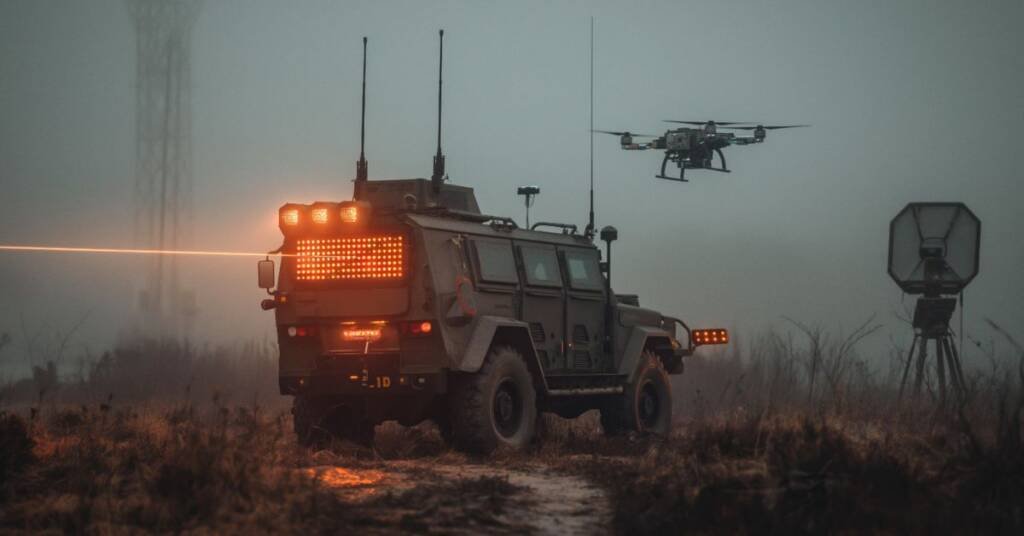
At the same time, DRDO is developing and testing Directed Energy Weapons and laser-based defense systems designed to:
- Neutralize drones at very low cost
- Reduce the expense of air defense
- Provide India with a technological edge in future warfare.
🤝 7️⃣ India–Israel Defense Collaboration
- India and Israel have significantly strengthened their defense partnership in recent years.
Recent cooperation focuses on:
- Collaboration around Iron Dome air defense technology
- Technology sharing related to Iron Beam laser defense systems
- Advanced radar and sensor systems
- Joint research and development
This partnership benefits both countries.
Israel gains:
- Access to India’s large-scale manufacturing capabilities
- Faster production capacity
India gains:
- Access to advanced defense technologies
- Faster development cycles
- Lower production costs
Together, this partnership creates a powerful combination of advanced technology and large-scale production capability.
🌍 8️⃣ Global Partnerships and India’s Defense Strategy
- The current government has placed strong emphasis on international defense collaboration and technology transfer.
India is working with several countries on:
- Fighter aircraft technologies
- Missile systems
- Drone and UAV development
- Advanced weapon platforms
- Defense electronics and sensors
The objective is to:
- Strengthen India’s defense capabilities
- Accelerate technological advancement
- Maintain a strong global strategic position in an increasingly unstable world.
🕉️ 9️⃣ The Balance Between Peace and Strength
- India’s civilizational philosophy has always emphasized peace, harmony, and global welfare.
Sanatana Dharma teaches the principle:
- “Vasudhaiva Kutumbakam” — The world is one family.
However, India’s spiritual traditions also recognize that:
- When injustice and disorder rise, defending dharma and justice becomes a duty.
>In the Bhagavad Gita, Lord Krishna advises Arjuna that protecting righteousness sometimes requires strength and action.
Thus India’s approach is balanced:
- Commitment to peace and cooperation
- Preparedness to defend national sovereignty and justice
The nature of warfare in the 21st century is evolving rapidly.
Future conflicts will be shaped by:
- Technology
- Innovation
- Cost efficiency
- Strategic alliances
Nations that successfully balance these factors will remain secure and resilient.
By combining:
- Indigenous research
- Global technological collaboration
- Modern defense systems
- Strategic planning
>India is positioning itself as a strong, responsible, and stabilizing power in the global order.
India’s guiding philosophy remains clear:
>Strength with responsibility.
>Security with peace.
>Power with purpose.
🇮🇳Jai Bharat, Vandematram 🇮🇳
Read our previous blogs 👉 Click here
Join us on Arattai 👉 Click here
👉Join Our Channels 👈