Fragmented Geography & The Truth Behind 2500 Years of History
1. Introduction – The Hidden Story of Our Civilization
For more than 2,500 years, India was attacked repeatedly by foreign powers. History books list every invader, yet they never mention something shocking:
- No invader ever separately attacked Afghanistan, Nepal, Bhutan, Sri Lanka, Myanmar, Maldives, Bangladesh, Tibet or Pakistan.
Why?
- Because these regions were NEVER separate nations.
They were integral cultural parts of Akhanda Bharat, one connected civilizational geography.
The breakup happened not by natural evolution, but by:
- Colonial manipulation
- Geopolitical engineering
- Religious conversions
- Geostrategic carving
- Fake “secular” rewriting of history
To understand Akhanda Bharat, we must reclaim the truth that was hidden from us.
2. The Real Boundaries of Akhand Bharat
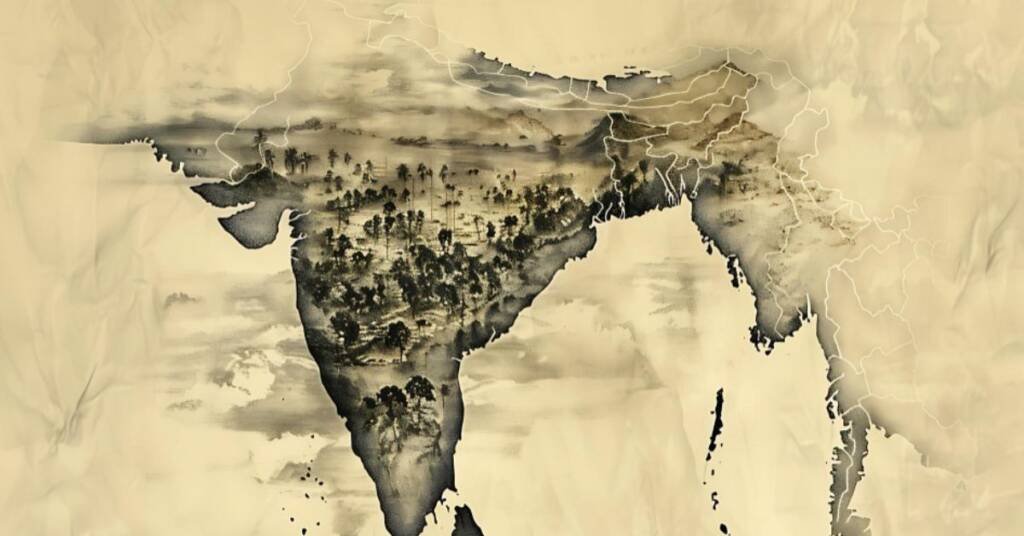
Ancient Bharat’s boundaries were not limited to today’s India. The natural civilizational boundaries were:
- North: Himalayas, Kailash, Mansarovar
- South: Indian Ocean
- East: Up to Indonesia (Java, Sumatra, Bali)
- West: Aryana (modern-day Iran)
This region was collectively known as:
🕉️ आर्यावर्त — The Land of Dharma, Knowledge & Civilization
Shared Characteristics Across the Region:
- Sanskrit-based languages
- Vedic, Buddhist or Sanatana traditions
- Similar food, attire, rituals, temples
- Common festivals (Diwali, Holi, Vesak, Navaratri)
- Shared philosophy, arts, music and architecture
This was not a political empire. This was one cultural family, unified by civilizational Dharma.
3. Sagarmatha / Gauri-Shankar – Identity Destroyed by Renaming
- The highest peak in the world was once proudly known as: Sagarmatha/Gauri-Shankar
- In 1835, British colonizers renamed it “Mount Everest” after a British surveyor.
This renaming was part of a bigger plan:
- Erase ancient names
- Break cultural memory
- Replace Bharat’s identity with colonial labels
The same formula was used for cities like Prayagraj, Kashi, Kochi, and Indraprastha.
4. Geography Destroyed – 24 Fragmentations in 2500 Years
- Contrary to popular belief, 1947 was not the first partition.
- Akhanda Bharat underwent 24 divisions over 2500 years.
Size Comparison:
- Akhanda Bharat (1800 AD): 83 lakh sq km
- Current India: 33 lakh sq km
- Other regions carved out: 50 lakh sq km
Colonial powers took a unified civilization and broke it into ten artificial countries.
5. Before 1800 – These Were Not Foreign Countries
Before the British created borders:
- Afghanistan was Gandhar
- Bangladesh was Gaud/Varendra
- Pakistan was Sindhu-Sapta Sindhu region
- Nepal was part of Indic Himalaya kingdoms
- Sri Lanka was the Lanka of Ramayana
- Myanmar was Brahmadesh
- Tibet was the spiritual roof of India
- Bhutan & Sikkim were Vedic-Buddhist cultural regions
- Maldives followed Indic maritime traditions
Their identity was Indic, Sanskritic, Dharmic — not foreign.
6. Why Only India Was Attacked? — A Key Historical Mystery
- History books list dozens of invasions on India, yet none on the regions surrounding it.
Reason:
Invaders attacked the core — India. By controlling India, they indirectly controlled:
- Himalayan kingdoms
- Gandhar region
- Lanka’s maritime zones
- Myanmar’s golden land routes
- Tibet’s trade routes
Thus, invasions were aimed at Bharatvarsha, the civilizational nucleus.
7. How Afghanistan Was Manufactured (1834–1876)
Afghanistan did NOT exist as a modern country.
It was created through the Gandamak Treaty (1876) by:
- British (from the Indian side)
- Russian Empire (from Central Asia)
Purpose:
- Create a buffer state
- Prevent Russia from reaching the Indian Ocean
- Separate Gandhar (Kandahar, Kabul, Peshawar) from India
- Divide the cultural unity of the region
This was a geopolitical weapon against Bharat.
8. Nepal – Artificial Independence Under British Control
In 1904, the British signed the Sugauli Treaty:
- Declared Nepal “independent”
- But placed a British Resident with complete control
- Restricted Nepal’s trade, military & political decisions
- Prevented Nepal from aligning culturally with India
Nepal became truly independent only after 1947.
9. Bhutan & Sikkim – Gradual Separation
In 1906, the British:
- Took administrative control
- Restricted Indic cultural activities
- Encouraged missionary expansion
- Positioned these regions as “separate identities”
Their Vedic-Buddhist traditions were systematically weakened.
10. Tibet – The Biggest Civilizational Loss
In 1914, the McMahon Line was drawn by British India and China.
Impact:
- Cut India off from Tibet
- Broke spiritual links (Kailash, Mansarovar)
- Removed Tibet as a protective buffer
- Enabled later Chinese occupation
This is one of the largest geopolitical amputations of Bharat’s civilizational geography.
11. Sri Lanka & Myanmar – Created for Imperial Strategy
The British split them from India in:
- Sri Lanka → 1935
- Myanmar → 1937
Why?
- Control Indian Ocean
- Protect missionary activity
- Reduce India’s maritime power
- Break Dharmic cultural unity
Rangoon Jail in Myanmar became a torture center for Indian freedom fighters.
12. Two Countries Became Three – Birth of Bangladesh
British policy created:
- India and Pakistan
- But Pakistan had two wings separated by 2,500 km
- This artificial geography collapsed in 1971, and Bangladesh was born.
- Even today, Bengali culture remains deeply Indic at its root.
13. The Real Culprits – India’s “Secular” Historians
Post-independence historians:
- Copied colonial narratives
- Suppressed civilizational history
- Mocked “Akhanda Bharat”
- Promoted foreign interpretations
- Hid Sanskritic influence across Asia
- Congress Aligned with vote-bank politics
They never explained:
- Why Lanka is central to Ramayana
- Why Gandhar is in Afghanistan
- Why Bali has Rama temples
- Why Tibet follows Indian Buddhism
By silencing truth, they weakened the nation.
14. The Warning – India May Face More Breakups
If Bharat does not restore:
- True history
- Cultural unity
- Dharmic memory
- Civilizational pride
Then enemies of Sanatana Dharma will attempt new fragmentations in the future.
- Fake historians and anti-national networks continue to push distorted narratives.
15. Akhand Bharat Is a Civilizational Identity
Akhanda Bharat is:
- A spiritual reality
- A cultural continuum
- A shared memory
- A linguistic family
- A geographic civilization
- A unified Dharma-based culture
Borders can be drawn on maps, but civilizations cannot be erased.
The truth is clear:
- Akhanda Bharat was real. Its soul still lives. And its awakening has already begun.
🇮🇳Jai Bharat, Vandematram 🇮🇳
For old Blogs please visit our website www.saveindia108.in
To join our whatsapp Community please click
https://chat.whatsapp.com/FMr2WNIgrUVG9xK78FW5Dl?mode=r_t
To join our Telegram group please Click https://t.me/+T2nsHyG7NA83Yzdl Old Blogs are available on the telegram group also.