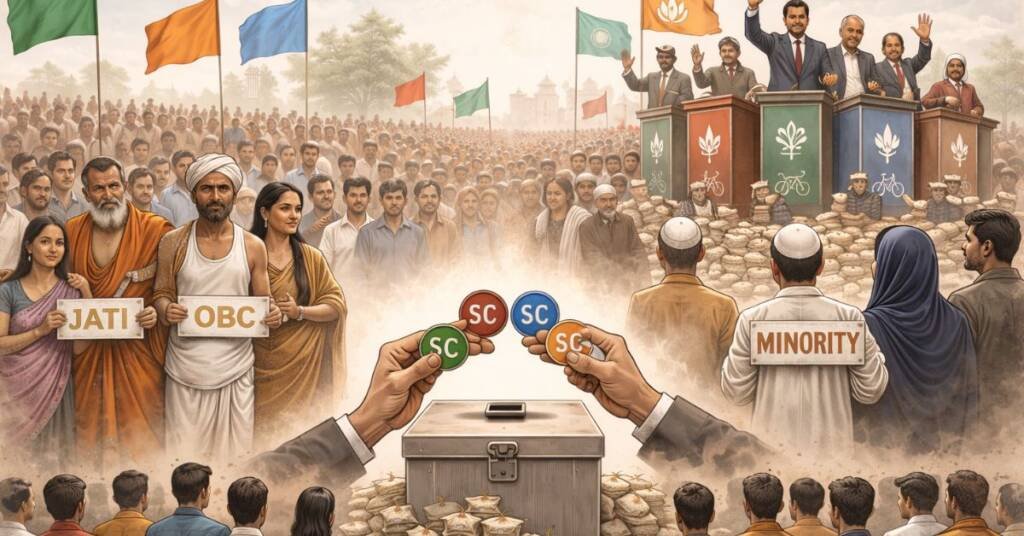
Summary
- For decades, Indian politics has revolved around caste arithmetic, community consolidation, and appeasement-based strategies. While these methods may have delivered short-term electoral success, they have also deepened social fragmentation, distracted from economic reform, and weakened national cohesion.
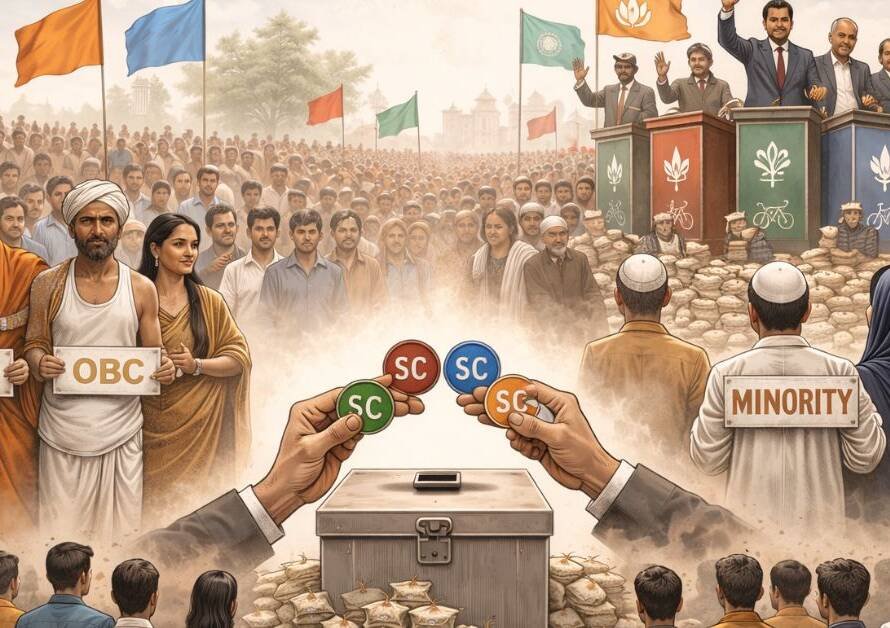
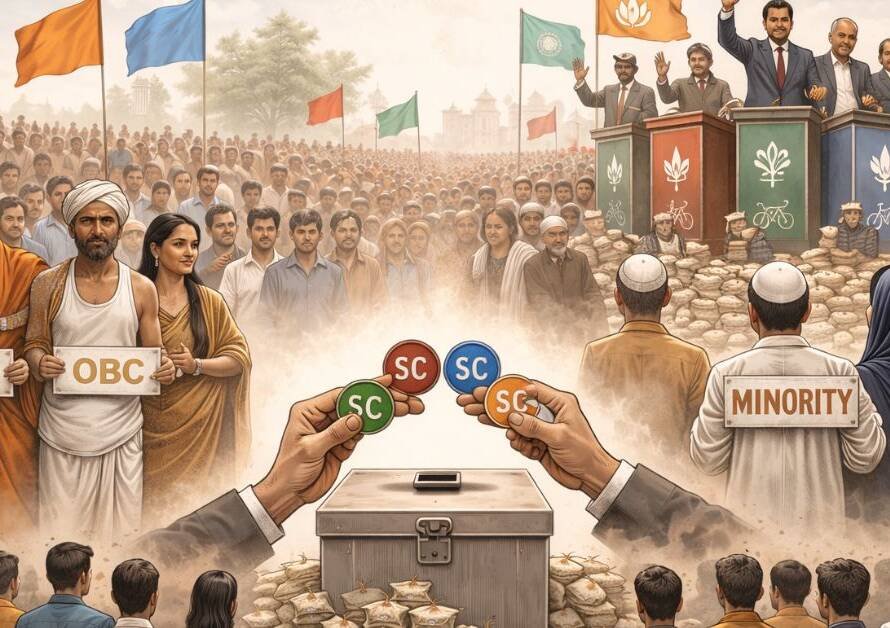
- Political correctness cannot prevent us from examining this reality. Identity-based politics—whether caste-driven or community-driven—ultimately divides society and slows structural progress.
- India’s continued rise depends on shifting from appeasement to empowerment, from fragmentation to integration, and from vote-bank management to growth-oriented governance rooted in civilizational unity and national interest.
The Rise of Identity-Based Politics After Independence and Its Impact
⚖️ 1️⃣ The Foundational Political Trajectory After Independence
- Independence in 1947 was not merely a transfer of power; it was a historic opportunity to define India’s political architecture.
India could have progressively moved toward:
- Citizen-first identity
- Economic upliftment as primary policy
- Gradual reduction of caste centrality
- Institutional strengthening
Instead, critics argue that post-independence political structures increasingly formalized identity categories within governance.
Over time:
- Community blocs became electorally significant.
- Political incentives aligned toward retaining consolidated vote banks.
- Caste classifications expanded in official systems.
- Electoral campaigns relied on segmented social mobilization.
This framework gradually normalized identity as the central axis of political competition.
🧩 2️⃣ Consolidation vs Fragmentation: The Structural Imbalance
A recurring critique highlights two parallel political patterns:
🔹 Minority Consolidation
- Community-sensitive positioning
- Bloc-based electoral mobilization
- Targeted political assurances
🔹 Hindu Fragmentation
- Expansion of caste-based categories
- Competitive reservation politics
- Micro-targeted caste mobilization
- Inter-caste electoral competition
The result:
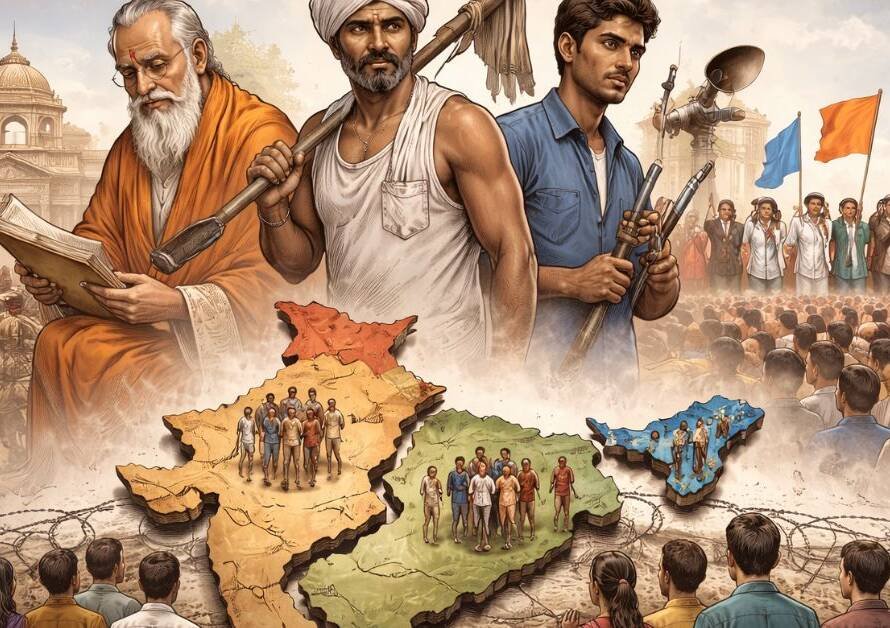
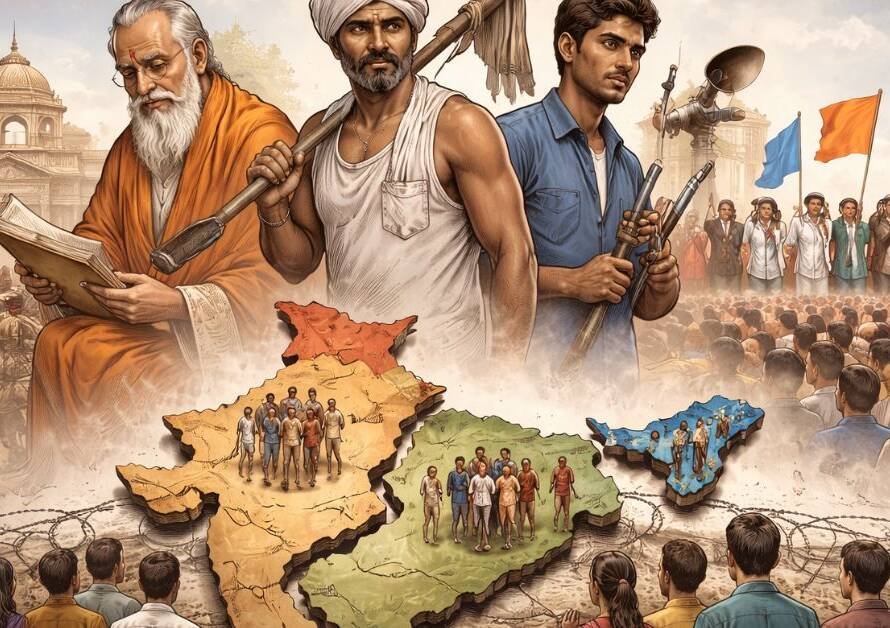
- Consolidated voting on one side
- Fragmented voting on the other
Electoral mathematics rewards unity and punishes division.
- This structural imbalance has shaped political outcomes for decades.
🏛️ 3️⃣ Caste Institutionalization and Political Incentives
Caste existed historically, but governance after independence formalized it through:
- Census enumeration
- Welfare classification
- Reservation structures
- Policy segmentation
Reservation was introduced as corrective justice for limited time. However, over decades:
- Inclusion in backward categories became politically valuable.
- Electoral campaigns focused on caste arithmetic.
- Identity negotiation replaced structural reform debate.
Corrective policy gradually evolved into permanent political strategy.
💰 4️⃣ Poverty Across Communities: The Policy Debate
- There is no denying historical injustice and inequality.
However, a critical debate now exists:
- Poverty exists across all castes.
- Economic vulnerability is no longer caste-exclusive.
- Urbanization and economic shifts have changed social realities.
Key questions:
- Should welfare remain primarily caste-driven?
- Should economic criteria play a larger role?
- Can India gradually transition to vulnerability-based targeting?
This debate is sensitive—but unavoidable if long-term integration is the goal.
🌐 5️⃣ The Digital Era: Narrative Amplification
- Politics today is no longer limited to rallies and manifestos.
Social media war has intensified:
- Identity-based messaging
- Emotional polarization
- Community-sensitive narratives
Digital environments often amplify:
- Caste-based provocations
- Divisive rhetoric
- Emotional outrage cycles
Whether organized or organic, the impact is visible:
- Internal hostility increases.
- Trust declines.
- Rational debate is overshadowed by reaction.
A divided society is easier to politically manipulate than a cohesive one.
⚠️ 6️⃣ Political Correctness vs Honest National Conversation
There is a difference between:
>Responsible discourse and
>Avoiding uncomfortable realities.
National interest requires:
- Honest evaluation of identity-based politics
- Critical review of vote-bank dependency
- Open debate on long-term structural impact
Suppressing discussion in the name of sensitivity does not solve fragmentation.
- It merely delays reform .
🚀 7️⃣ The Development Imperative
India’s real challenges are not identity battles. They are structural:
- Employment generation
- Skill development
- Manufacturing expansion
- Agricultural modernization
- Infrastructure scaling
- Global competitiveness
- Technological innovation
These require:
- Policy continuity
- Institutional stability
- Social cohesion
- Predictable governance
Identity conflicts consume political bandwidth and slow economic transformation.
🕉️ 8️⃣ Civilizational Unity as Strategic Advantage
India’s civilizational strength lies in:
- Shared cultural foundations
- Plurality within cohesion
- Long-term societal resilience
Civilizational unity does not mean erasing diversity. It means:
- Placing national interest above sub-identity
- Reducing caste reflex in political behavior
- Evaluating leadership based on governance
- Rejecting divisive narrative manipulation
When society aligns around development and national progress, identity politics loses leverage.
🔄 9️⃣ The Required Political Transition
India must gradually transition from:
- Identity-first politics → Citizen-first governance
- Appeasement → Empowerment
- Fragmentation → Integration
- Vote-bank arithmetic → Performance-based competition
Such a transition demands:
- Voter maturity
- Leadership accountability
- Institutional reform
- Public awareness
Without this shift, identity politics will continue to dominate and hurt National progress.
🧭 🔟 The Only Sustainable Path Forward
Identity and appeasement-based politics will always:
- Divide society
- Distort policy priorities
- Slow structural reform
- Create political volatility
- Hurt long-term national interests
>A nation of India’s scale cannot afford permanent segmentation.
Sustained progress requires:
- Civilizational unity over caste arithmetic
- Economic upliftment over emotional mobilization
- Growth-oriented policies over electoral appeasement
- Equal citizenship over selective accommodation
- National purpose over fragmented interests
If India focuses on:
- Social integration
- Institutional strength
- Economic acceleration
- Technological leadership
- Governance discipline
>Its rise will be durable and irreversible.
The choice before society is clear:
>Continue identity-driven fragmentation or
>Embrace unity-driven progress.
The future of depends on that decision.
🇮🇳Jai Bharat, Vandematram 🇮🇳
Read our previous blogs 👉 Click here
Join us on Arattai 👉 Click here
👉Join Our Channels 👈