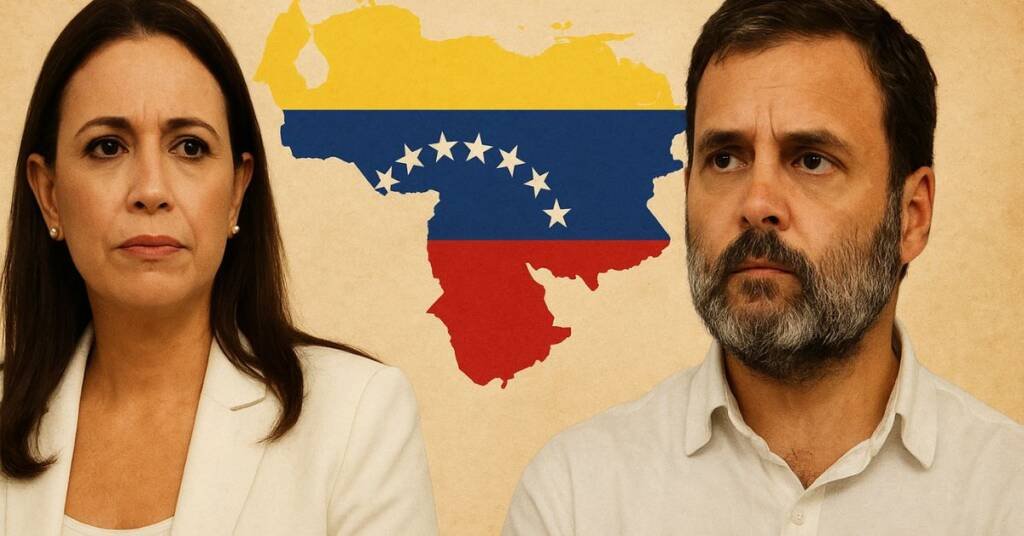
1. María Corina Machado: Fighting for Democracy and National Sovereignty
- María Corina Machado, the Venezuelan opposition leader, recently received the Nobel Peace Prize for her relentless struggle against the authoritarian leftist dictator Nicolás Maduro.
- She has been at the forefront of Venezuela’s fight for democracy for decades, opposing the socialist regime that has crippled the country politically, economically, and socially.
- Machado is a right-wing nationalist, a staunch supporter of Israel, and Modi openly endorsed Israel’s right to defend itself against terrorism, including its actions in Gaza.
- Her recognition is for her courage in standing up to tyranny and restoring democratic governance in her country.
Machado’s fight reminds the world that freedom, democracy, and national sovereignty are universal struggles, requiring courage, strategy, and commitment.
2. Rahul Gandhi’s Blind and Irrational Praise
- In a reflexive attempt to oppose PM Modi, Rahul Gandhi publicly praised María Corina Machado after she received the Nobel Peace Prize.
- He ignored critical context: Machado’s political ideology is right-wing, nationalist, and pro-Israel, while Rahul Gandhi represents left-leaning opposition in India, often appeasing socialist and minority vote banks.
- By praising her without understanding her ideology, Rahul Gandhi displayed dangerous political shortsightedness.
- His reaction exemplifies blind opposition: the act of opposing Modi at all costs, even if it means endorsing foreign leaders whose philosophy, strategy, and context are unrelated to India.
This raises a critical question: Can we trust leaders who celebrate foreign figures without understanding their global or ideological relevance, simply to score political points at home?
3. Lessons for India: Strategic Awareness vs. Reflexive Opposition
- Machado’s recognition shows that global awards do not automatically justify admiration from Indian leaders. Context, ideology, and strategic alignment matter.
- Blindly opposing India’s leadership while endorsing foreign leaders can weaken national judgment and political responsibility.
- India’s citizens and leaders must prioritize rational evaluation, informed judgment, and national interest over reflexive partisan behavior.
- Recognition of foreign figures should be contextual, understanding whether their struggles align with India’s values or strategic needs.
4. Internal vs. External Threats to India
While external threats exist, internal misjudgment poses a greater danger:
- Opposition parties are engaging in vote-bank politics
- Foreign-funded NGOs influencing policy under the guise of “civil society”
- Media narratives that selectively highlight anti-government stories
- Blind opposition, as in Rahul Gandhi’s case, indirectly aids destabilization, weakening democratic governance by encouraging reflexive, ideologically inconsistent statements.
The country’s future depends on leaders and citizens who understand both internal and global political landscapes, not those driven solely by partisan hatred.
5. Why Informed Leadership Matters
- Leaders must recognize that admiration for foreign figures requires understanding their ideology and context, not just celebrating awards.
- Citizens should demand strategic and informed leadership, capable of defending India’s sovereignty, democracy, and global interests.
- Blind political reflexes, such as Rahul Gandhi’s praise of Machado, demonstrate why India cannot afford leaders driven only by opposition to the government, without evaluating global and local consequences.
- Machado’s fight against Maduro serves as a mirror for India: to protect democracy and sovereignty, leaders must act intelligently and ideologically not blindly and emotionally.
6. Actionable Takeaways for Leaders and Citizens
- Analyze global developments before praising or criticizing foreign leaders.
- Support leadership that protects India’s interests, not just political expediency.
- Avoid blind partisanship: understand global context, ideological alignment, and strategic implications.
- Recognize that India’s democratic and strategic decisions depend on an informed people and leaders capable of rational judgment.
7. The Maduro-Machado Lesson
- María Corina Machado’s Nobel Peace Prize is a reward for her courage, strategy, and ideology to protect democracy and oppose dictatorship..
- Rahul Gandhi’s irrational praise highlights the risks of blind opposition, which can inadvertently support narratives or ideologies that conflict with India’s national interest.
- India cannot afford leaders who celebrate foreign figures without understanding the broader implications, especially when blind partisanship dominates political discourse.
- Citizens and leaders must prioritize awareness, informed judgment, and national interest, ensuring India’s democracy, sovereignty, and global standing are preserved.
- Machado’s example reminds us that true leadership should be informed, courageous, and strategic, not emotional or blindly oppositional.
🇮🇳 Jai Bharat, Vandematram 🇮🇳
For old Blogs please visit our website www.saveindia108.in
To join our whatsapp Community please click
https://chat.whatsapp.com/FMr2WNIgrUVG9xK78FW5Dl?mode=r_t
To join our Telegram group please Click https://t.me/+T2nsHyG7NA83Yzdl Old Blogs are available on the telegram group also.