Summary
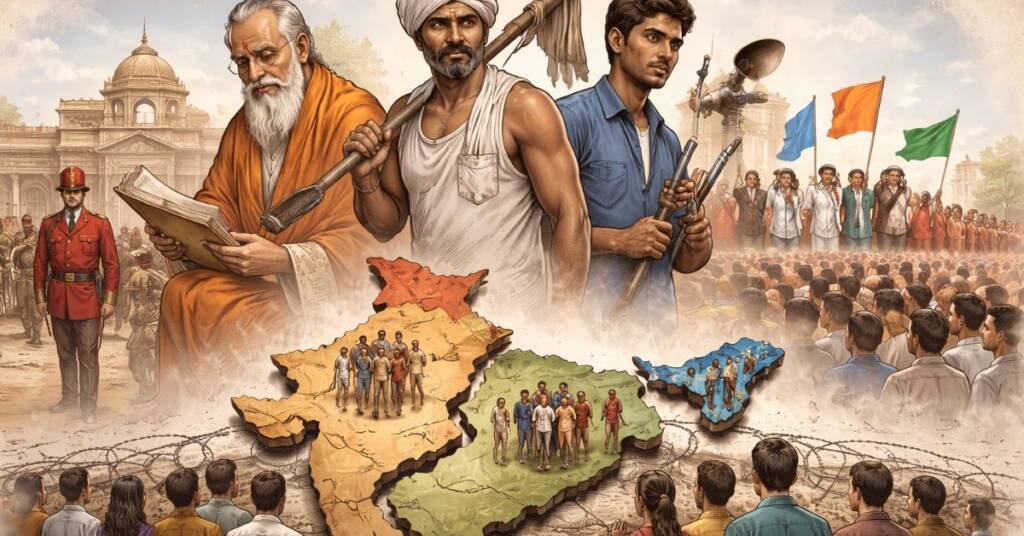
- A common narrative claims that Hinduism was inherently built upon thousands of rigid, birth-based castes. However, a careful reading of Vedic literature, epics, ancient dynasties, foreign travel accounts, and colonial administrative records presents a far more complex and evolving social structure.
- Social divisions developed gradually over time; they were not originally codified as a fixed, immutable religious command. During British rule, caste identities were rigidified and institutionalized through administrative classification under the “Divide and Rule” policy. After independence, identity-based politics continued to shape electoral strategies, often deepening internal fragmentation.
- In recent years, a new political discourse has emerged that emphasizes national interest above caste arithmetic and vote-bank calculations. This article integrates historical evolution, colonial impact, post-independence politics, and contemporary national-first rhetoric into a broader analytical narrative.
Re-reading History and the Path Toward National Unity
1. The Core Question: Do Hindu Scriptures Mention 6,000 Castes?
- The Vedas refer to four varnas — Brahmin, Kshatriya, Vaishya, and Shudra.
- There is no systematic mention of thousands of rigid, birth-based castes in early Vedic texts.
- The foundational idea of varna is widely interpreted as role-based or functional classification.
- Early literature does not clearly prescribe permanent hereditary immobility in the way modern caste rigidity is often portrayed.
- Many scholars interpret the early structure as a division of labor model, not an unchangeable birth-based hierarchy.
Society was dynamic — not frozen.
2. Epic Traditions and Social Mobility
Examples from classical Hindu narratives suggest fluidity:
- King Shantanu’s marriage to Satyavati, who came from a fishing community.
- Vyasa, traditionally regarded as coming from a mixed background, became one of the most revered sages and the composer of the Mahabharata.
- Vidura, considered born to a maidservant, rose to become the chief minister of Hastinapur and is remembered for his profound ethical treatise, Vidura Niti.
- Krishna, raised in a pastoral community, became universally revered.
- Balarama, symbolically associated with agriculture through the plough.
- These examples suggest that merit, wisdom, and duty often outweighed rigid birth identity in cultural memory.
3. Ancient Dynasties and Social Rise
Political power in ancient India was not confined to a single social group:
- Mahapadma Nanda established rule over Magadha despite being associated with a modest background in later traditions.
- Chandragupta Maurya, guided by Chanakya, rose to establish one of the largest empires in Indian history.
- The Mauryan and Gupta periods are often described as golden ages of governance and culture.
- If caste barriers were absolutely rigid and immutable from the beginning, such upward mobility would have been structurally impossible.
4. How Did Social Rigidity Increase Over Time?
Over centuries:
- Occupational identities became hereditary.
- Local communities developed distinct sub-identities.
- Periods of political instability and foreign invasions led to defensive social consolidation.
- These processes gradually produced thousands of jatis (sub-castes).
This was a historical evolution shaped by circumstances — not a doctrinal command.
5. Colonial Rule: Institutionalizing Division
During British rule:
- Extensive caste-based census operations categorized communities rigidly.
- Social identity became an administrative tool.
- The “Divide and Rule” strategy emphasized religious and caste differences.
This resulted in:
- Fixed social labeling.
- Institutional recognition of divisions.
- Competitive identity politics encouraged by administrative design.
- Many historians argue that colonial governance significantly hardened caste identities and embedded them into modern political structures.
6. Post-Independence India: Social Justice and Political Mobilization
- Independent India introduced policies to address historical inequality, including affirmative action and constitutional safeguards.
However, over time:
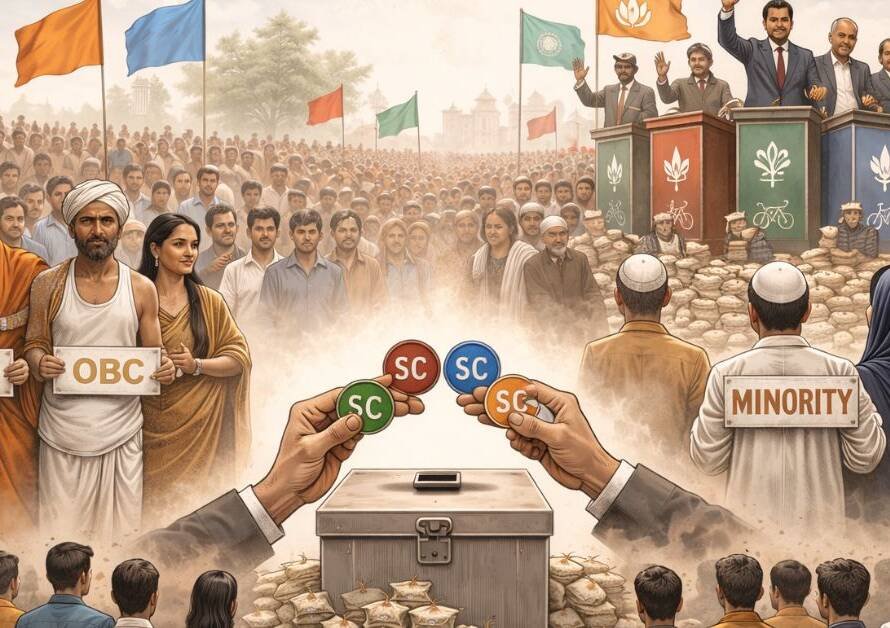
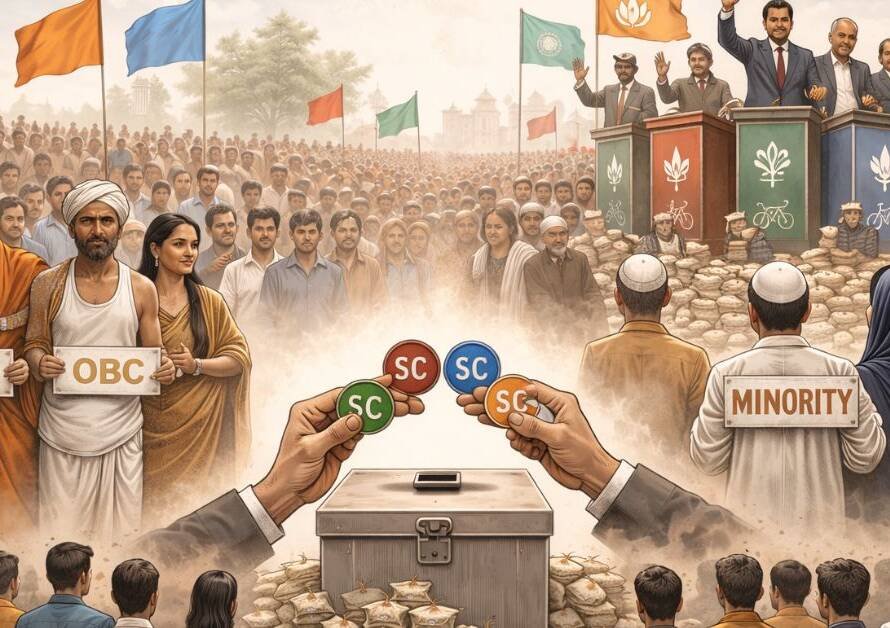
- Caste identities became central to electoral strategy.
- Vote-bank politics linked community identity with political bargaining.
- Religious and caste polarization became part of campaign dynamics.
Some analysts argue that this deepened fragmentation within Hindu society.
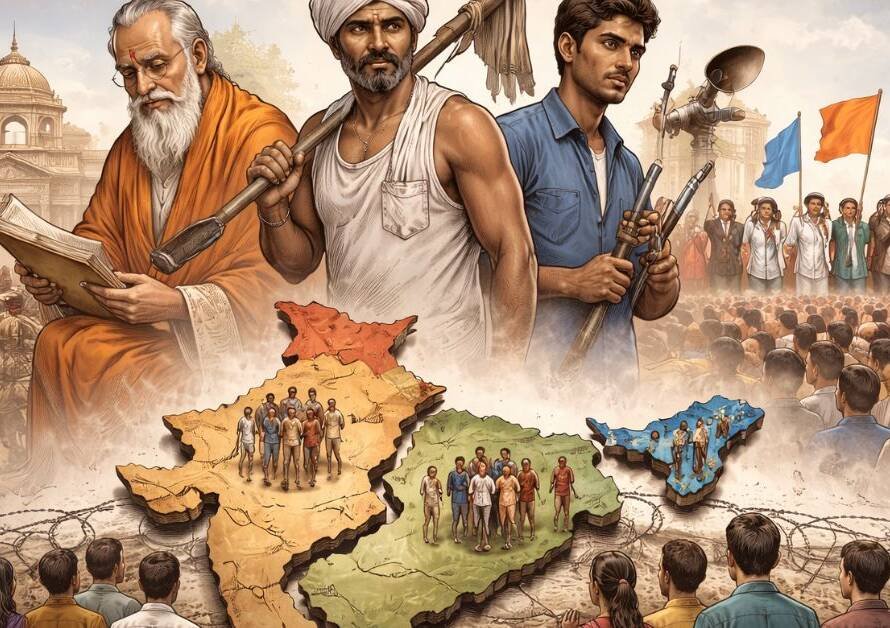
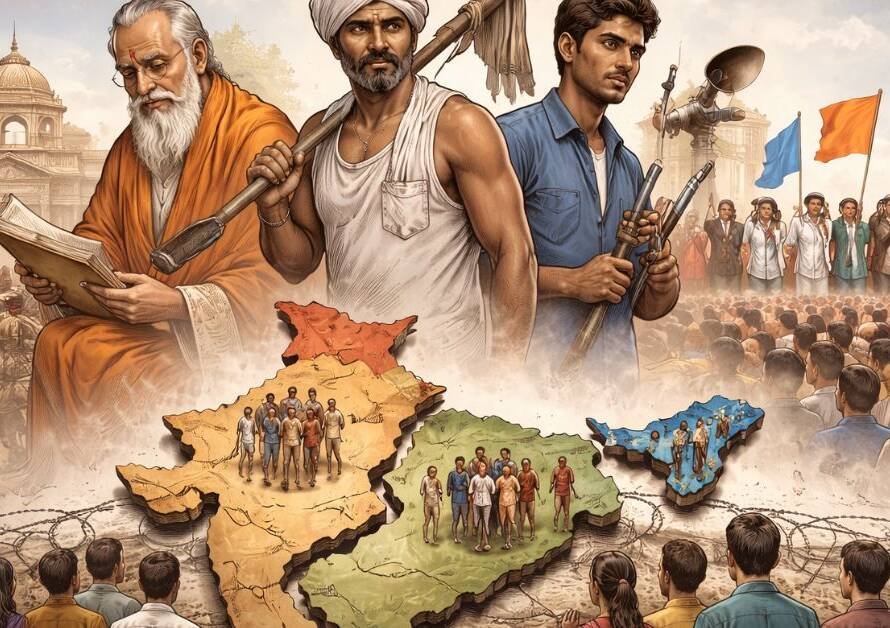
7. Internal Fragmentation and National Strength
History across civilizations shows:
- Internal division weakens collective resilience.
- Identity-based polarization can be exploited politically.
- Long-term unity requires shared civic purpose beyond sectional interests.
- Sustainable democracy depends on informed and vigilant citizens.
8. Contemporary Political Discourse: National Interest First
- In recent years, under the leadership of Narendra Modi, a narrative emphasizing “Nation First” has gained prominence.
Supporters argue that:
- Development-focused politics is prioritized over caste arithmetic.
- Welfare schemes are framed in universal beneficiary terms.
- National security and sovereignty receive central emphasis.
- Regulatory enforcement has become more assertive.
From this perspective:
- Identity-based fragmentation is weakening.
- A broader national unity discourse is strengthening.
- Political interpretations vary, but the rhetorical shift is visible.
9. The Responsibility of Society
- Political maturity depends not only on leaders but on citizens.
Society must ask:
- Are we voting based on performance or identity?
- Are we prioritizing development and security? Are we recognizing divisive narratives?
- Are we strengthening social cohesion?
- Awareness is the foundation of unity.
Learning from History, Shaping the Future
>Indian civilization evolved over millennia.
>It was neither perfectly egalitarian nor uniformly oppressive.
- Caste rigidity developed historically — influenced by social evolution, colonial codification, and later political mobilization.
The path forward requires:
- Strengthening social harmony.
- Rising above divisive identity politics.
- Placing national interest above partisan calculations.
- Promoting equal opportunity and civic unity.
>History should inform — not inflame.
>Unity should empower — not exclude.
- A strong nation emerges when society moves beyond fragmentation and toward shared purpose.
🇮🇳 Jai Bharat, Vandematram 🇮🇳
Read our previous blogs 👉 Click here
Join us on Arattai 👉 Click here
👉Join Our Channels 👈