Summary
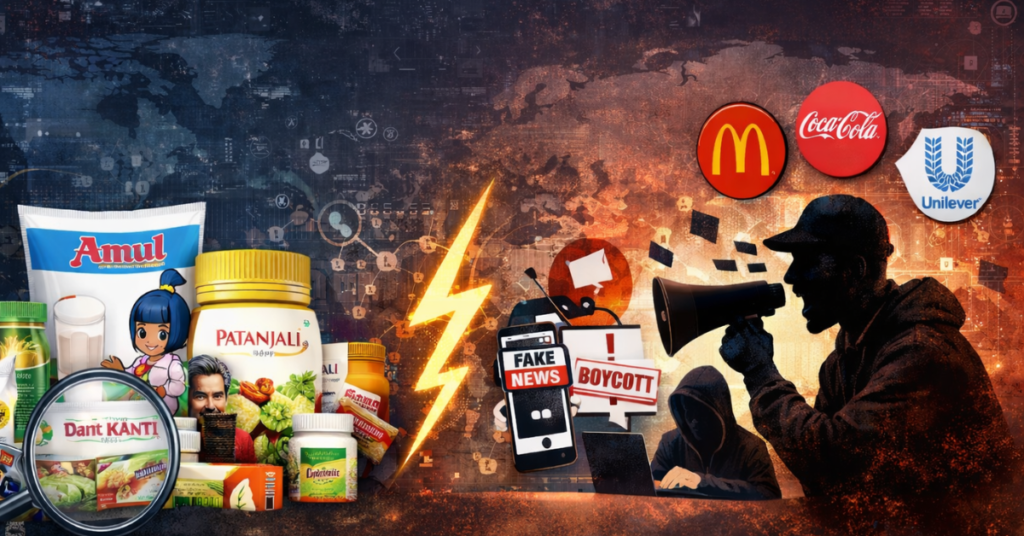
- In recent times, a recurring pattern of narrative pressure has emerged against India’s most trusted, home-grown food brands—particularly Amul and Patanjali.
- These episodes are often framed as isolated “concerns,” but taken together they reflect a systematic attempt to weaken consumer confidence in indigenous brands and smooth the path for foreign market entry.
- The mechanism is familiar: selective claims amplified on social media, influencer-driven outrage cycles, and context-poor repetition that travels faster than verification. The result is confusion, mistrust, and wasted public attention—a global problem, not an India-only phenomenon.
- This note explains why Amul and Patanjali become prime targets, how social-media noise obscures truth, why cultural acceptability of ingredients matters for Indian consumers, and what responsible responses—from citizens and policymakers—can protect transparency, choice, and food sovereignty.
Why Amul & Patanjali Are Being Targeted—Why Consumers Must Stay Alert
1. Why Amul and Patanjali Are Prime Targets
- Amul and Patanjali are not just companies; they are symbols of Indian self-reliance.
Amul
- Farmer-owned cooperative model
- Dairy self-sufficiency and price stability
- Affordable nutrition at national scale
- Transparent supply chains tied to rural livelihoods
Patanjali
- Swadeshi manufacturing and rapid scale-up
- Traditional/Ayurvedic positioning
- Strong challenge to multinational FMCG incumbents
- Competitive pricing and mass adoption
When domestic brands win trust and market share, they invite intense scrutiny—which must be fair and evidence-based. Problems arise when scrutiny becomes selective amplification rather than balanced evaluation.
2. From Products to Perceptions: The Familiar Playbook
When foreign products struggle to enter or dominate on merit, price, scale, or cultural fit, pressure often shifts from products to perceptions:
- Selective allegations amplified without full context
- Influencer-led outrage that precedes verification
- Repetition at scale to manufacture doubt
- Silence on comparable issues with foreign brands
This is economic pressure via narrative noise—not proof of wrongdoing.
3. Social Media: Where Noise Outruns Truth
Social platforms magnify harm because:
- Information spreads faster than fact-checking
- Algorithms reward outrage over accuracy
- Repetition creates perceived truth
- Nuance and clarifications are drowned out
The consequence is a fog where truth becomes hard to find, consumers feel misled, and public time and energy are wasted. This pattern is visible worldwide wherever markets are contested.
4. An Overlooked Dimension: Cultural Acceptability of Ingredients
- A critical but often ignored issue is ingredient compatibility with Indian cultural and dietary practices.
- Many imported processed foods and dairy products may contain animal-origin ingredients (e.g., gelatin, animal fat, animal-derived enzymes/rennet, or processing aids).
- While legal and common in some markets, such ingredients are unacceptable to a large section of Indian consumers for cultural reasons.
- Labeling standards vary across countries, making these components harder to spot for the average buyer.
Why this matters
- It’s not about legality—it’s about transparency and informed choice.
- Indian equivalents are typically formulated with local cultural norms in mind, and vegetarian/non-vegetarian markers are clearer for domestic consumers.
5. Timing and Selectivity: Signals of Coordination
Observe when the noise peaks:
- During demand surges or category growth
- When indigenous brands gain traction
- When foreign entry faces resistance (regulatory, price, or consumer preference)
Timing + amplification + selectivity together suggest coordination, not coincidence.
6. What Consumers Can Do (A Responsible Playbook)
Be vigilant without panic:
- Pause before reacting to viral claims; read primary sources and methods.
- Demand evidence, not influencer soundbites.
- Check labels carefully, especially on imports; look for processing aids and enzymes.
- Prefer Swadeshi when quality and disclosure meet expectations.
This is informed consumption, not blind nationalism.
7. Why Buying Swadeshi Strengthens India
Choosing Indian products:
- Keeps value with farmers and workers
- Builds resilient supply chains
- Preserves food and cultural sovereignty
- Reduces dependence on opaque imports
You strengthen your country, not a distant corporate balance sheet.
8. The Policy Imperative: Curb Coordinated Misinformation
What’s needed—globally and in India:
- Uniform rules against coordinated fake news and narrative manipulation
- Platform accountability for algorithmic amplification
- Faster, prominent fact-checks than rumor spread
- Penalties for deliberate misinformation, while protecting honest critique
Free expression must not become freedom to mislead millions.
Discernment Over Doubt
- When products can’t compete, doubt is marketed.
- The antidote isn’t denial—it’s discernment, transparency, and informed choice.
Be alert. Read labels. Support Swadeshi. Build Bharat.
🇮🇳 Jai Bharat, Vandematram 🇮🇳
Read our previous blogs 👉 Click here
Join us on Arattai 👉 Click here
👉Join Our Channels 👈