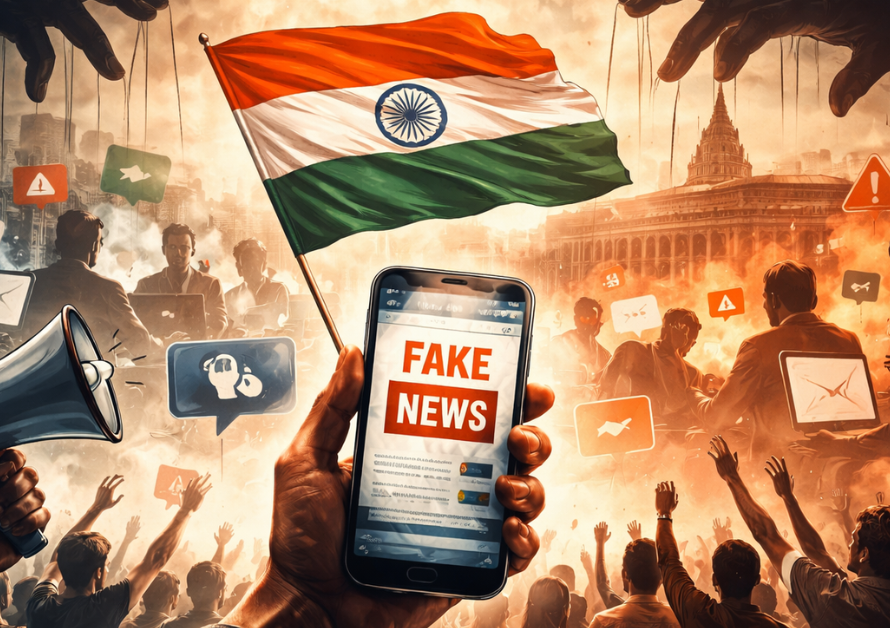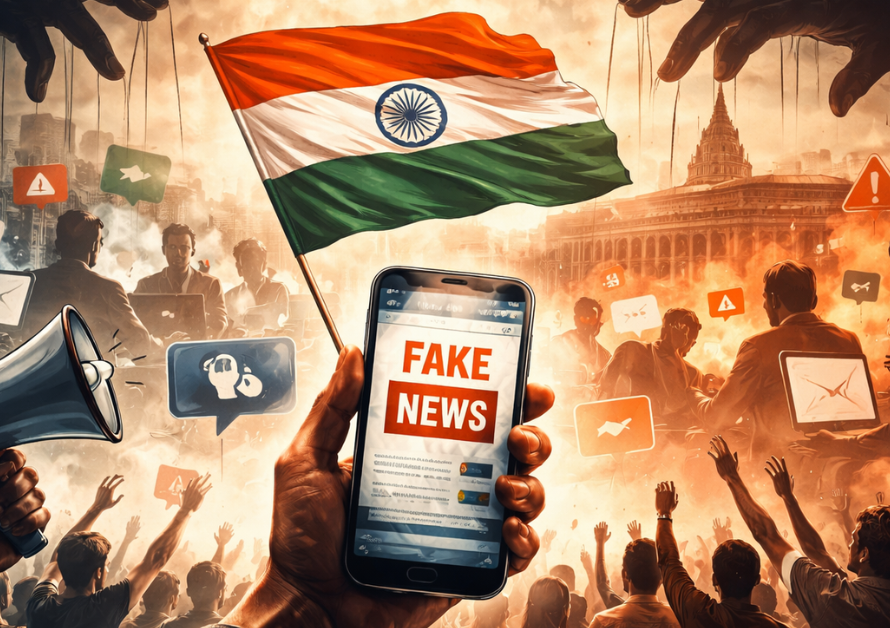
A Silent but Relentless Assault on Truth, Institutions, and National Cohesion
- Bharat today is facing a form of invisible warfare that does not involve missiles, tanks, or visible battlefields. Instead, it unfolds quietly across screens, timelines, and messaging platforms.
- This is disinformation warfare—a calculated strategy designed to weaken a nation by poisoning public perception, eroding trust in institutions, and fragmenting social unity.
- This war is not accidental. It is organised, persistent, and adaptive.
- Its objective is not to win debates, but to make truth indistinguishable from lies, thereby paralysing society from within.
🟥 1. Disinformation Is Not Dissent — It Is a Weapon
A healthy democracy welcomes criticism, debate, and accountability. Disinformation, however, operates on a fundamentally different principle:
- It replaces evidence with insinuation
- It substitutes facts with repetition
- It attacks credibility instead of policy
- It targets institutions rather than decisions
The goal is not reform, but delegitimisation—to ensure that citizens distrust everything and everyone, including the very structures that hold the nation together.
🟥 2. A Coordinated Pattern, Not Random Noise
Across major social media platforms, a clear and repeatable pattern has emerged that raises serious concerns:
- Identical allegations posted by multiple accounts simultaneously
- The same text, visuals, and hashtags appearing across X, Facebook, Instagram, Telegram, and WhatsApp
- Sudden trending of narratives with minimal organic discussion
- Anonymous, recently created, or low-credibility accounts driving virality
- Revival of debunked claims again and again to keep suspicion alive
These are globally recognised indicators of coordinated inauthentic behaviour, often associated with organised disinformation campaigns and content-farm operations.
🟥 3. Political Amplification: When Allegations Replace Proof
- A particularly dangerous stage is reached when baseless or unverified claims are echoed, hinted at, or selectively amplified by political leaders or aligned ecosystems.
This creates a destructive feedback loop:
- False narratives gain political legitimacy
- Political statements trigger further online amplification
- Fact-checks are dismissed as “cover-ups”
- Institutions are forced into permanent damage control
In this cycle, outrage becomes more powerful than evidence, and truth becomes the first casualty.
🟥 4. Targeting National Institutions and Civilisational Identity
The preferred targets of this disinformation ecosystem are not chosen randomly. They often include:
- Constitutional authorities
- Security and defence institutions
- Diplomatic credibility
- Governance frameworks
- Cultural and civilisational traditions
Why? Because institutions cannot respond emotionally, and culture cannot defend itself in courts. Repeated attacks slowly weaken public confidence and normalise suspicion, leaving society fragmented and directionless.
🟥 5. The Role of Professionalised Digital Operations
There is growing concern that misinformation today is no longer spontaneous, but professionalised:
- Narrative engineers design talking points
- Content farms mass-produce messages
- Paid amplification ensures visibility
- Influencers provide legitimacy
- Platform algorithms are gamed for reach
If such systems are used to spread forged documents, manipulated videos, or knowingly false claims, the issue moves beyond politics into the domain of fraud, deception, and public harm.
- This is precisely why the matter must be examined through lawful investigation and due process, not dismissed as mere political mudslinging.
🟥 6. Why Apologies and Retractions Are Not Enough
In the digital age:
- A lie can reach millions in minutes
- A correction may reach only thousands and after a long delay
- The emotional impact of falsehood often outlasts the factual rebuttal
By the time an apology is issued:
- Institutional credibility is damaged
- Public fear or anger has been triggered
- Social trust has eroded
- Diplomatic or security consequences may already exist
Allowing such acts to end without consequences creates moral hazard, where spreading falsehoods becomes a low-risk, high-reward strategy.
🟥 7. The Case for Firm but Fair Legal Deterrence
- Protecting democracy does not mean suppressing free speech. It means defending the integrity of public discourse.
A balanced response must include:
- Identification of coordinated disinformation networks through lawful means
- Accountability for originators and major amplifiers of fabricated content
- Proportionate legal action where intent and harm are established
- Stronger cooperation from digital platforms
- Clear legal distinction between criticism and deliberate deception
This is not censorship. It is democratic self-defence.
🟥 8. Citizens Are the First Line of Defence
No institution alone can defeat disinformation. Citizens must recognise their role:
- Verify before sharing
- Be cautious of anonymous “leaks” and AI-generated content
- Demand evidence, not outrage
- Support credible fact-checking
- Report coordinated abuse and fake content
In today’s Bharat, digital responsibility is civic responsibility.
🟥 9. Why This Matters for India’s Future
If disinformation remains unchecked:
- Institutions weaken
- Elections lose meaning
- Governance becomes reactive
- Society becomes permanently polarised
A nation that cannot protect truth becomes vulnerable to manipulation, internal conflict, and external pressure.
🔚 Truth Is National Security
Disinformation is not harmless speech. It is a strategic weapon in modern hybrid warfare.
Defending truth is not ideological.
- It is constitutional.
- It is democratic.
- It is essential for national security.
Bharat’s strength lies not only in its borders and armed forces, but in the clarity, unity, and awareness of its citizens.
🇮🇳Jai Bharat, Vandematram 🇮🇳
For old Blogs please visit our website www.saveindia108.in
👉Join Our Channels👈