Summary
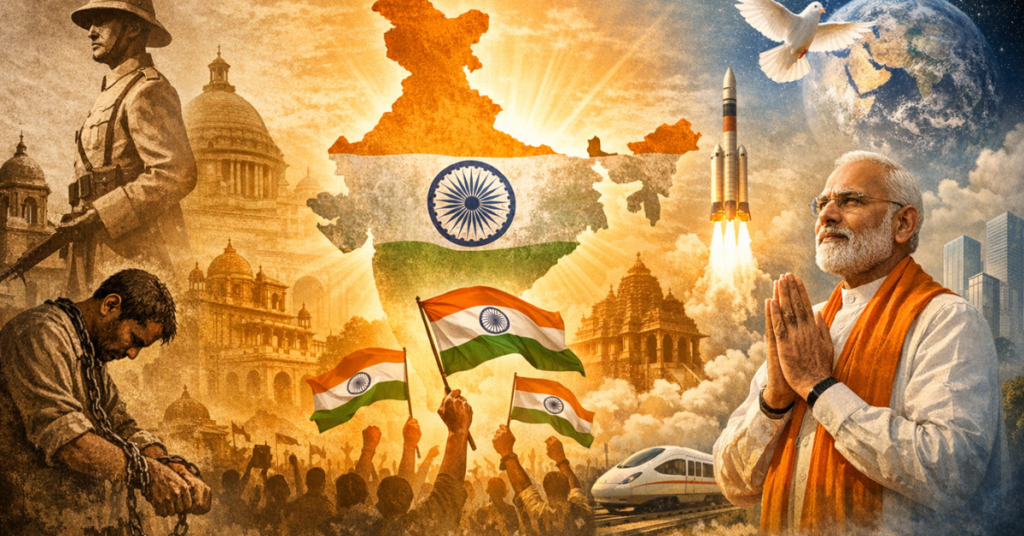
India has endured centuries of invasions and colonial rule that impacted not only its economy but also its collective mindset.
- Historical experiences during medieval and British rule deeply influenced India’s cultural and administrative structures.
- Post-independence politics has also been debated, particularly regarding identity politics, appeasement, and corruption allegations.
- Since 2014, supporters argue that a phase of cultural revival and renewed national confidence has begun.
However, many believe that true transformation will only occur when society fully overcomes its “colonial mindset” and becomes self-confident, united, and civilizationally aware.
From Colonial Mindset to a Confident India
1. Historical Experiences and Cultural Memory
India’s history is marked by both glory and struggle.
- Many historical accounts describe periods of invasions during which temples, cultural institutions, and economic resources suffered damage. Later, British colonial rule reshaped India’s economy, education system, and administrative structure in ways that had long-term consequences.
- These experiences, according to many observers, did not only cause material loss but also left a psychological imprint—often referred to as a “colonial mindset” or “slave mentality.”
This mindset is said to manifest as:
- Hesitation in embracing one’s own culture
- Viewing Western standards as inherently superior
- Lack of collective confidence
- Internal divisions and social fragmentation
2. Post-Independence Politics: Continuing Debates
- After independence, India adopted a democratic system. However, decades of governance by dominant political parties have remained subjects of debate.
Critics argue that:
- Identity-based politics was encouraged
- Vote-bank strategies deepened social divisions
- Caste, community, and regional considerations were used politically
- Corruption and scandals slowed national development
At the same time, it is important to acknowledge that disagreements over governance models are natural in a democracy.
3. The Post-2014 Era: A Claimed Return of Civilizational Confidence
- Supporters assert that after Narendra Modi came to power in 2014, a new narrative began to take shape.
They describe this period as marked by:
- Restoration of cultural and religious symbols
- A stronger stance on national security
- Emphasis on self-reliance through initiatives like “Vocal for Local”
- Greater global visibility and diplomatic assertiveness
According to them, this phase has focused not only on economic growth but also on reviving national pride and cultural identity.
4. Cultural Revival and Sanatana Consciousness
- Supporters argue that Sanatana Dharma represents a holistic worldview rather than merely a religious identity. It embodies duty, balance, tolerance, and universality.
They point to:
- Reconstruction and restoration of ancient temples
- Global promotion of Yoga and traditional knowledge
- Increased recognition of Indian festivals and civilizational heritage as signs of what they call a “cultural awakening.”
In their view, these efforts have strengthened collective self-confidence and restored historical continuity.
5. The Challenge of Overcoming the Colonial Mindset
- However, supporters emphasize that policy changes alone are not sufficient.
If society:
- Remains divided along caste or regional lines
- Continues to doubt its own heritage
- Prioritizes short-term political interests over national unity then transformation will remain incomplete.
Overcoming the colonial mindset, in this perspective, means:
- Taking pride in civilizational roots
- Embracing self-reliance as a social ethic
- Placing national interest above sectional interests
- Developing intellectual and cultural confidence
6. India’s Path Toward Global Leadership
- Many supporters believe that once India fully recognizes its civilizational strength, it can emerge not only as an economic superpower but also as a moral and spiritual leader.
- They cite the ancient principle of “Vasudhaiva Kutumbakam”—the world as one family—as a guiding philosophy for global peace and harmony.
In their view, the combination of:
- Cultural confidence
- Political stability
- Economic self-reliance
- Social unity
can position India as a guiding force in shaping a peaceful and balanced global order.
7. The Way Forward: Awakening and Unity
From this perspective, the next step requires:
- Rising above internal divisions
- Reinterpreting Sanatana values in a modern context
- Strengthening cultural awareness within education and society
- Prioritizing national unity
Supporters believe that when society becomes mentally free and self-assured, India can fully assume a leadership role on the world stage.
From Struggle to Strength
- India’s history has been shaped by challenges, yet its civilizational core has remained resilient.
Supporters argue that the post-2014 period marks an important step toward reviving that civilizational spirit.
- However, the ultimate transformation depends not only on leadership but more on society’s willingness to overcome psychological dependency and internal fragmentation.
- According to this view, liberation from the colonial mindset and the expansion of cultural consciousness are essential if India is to emerge as a confident, self-reliant, and globally influential nation—capable of contributing to a more peaceful and harmonious world.
🇮🇳 Jai Bharat, Vandematram 🇮🇳
Read our previous blogs 👉 Click here
Join us on Arattai 👉 Click here
👉Join Our Channels 👈