And How It Must Respond Now
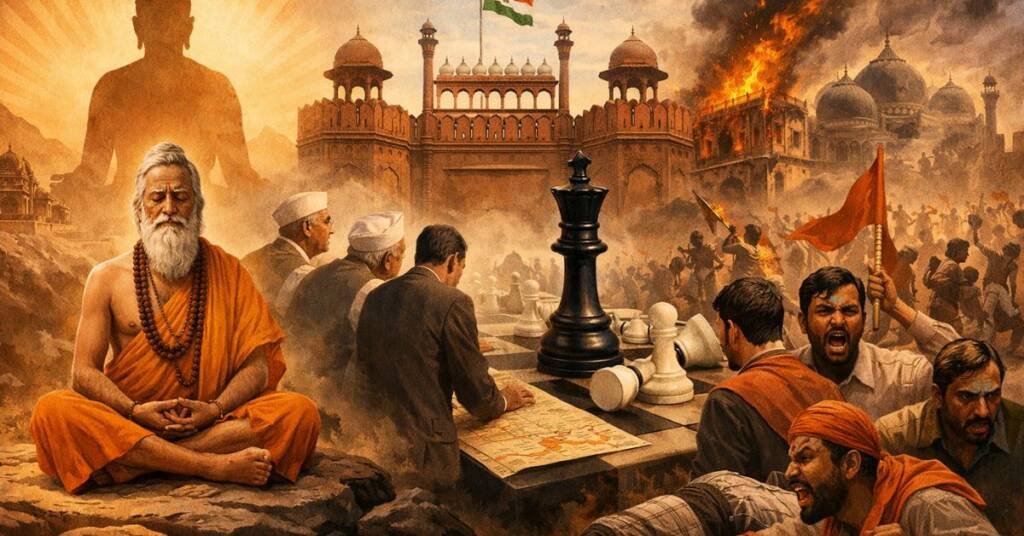
1️⃣ A Civilizational Failure, Not a Numerical One
- The Hindu community has never been a minority in numbers.
Yet, for decades after Independence, it increasingly became a minority in influence, narrative control, and institutional power.
This was not due to weakness of faith or culture, but due to:
- strategic silence,
- institutional neglect,
- misplaced trust in political elites,
- and disengagement from democratic power structures.
Understanding this failure is essential—not to assign blame, but to correct course.
2️⃣ The First Mistake (1947–1960s): Confusing Freedom with Security
After Independence, many Hindus believed:
- political freedom meant civilizational safety,
- the new state would naturally protect majority culture,
- constitutional guarantees were sufficient safeguards.
This assumption ignored reality:
- modern democracies operate through policy, pressure, numbers, and narratives,
- not moral goodwill alone.
As Congress-era politics consolidated power, Hindu society largely withdrew into private religiosity, leaving public institutions unattended.
3️⃣ Partition Trauma and the Psychology of Avoidance
Partition left deep scars:
- genocide and displacement of Hindus in Pakistan,
- loss of temples, lands, and communities,
- mass psychological exhaustion.
Instead of converting trauma into institutional consolidation, Hindu society chose:
- silence over resistance,
- peace over preparedness,
- avoidance over engagement.
This created a long-term pattern where fear of instability outweighed defense of interests.
4️⃣ Tolerance Turned into Political Vulnerability
Sanatana Dharma emphasizes:
- सहिष्णुता (tolerance),
- सह-अस्तित्व (coexistence),
- संवाद (dialogue).
But electoral politics rewards:
- organization,
- bargaining power,
- vote-bank discipline.
Congress and later opposition alliances exploited Hindu restraint, assuming Hindu votes as guaranteed while cultivating rigid vote banks elsewhere.
- Tolerance without organization became political invisibility.
5️⃣ Outsourcing Temples and Culture to the State
One of the most damaging failures was allowing:
- temples to be taken over by governments,
- temple revenues to be diverted,
- religious administration to be politicized,
- Hindu education to lose institutional support.
While other communities built autonomous religious, legal, and educational institutions, Hindus relied on a state shaped by appeasement politics.
- This left Sanatana Dharma institutionally defenseless.
6️⃣ Internal Fragmentation: Divided Within, Controlled From Outside
Hindu society remained fractured along:
- caste lines,
- regional identities,
- linguistic divisions,
- sectarian rivalries.
Instead of resolving differences internally:
- divisions were politicized,
- social justice was weaponized,
- unity was replaced with suspicion.
A fragmented civilization cannot protect collective interests, regardless of its size.
7️⃣ Withdrawal from Power, Policy, and Law
For decades:
- dharmacharyas avoided policy debates,
- scholars distanced themselves from governance,
- professionals avoided advocacy,
- politics was seen as morally inferior.
This created a vacuum where:
- laws affecting temples passed unchallenged,
- courts lacked civilizational context,
- bureaucracy drifted away from cultural neutrality.
Power never remains empty—it is occupied by those who pursue it.
8️⃣ Legal and Narrative Vacuum
Unlike other groups, Hindu society failed to build:
- permanent legal advocacy bodies,
- coordinated constitutional litigation strategies,
- policy think tanks,
- sustained media and academic platforms.
As a result:
- selective secularism became normalized,
- cultural acknowledgment was framed as bias,
- judges upholding Hindu customs faced intimidation,
- narratives hostile to Sanatana Dharma went unchallenged.
The targeting of judges like Justice Swaminathan is a symptom of this vacuum, not an isolated event
9️⃣ Fear of Labels and Self-Censorship
Many Hindus remained silent due to fear of being labeled:
- communal,
- regressive,
- anti-secular,
- politically incorrect.
This self-censorship:
- normalized institutional bias,
- discouraged leadership,
- weakened collective confidence.
A civilization afraid to speak slowly disappears from public life.
🔟 National Security Neglected Through Silence
Hindu disengagement indirectly allowed:
- ideological extremism to be downplayed,
- terrorism to be treated as law-and-order issues,
- appeasement politics to override deterrence.
Silence on security, driven by fear of labels, endangered the nation itself.
1️⃣1️⃣ The Awakening: From Innocence to Awareness
The shift in Hindu consciousness emerged not from hatred, but from pattern recognition:
- unequal laws,
- cultural targeting,
- judicial intimidation,
- demographic manipulation,
- repeated security failures.
The realization became unavoidable:
- Silence is not neutrality. It is surrender.
1️⃣2️⃣ How the Hindu Approach Must Change — Structurally
Institutions, not emotions, protect civilizations.
1️⃣3️⃣ How the Hindu Approach Must Change — Politically & Legally
- Active democratic participation
- Lawful lobbying and policy engagement
- Consistent constitutional challenges
- Collective support for judicial independence
Judges must never feel isolated for acknowledging Indian civilization.
1️⃣4️⃣ How the Hindu Approach Must Change — Narratively
- Reclaim history through scholarship
- Assert culture without apology
- Counter propaganda with facts, not anger
- Separate ideological critique from hatred of people
Narrative confidence is civilizational armor.
1️⃣5️⃣ How the Hindu Approach Must Change — Spiritually
Sanatana Dharma must inspire:
- कर्मयोग (disciplined action),
- ज्ञानयोग (clarity of thought),
- धर्म (ethical restraint).
Spirituality should empower engagement, not justify withdrawal.
1️⃣6️⃣ What Must Never Be Repeated
- Blind trust in political elites
- Institutional neglect
- Fear-driven silence
- Internal fragmentation
And what must never be adopted:
- hatred,
- violence,
- abandonment of the Constitution.
Sanatana Dharma survives by conscious self-defense within democracy.
- But if the adhrma dominates, then retaliation and action against Adharma is our sacred religious duty to protect Sanatana Dharma and the country.
⭐ From Passive Civilization to Participatory Civilization
The Hindu community did not fail due to weakness of faith. It failed due to disengagement from social and political realities
The correction lies in:
- organization over outrage,
- participation over passivity,
- confidence over apology,
- Dharma aligned with democracy.
A civilization that participates consciously does not lose its soul
- it finally protects it.
🇮🇳Jai Bharat, Vandematram 🇮🇳
For old Blogs please visit our website www.saveindia108.in
👉Join Our Channels👈