The Historical and Cultural Transformation of the Hindu Society
Summary
- This article provides a deep analysis of the social and political behavior of India’s majority community from 1925 to the current era.
- It illustrates how a traditionally tolerant society endured decades of appeasement politics and the erosion of its rights before finally rising to protect its cultural roots and self-respect.
- It frames the Ayodhya movement not merely as the construction of a temple, but as the most significant civilizational resurgence in world history.
1. The Pre-Independence Era and the Birth of RSS (1925–1947)
- Organization vs. Movement: In 1925, Dr. Hedgewar founded the Rashtriya Swayamsevak Sangh (RSS) to organize the Hindu society. Although Hindus were the majority, their inclination at the time was toward Mahatma Gandhi’s non-violent movements and the inclusive politics of the Congress rather than a communal organization.
- The Ultimate Sacrifice: Hindus fought shoulder-to-shoulder for India’s freedom, believing that independence would usher in a nation where their faith and heritage would be respected.
- The Sting of Partition: In return for their unwavering faith in leadership, Hindus received the ‘Partition.’ The land that had been the epicenter of Sanatan culture for millennia was carved out to create Pakistan. Millions were displaced, yet the majority remained liberal and welcoming in the new India.
2. The Nehruvian Era and Ideological Neglect (1947–1980)
- The Path of Democracy: Despite the horrors of Partition, the Hindu society did not turn toward radicalism. It chose the democratic framework of Pandit Nehru over the ideology of Nathuram Godse.
- The Rise of Minorityism: During this era, a definition of ‘Secularism’ emerged that often discouraged the majority from taking pride in its identity.
- Institutional Capture: Educational and cultural institutions were dominated by a specific ideology that marginalized India’s glorious Hindu past while glorifying the history of invaders.
3. The 1980s: The Rise of BJP and Social Tolerance
- Political Alternatives: The Bharatiya Janata Party (BJP) was formed in 1980. However, the Hindu voter remained largely with Indira Gandhi and later Rajiv Gandhi, believing that national integrity was safer under their leadership.
- Symbolic Appeasement: This period saw the start of state-sponsored ‘Iftar parties’ in Parliament and Rashtriya Bhavan. The Hindu society never objected, as the concept of Sarva Dharma Sambhav (equal respect for all religions) was deeply rooted in their values.
- Religious Imbalance: While Hindus remained busy with peaceful worship at home, the corridors of power were increasingly influenced by the politics of appeasement and vote-bank strategies.
4. Appeasement and the Silent Suffering of Hindus
- Haj Subsidy vs. Pilgrim Tax: Governments provided financial aid for the Haj pilgrimage, while Hindu devotees faced severe inconveniences and terrorist threats during arduous journeys to Amarnath, Vaishno Devi, and Mansarovar.
- Occupation of Public Spaces: Administrations remained silent when roads, parks, and railway stations were blocked for mass prayers. The common Hindu citizen, avoiding conflict, was forced to take “unpaved side-paths” to reach home or work.
- Opposition to CAA and NRC: In recent years, protests like those in Shaheen Bagh (Delhi) blocked major routes for months. Even after traveling 20 kilometers extra every day, the Hindu society endured it as a part of democratic expression.
5. The Waqf Act and Encroachment via Mazaars
- Legal Inequality: Unlimited powers granted to the Waqf Board led to claims over both government and private properties across the country.
- While the Hindu society was demanding hospitals and schools, their lands were being occupied in the name of Mazaars (shrines).
- Faith vs. Development: The irony was that while Hindus spoke of ‘Development,’ another section was expanding its territorial influence based on religious identity.
- The encroachment near ancient temples was often ignored by Hindus to maintain social peace.
6. The Ram Janmabhoomi Movement: The Turning Point
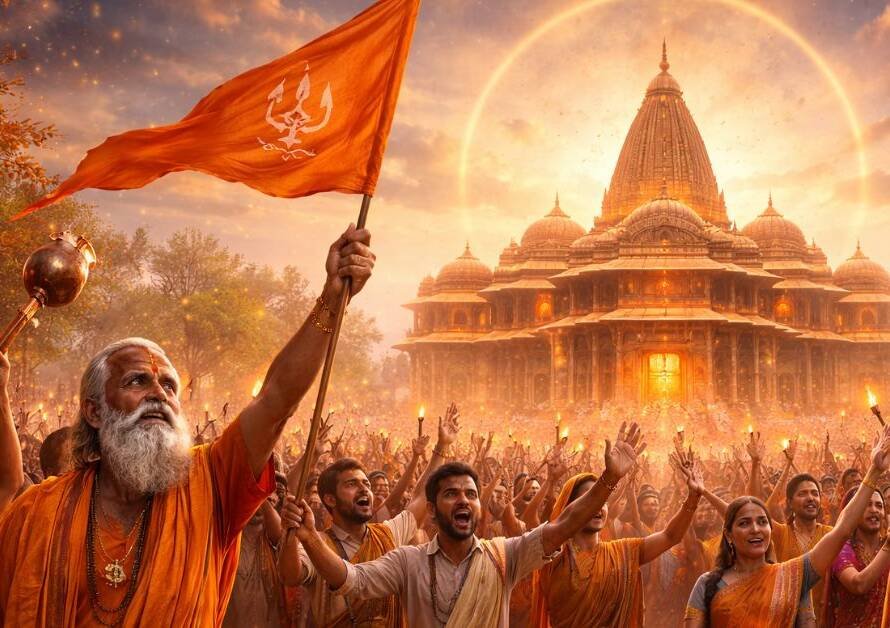
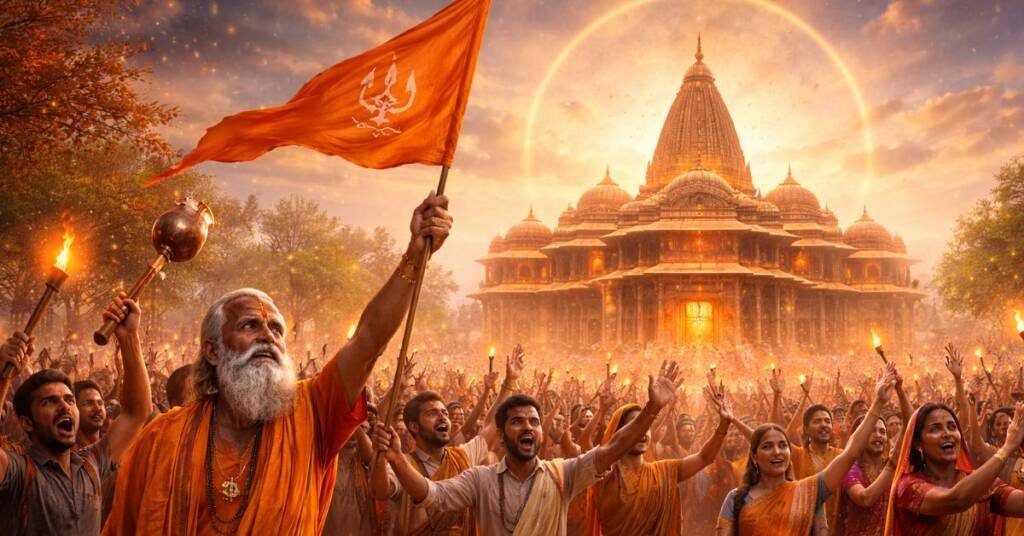
- The Return of the Deity: Eventually, the Hindu society demanded the return of the birthplace of Lord Shri Ram. This was not just about a piece of land; it was a battle for self-respect.
- The Arrogance of Pseudo-Secularism: The ‘Modern Ravanas’ in power labeled Lord Ram as a mythical character. They argued for the existence of the Babri Masjid, despite Babur having no emotional or historical connection to Ayodhya.
- Sacrifice of the Kar Sevaks: In the 1990s, devotees were fired upon. The waters of the Sarayu turned red, and the streets of Ayodhya were stained with the blood of believers. The Godhra incident, where devotees were burnt alive in a train coach, finally shook the sleeping society.
7. Hindu Renaissance and Global Impact
Unprecedented Unity: After years of humiliation and neglect, the Hindu society united. It rejected the curse of being a ‘second-class citizen’ in its own land.
Global Comparison:
- Jews: Despite centuries of struggle, they still grapple for control over many of their holiest sites.
- Parsis: Lost their homeland and became refugees in other lands.
- Christians and Muslims: Have been locked in bloody conflicts over sites like Jerusalem for centuries.
The Indian Example: Hindus achieved what no other ancient civilization could—reclaiming their holiest site through a democratic and judicial process.
8. The Current Status: A New Resolve
- From Ayodhya to Mathura-Kashi: The society is now awake. It understands that development and heritage go hand-in-hand. Ayodhya is just a glimpse; the resolve to liberate other centers like Mathura and Kashi is now firmly embedded in the Hindu psyche.
- A Message to Politics and Religion: No politician or religious leader can now remain in power by ignoring the Hindu society. This is the era of ‘Ram’s Vanar Sena’ (Army of Monkeys), which knows how to fight for the truth and how to win.
- The Concept of Hindu Rashtra: This is more a cultural idea than a geographical one—a nation where Atithi Devo Bhava (the guest is God) exists alongside the resolve of Shathe Shathyam Samacharet (treating the wicked as they deserve).
History is witness that a society that forgets its roots eventually vanishes.
- The Indian Hindu society has passed the test of tolerance. Now is the time to establish itself on the world stage as a ‘Vishwa Guru’ (Global Teacher) with culture, dignity, and self-respect.
🇮🇳 Jai Bharat, Vandematram 🇮🇳
Read our previous blogs 👉 Click here
Join us on Arattai 👉 Click here
👉Join Our Channels👈