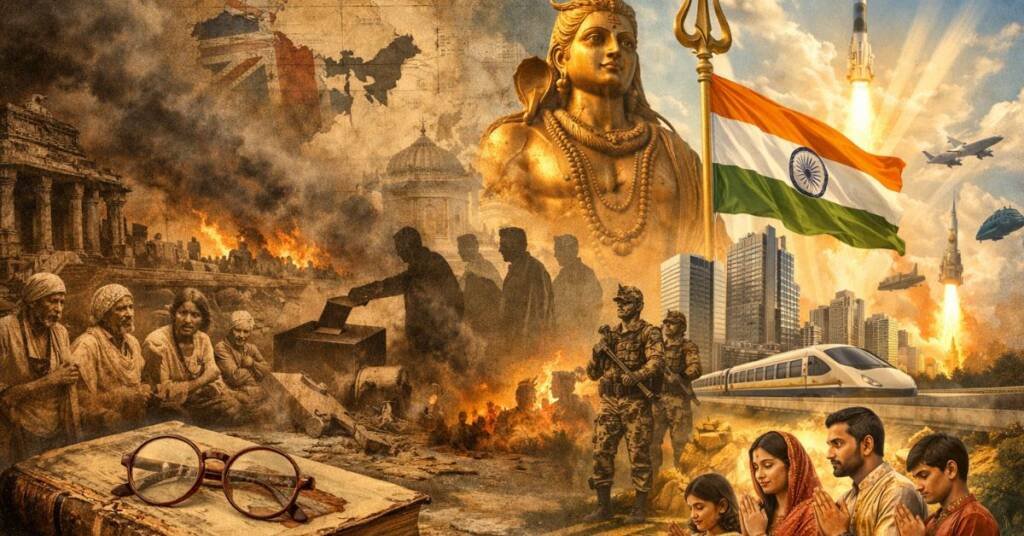
The Story of Appeasement, Division, and Cultural Erosion
🔶 Section 1 — The 1914 Warning That History Proved Right
- In 1914, scholar U.N. Mukherjee published a small yet unsettling book titled “Hindus – A Dying Race.”
Relying on the 1911 Census, he warned of a slow but steady civilizational weakening driven by demography, policy choices, and disunity.
- This was before RSS, Savarkar, or the Hindu Mahasabha.
- This was before Partition.
- This was analysis, not agitation.
Tragically, that warning did not fade with time—it continued to echo for a full century.
🔶 Section 2 — 1914 to 2014: Decline That Refused to Stop
- The “dying” that Mukherjee described was not biological extinction; it was political, cultural, and institutional erosion.
From Independence to 2014, the trend continued. Key features of this period included:
- Vote-bank politics elevated as a governing strategy.
- Appeasement policies justified in the name of “secularism.”
- Suppression of Hindu concerns, routinely dismissed as “communal.”
- Fragmentation of Hindus along caste, language, region, sect, and sub-identities.
This fragmentation weakened:
- social cohesion,
- cultural confidence,
- and collective bargaining power.
🔶 Section 3 — The National Cost of Appeasement Politics
Policies driven by electoral arithmetic had consequences beyond community harm—they endangered national interests.
- Law and order became selective.
- Security risks were downplayed.
- Radicalization was ignored until it turned violent.
- Borders, institutions, and sovereignty faced repeated challenges.
A divided majority and pampered vote-banks produced instability.
This period left India economically hesitant, strategically unsure, and culturally defensive.
🔶 Section 4 — 2014: A Civilizational Turning Point
It was India’s good fortune that in 2014, a government came to power that rejected appeasement as policy. The shift was clearly visible:
- National interest placed above vote-bank politics.
- Cultural identity no longer treated as an embarrassment.
- Sanatana Dharma acknowledged as civilizational heritage.
- Security and sovereignty declared non-negotiable.
This was not domination; it was really needed correction.
🔶 Section 5 — From Fragility to a Rising Power
In 2014, India inherited:
- economic fragility,
- policy paralysis,
- global hesitation,
- internal divisions.
Since then:
- Infrastructure, defence, and manufacturing gained priority.
- India’s global voice strengthened.
- Cultural confidence returned.
- The nation moved from dependency to self-assertion.
Progress required political will—and sustained public support.
🔶 Section 6 — The Uncomfortable Truth About Religious Leadership
Alongside political failure, another truth demands honesty:
- Much of Hindu religious and spiritual leadership neglected its dharmic duty.
Instead of:
- guiding society in times of threat,
- safeguarding Dharma and community interests,
- advising governments responsibly,
many focused on:
- ritualism over responsibility,
- donation-driven expansion,
- institutional empires,
- silence on civilizational losses.
Their withdrawal weakened society’s moral compass.
🔶 Section 7 — A Core Dharmic Principle Often Forgotten
Sanatana Dharma teaches:
- Moksha (liberation) and Raksha (protection) are not opposites.
If:
- the country is unsafe,
- the community is insecure,
- the civilisation erodes,
- then spiritual authority loses relevance.
In any crisis, religious institutions are not insulated—they are often the first affected.
🔶 Section 8 — Consequence of Missing Guidance
In the absence of clear guidance:
- individualism replaced collective duty,
- short-term gain overshadowed long-term survival,
- Dharma shrank to ritual, not responsibility.
A society without direction drifts- and drifting civilisations do not survive.
🔶 Section 9 — What Must Be Done Now
Urgent, ethical priorities:
- Unity beyond caste and region—fragmentation is weakness.
- Cultural confidence—no apology for heritage.
- Institution-building—education, charity, entrepreneurship.
- Democratic participation—policy support, civic engagement.
- Accountable leadership—political and spiritual alike.
- Fact-based discourse—counter false narratives responsibly.
If these steps are delayed, we risk becoming a historical memory instead of a living civilisation.
🔶 Section 10 — From “Dying” to Defining the Future
- Hindus are not a dying race. We are Sanatana—timeless.
But timelessness requires:
- vigilance,
- unity,
- responsibility,
- and sustained action.
From 1914 to 2014, decline was enabled by:
- denial,
- appeasement,
- fragmentation,
- silence.
- From 2014 onward, correction has begun—but it must be deepened and defended.
Otherwise, history will remember us not for what we were, but for the civilization that we failed to protect.
🇮🇳 Jai Bharat, Vandematram 🇮🇳
Website: https://www.saveindia108.in
Email: info@saveindia108.com
Old Blogs: https://saveindia108.in/our-blog/
WhatsApp: https://tinyurl.com/4brywess
Arattai: https://tinyurl.com/mrhvj9vs
Telegram: https://t.me/+T2nsHyG7NA83Yzdl