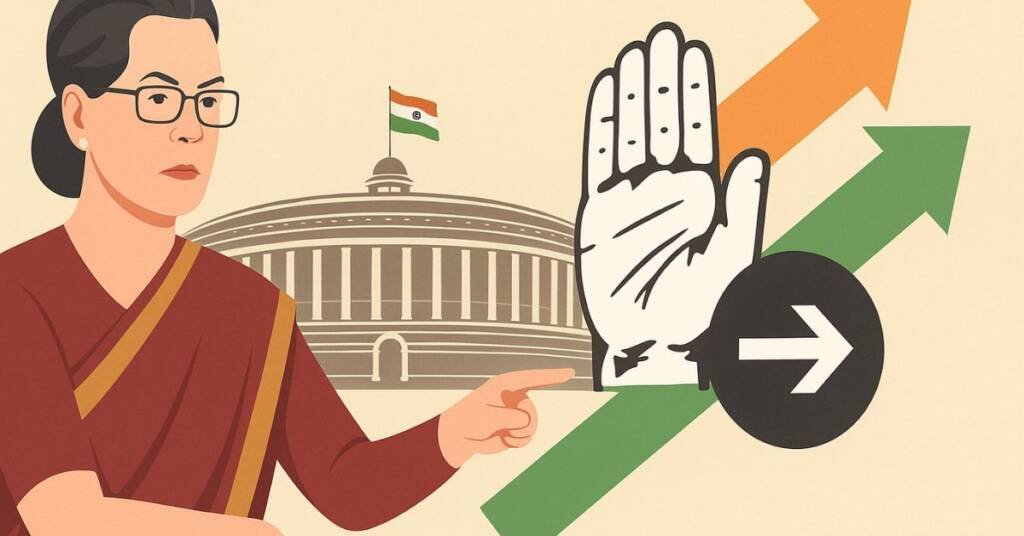
How the Congress Party’s Direction and Identity Changed
- It shifted Congress from a self-reliant, patriotic force to a global left-liberal entity advancing anti-national agendas and fostering dependence on foreign ideological masters.
SECTION 1 — INTRODUCTION: A SHIFT THAT WENT UNNOTICED BUT CHANGED EVERYTHING
- 14 March 1998 is not just a date in Congress history —
It is a political pivot point, a moment after which the Indian National Congress transformed from a broad nationalist movement into a party increasingly aligned with global progressive-left structures and foreign ideological networks. - This transition was subtle, layered, and long-hidden from public view.
- But its consequences are visible today — in Congress’s rhetoric, alliances, ideological confusion, and growing distance from India’s civilizational identity.
SECTION 2 — THE ROOTS OF GLOBAL SOCIAL-DEMOCRATIC NETWORKS
1. The Fabian Society (London)
- Founded in the late 1800s.
- Advocated “gradual socialism” through institutions and policy.
- Ideological godfather of the UK Labour Party.
- Influenced global governance debates for decades.
2. The Creation of Socialist International (SI)
A coalition of socialist and social-democratic parties across continents. It Promoted:
- social welfare policies
- international cooperation
- reduction of nationalism
- global governance structures
Not a conspiracy, but a very real ideological network.
3. Influence Across Nations
- SI involved parties from Europe, South America, Africa, and Asia.
- Many left parties shaped their policies under SI’s ideological umbrella.
Critics argued it indirectly encouraged:
- weakening national identity
- foreign dependency
- elite-driven policy consensus
It encouraged dependance of developing countries on developed countries to control the world narrative.
SECTION 3 — INDIA’S EARLY DISTANCE FROM SOCIALIST INTERNATIONAL
1. Nehru’s Influence but Caution
Although Jawaharlal Nehru was personally influenced by Fabian ideas:
- He still avoided attaching Congress to SI.
- The party had multiple ideological factions.
- Strong nationalist voices prevented external ideological alignment.
2. Why Congress Refused SI Membership
Congress remained away from SI during:
- Nehru era
- Indira era
- Rajiv era
Reason:
- Presence of influential nationalist leaders who wanted Congress to remain rooted in India’s civilizational ethos.
3. The Last Nationalist Pillar: P. V. Narasimha Rao
- Believed in independent foreign policy.
- Promoted economic pragmatism.
- Protected Congress from ideological foreign entanglements.
As long as Rao was influential, Congress retained a measure of nationalist grounding.
SECTION 4 — 14 MARCH 1998: THE TURNING POINT
When Sonia Gandhi officially became Congress President, the party’s ideological compass shifted dramatically. This most likely was due to her foreign origion and ideology.
Immediate implications
- Return of dynastic control
- Marginalization of nationalist-origin leaders
- Rise of foreign-educated consultants & global influences
- Strategic reorientation from India-first to global-progressive-first
This shift paved the way for Congress to join external ideological networks.
SECTION 5 — 1999: CONGRESS JOINS SOCIALIST INTERNATIONAL (SI)
In Buenos Aires (1999), Congress formally signed up as a member of Socialist International.
Significance of this step
- Congress aligned with global socialist-progressive networks.
- Adopted ideas suited to European political environments, not Indian realities.
It began shifting away from:
- traditional nationalism
- civilizational identity
- grassroots sensibilities
Political Impact
- Congress’s rhetoric increasingly mirrored Western left parties.
- Vacant nationalist space allowed BJP/RSS to grow culturally and politically.
- Congress moved into a global ideological orbit at the expense of domestic relevance.
SECTION 6 — 2014: PROGRESSIVE ALLIANCE (PA) MEMBERSHIP
- In 2014, SI evolved into a broader grouping called the Progressive Alliance, involving 140+ global left parties.
- Congress joined PA too. Rahul Gandhi soon entered its Presidium structure.
Implications
- Congress became deeply embedded in international progressive blocs.
- Public perception grew that Congress seeks foreign validation.
Its narratives started reflecting:
- global-left identity politics
- Western academic terms
- post-nationalist vocabulary
This alienated a large section of Indian voters rooted in cultural consciousness.
SECTION 7 — HOW THIS SHIFT CHANGED CONGRESS’S BEHAVIOUR
Once Congress entered these networks, its political behaviour transformed in predictable patterns:
1. Narrative Shifts
- More emphasis on identity politics and minority appeasement.
- Reduction in emphasis on Indian civilizational heritage.
Increased criticism of:
- Hindu identity
- Sanatana Dharma
- RSS
- traditional institutions
2. Anti-RSS, Anti-Hindu, Anti-Sanatana Positioning
Congress increasingly:
- Blamed RSS for historical events without evidence.
- Attacked BJP as “fascist” — adopting Western terminology.
- Framed Hindutva as “dangerous” — echoing global-left talking points.
- Targeted Sanatana Dharma using imported ideological frameworks.
This shift created:
- Loss of credibility
- Loss of nationalist voters
- Loss of middle-class trust
3. Rise of Fake Narratives
To cover political decline and electoral failures, Congress resorted to:
- Baseless allegations
- Misinformation campaigns
- False claims about institutions
- Internationalizing domestic issues
- Defamation of Modi, BJP, and RSS
4. Formation of “Thugbandhan”
Unable to compete electorally, Congress formed:
- opportunistic, unstable alliances
- coalitions based on fear of BJP
- partnerships with ideologically incompatible groups
This desperate manoeuvring is seen by voters as:
- Loss of principles
- Loss of leadership
- Loss of national alignment
SECTION 8 — NATIONALIST FORCES RISE AS CONGRESS DECLINES
As Congress drifted away from India’s roots:
1. RSS grew as a cultural-national force
- community service
- disaster relief
- social harmony initiatives
2. BJP grew as a political and governance force
- stable leadership
- strong diplomacy
- economic reforms
- national security doctrine
3. Sanatana Dharma gained global respect
- yoga
- Ayurveda
- spiritual philosophy
- civilizational values
4. Modi placed India at the global center
- strong foreign policy
- cultural diplomacy
- India’s rise as Vishwa Mitra
- global respect for India’s civilizational identity
Congress’s foreign-aligned ideological shift created a vacuum —
RSS, BJP, and Sanatana Dharma filled it with confidence and authenticity.
SECTION 9 — CONCLUSION:
1998 WAS THE YEAR CONGRESS BROKE AWAY FROM BHARAT
The ideological decisions taken after 14 March 1998:
- Disconnected Congress from Bharat’s roots
- Diluted its nationalist identity
- Made it dependent on foreign ideological ecosystems
- Pushed Indians toward indigenous nationalist forces
Today, the cultural, spiritual, and political energy of India flows not through Congress but through Sanatana Dharma, RSS, BJP, and India’s civilizational revival.
- Congress chose global-left frameworks; Bharat chose its own civilizational truth.
If we truly want to protect Bharat, Sanatana Dharma, our culture, and the Hindu society, then Congress and the thug-alliance parties that follow its ideology must be removed completely from India’s political landscape. Only then can Bharat truly emerge as a global superpower and establish itself as a Vishwaguru.
🇮🇳 Jai Bharat, Vandematram 🇮🇳
For old Blogs please visit our website www.saveindia108.in
To join our whatsapp Community please click
https://chat.whatsapp.com/FMr2WNIgrUVG9xK78FW5Dl?mode=r_t
To join our Telegram group please Click https://t.me/+T2nsHyG7NA83Yzdl Old Blogs are available on the telegram group also.