Summary
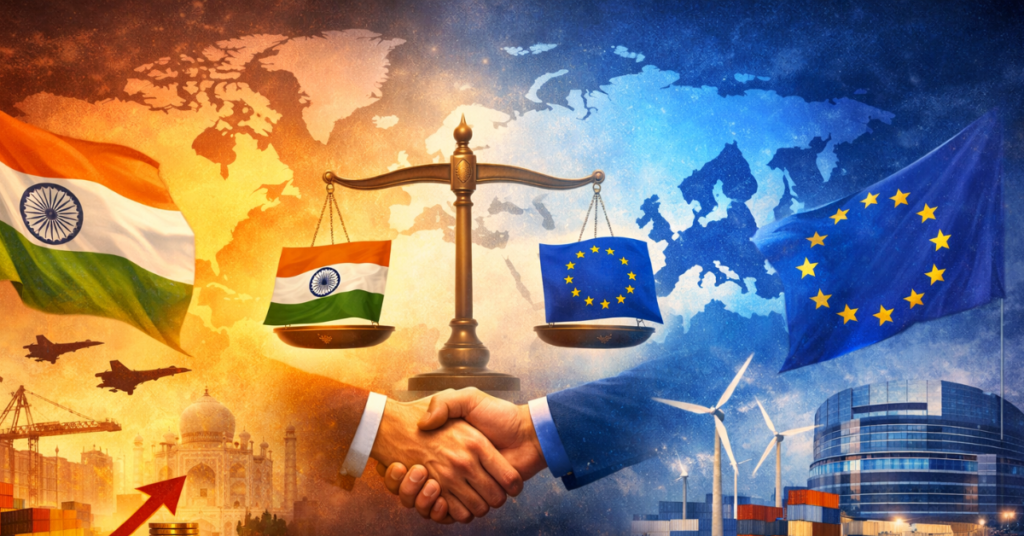
- Real power is often hidden not in speeches, but in the fine print of agreements. The India–European Union (EU) Free Trade Agreement (FTA) is one such example.
- Far from being just a trade pact between India and Europe, it reflects deeper shifts in the global economic and strategic order.
- This agreement directly links Indian states and industries to a $20-trillion EU market, boosts MSMEs, manufacturing, and jobs, and also indirectly impacts countries like Turkey through existing EU trade arrangements.
- Behind this lies Europe’s search for reliable alternatives, India’s rising global credibility, and a changing balance of power in the world economy.
- The opportunity is significant—but it also demands strategic maturity, internal stability, and national awareness.
The Politics of Agreements
Section 1: A Changing World and the Era of Strategic Agreements
- The global economic order is undergoing a major transition.
Key global trends include:
- Disruptions in supply chains forcing diversification
- Growing dissatisfaction with overdependence on traditional power centers
- Movement toward a multipolar world order
- Increasing influence of emerging economies in global trade
In such an environment, countries that are stable, predictable, and trustworthy gain long-term advantages.
Section 2: Why Europe Is Turning Toward India
In recent years, many European countries have felt the need to:
- Reduce dependence on traditional partners
- Escape pressure-driven, one-sided frameworks
- Secure diversified markets and production bases
India stands out as an attractive alternative because of:
- A large and rapidly expanding market
- Democratic institutions and policy stability
- Skilled manpower and manufacturing depth
- Credible global diplomacy that has built trust and respect
This growing confidence in India forms the foundation of the India–EU FTA.
Section 3: India–EU FTA — Trade as Strategy, Not Just Commerce
- The agreement gives India direct access to a $20-trillion market across 27 EU countries.
Major beneficiary sectors include:
- Textiles and apparel
- Engineering goods and electronics
- Pharmaceuticals and healthcare
- Agriculture, tea, spices, and processed foods
- Marine products
- Handicrafts, gems, jewellery, and chemicals
Expected outcomes:
- Higher exports for MSMEs and regional industries
- Expansion of manufacturing and value addition
- Job creation across skill levels
- Deeper integration into global supply chains
Trade policy here becomes a strategic economic tool, not just a commercial one.
Section 4: The Indirect but Powerful Impact on Turkey
- The deeper significance of this agreement becomes clear when we look at countries like Turkey.
Key facts:
- Turkey has been part of an EU Customs Union since 1995–96
- When the EU reduces tariffs for a third country, Turkey must align its external tariff structure accordingly
Implications:
If EU lowers tariffs on Indian goods under the FTA, Indian products enter the EU market at lower cost
- Since industrial goods move easily between the EU and Turkey,
- Indian products can also reach the Turkish market indirectly via the EU at competitive prices
This creates an indirect market advantage for India, even without a direct India–Turkey agreement.
Section 5: Rules of Origin and the Emerging Imbalance
The second, equally important dimension lies in Rules of Origin:
- Turkey is not a party to the India–EU FTA
- Turkish goods entering India must pay normal import duties
- Simply passing through an EU port does not qualify Turkish goods for Indian tariff concessions
As a result:
- Turkey may have to open its market more to Indian goods
- India has no reciprocal obligation to grant the same benefits to Turkey
This explains growing concern in Turkey—especially in:
- Textiles
- Automobiles
- Machinery and industrial goods
where Indian competition could intensify.
Section 6: Modern “Wars” Are Fought at Negotiation Tables
- In today’s world, competition is no longer limited to borders and battlefields.
The new reality:
- No bullets are fired
Yet the impact is felt on:
- Industries
- Jobs
- Market share
This is not confrontational geopolitics, but system-level competition—
changing outcomes from within the rules.
Countries that:
- Understand the system
- Read the fine print
- Use agreements strategically
gain lasting advantages.
Section 7: Opportunity for India, But With Caution
- India’s rising economic and strategic stature naturally attracts global attention.
That brings:
- Significant opportunities
- And equally real challenges
India must therefore ensure:
- Strategic and balanced diplomacy
- Internal stability and social cohesion
- Economic discipline and policy continuity
At this stage, national awareness and unity matter as much as government policy.
Section 8: From Global Integration to Local Prosperity
The ultimate goal of the India–EU FTA is not abstract influence, but tangible outcomes:
- Growth at the state and district level
- Expansion of industries and MSMEs
- Job creation and higher incomes
- Stronger global competitiveness
Global deals succeed only when their benefits reach local lives.
- The India–EU FTA demonstrates how power is shaped in the modern world—not through slogans, but through carefully designed agreements.
It offers India a historic opportunity:
- To operate within global rules
- To turn those rules to national advantage
- And to translate global engagement into domestic strength
In today’s world, the future is often decided not on battlefields, but at negotiation tables.
🇮🇳 Jai Bharat, Vandematram 🇮🇳
Read our previous blogs 👉 Click here
Join us on Arattai 👉 Click here
👉Join Our Channels👈