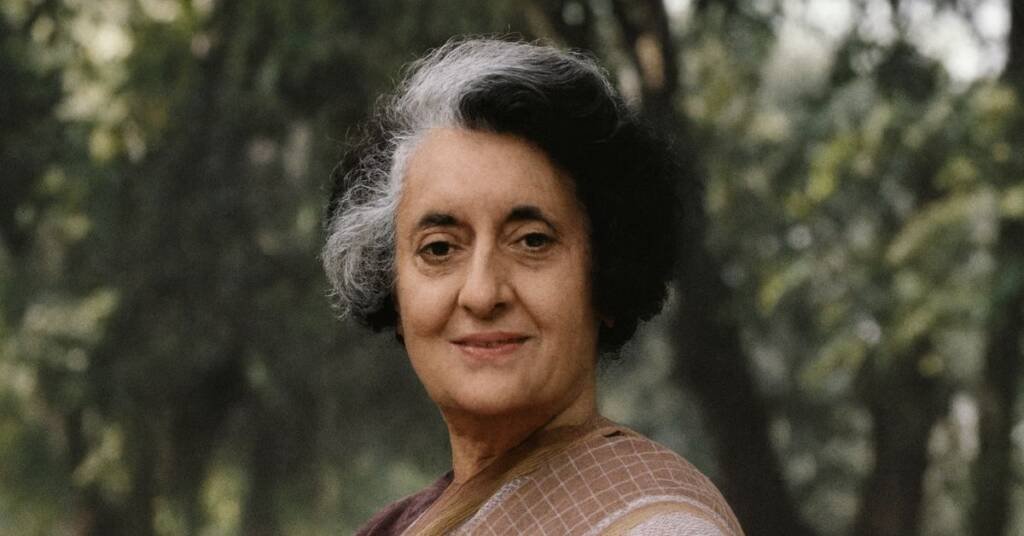
Indira Gandhi: Congress’s Decline
🔹 1. The Forgotten Remembrance of a Once “Iron Lady”
- Indira Gandhi’s death anniversary now passes almost silently.
- Gone are the days when the Congress-led governments marked the occasion with grandeur — garlands, processions, official tributes, and state ceremonies.
- Today, even her own party observes it without enthusiasm.
- This fading remembrance reflects the slow but steady collapse of the empire she built — the Congress Party itself.
- Once hailed as “Ma Durga” for her leadership during the Bangladesh war, Indira’s legacy is now weighed down by the shadows of authoritarianism, political manipulation, and dynastic obsession.
- Her rise was extraordinary — but her decisions rewrote Indian politics forever, breaking the Congress’s spine in the process.
🔹 2. 1969: The Year Congress Lost Its Soul
- When Indira Gandhi became Prime Minister in 1966 after Lal Bahadur Shastri’s death, she was seen as a compromise candidate
- A young, inexperienced woman expected to obey the powerful Syndicate that controlled the party.
- But within three years, she rebelled.
- Her hunger for total control and her mistrust of the old guard culminated in the 1969 split.
- The party fractured into Congress (O) — the organization loyal to the old leaders, and Congress (R) — Indira’s faction.
- She used populist slogans like “Garibi Hatao” to gain direct mass appeal, bypassing both Parliament and party structures.
- What began as a fight for ideology turned into a war for absolute power.
- That split was not just political — it was moral and institutional.
It replaced collective leadership with personality worship, and ideology with blind obedience. - The “freedom fighter’s Congress” died in 1969. What remained was “Indira’s Congress.”
🔹 3. Building an Empire of Loyalty and Fear
- After consolidating her power, Indira Gandhi began surrounding herself with a circle of loyalists whose only qualification was devotion to her.
- She promoted individuals who could echo her will rather than challenge her thoughts.
- This new generation of Congressmen — Kamal Nath, Digvijay Singh, Ashok Gehlot, Sharad Pawar, and Vilasrao Deshmukh — represented not leadership, but sycophancy.
> Debates disappeared.
> Dissent was silenced.
> Internal democracy vanished.
- Congress became a court, not a party. Indira became the queen, and her ministers became courtiers.
- Thus, while Indira’s personal power grew, the party’s institutional foundations eroded beyond repair.
🔹 4. The Two Congresses: Before and After Independence
It is vital to distinguish between the Congress that fought for India’s freedom and the Congress that followed Indira’s rule.
The pre-1947 Congress was nationalist, ideological, and spiritually connected to India’s civilizational values.
- It was home to leaders like Sardar Patel, Rajendra Prasad, Bal Gangadhar Tilak, and Subhas Chandra Bose — patriots who sacrificed comfort for the country’s cause.
- The post-1969 Congress, however, became dynastic, opportunistic, and morally bankrupt.
- It abandoned nationalism for populism, and ideology for power politics.
- So, when today’s Congress leaders claim, “Our party brought freedom to India,” they deliberately blur this truth.
- The Congress of Nehru and Shastri ended long ago.
- The Congress of Indira and Sonia is an entirely different entity — a family enterprise, not a freedom movement.
🔹 5. The Leadership Vacuum After Indira
- Indira Gandhi’s control was so absolute that it left no space for successors.
- She built a machine that worked only under her command — and when that command vanished, the machine collapsed.
After her assassination in 1984:
- Rajiv Gandhi became Prime Minister by emotion, not merit. His lack of experience showed in both governance and diplomacy.
- His tenure brought modernization but also the Bofors scandal, internal strife, and appeasement politics as well.
- After his assassination, P. V. Narasimha Rao tried to revive the Congress through liberal reforms but was sidelined by the Gandhi family loyalists.
- When Sonia Gandhi entered politics, the party reverted to its dynastic roots, and Rahul Gandhi’s repeated failures sealed the Congress’s decline.
- Thus, from 414 seats under Indira, Congress has fallen to double digits — a historic collapse caused by the absence of genuine leadership.
🔹 6. The Numbers Tell the Truth
- 1984: Congress wins 414 seats after Indira’s death — its highest ever.
- 1989: Loses power for the first time since independence.
- 1996–2024: Never again wins a full majority.
- 2024: Contests 324 seats, wins only 99 — celebrating failure as victory.
The Congress that once symbolized power is now a party of nostalgia, dependent on temporary alliances and divisive vote-bank politics.
🔹 7. The BJP-RSS Contrast: Strength through Structure
- While the Congress depended on a dynasty, the BJP and RSS depend on discipline and structure.
- The RSS model is built on grassroots training — every volunteer (Swayamsevak) learns leadership by serving.
- Narendra Modi, Amit Shah, and countless BJP leaders were trained to think as part of a collective mission, not a family empire.
- Even if top leaders retire, the organization remains strong, because its foundation is ideological, not personal.
That’s the fundamental difference:
- Congress’s power dies with its leaders.
- BJP’s power multiplies through its ideology.
🔹 8. Indira Gandhi’s “Dronacharya Mistake”
- Indira Gandhi had the intelligence of Dronacharya — sharp, strategic, and commanding — but she forgot to train an Arjuna.
- She nurtured heirs of blood, not of merit.
- Her obsession with power and her desire to keep leadership within her family meant that she created followers, not leaders.
- Had she prepared capable successors, the Congress might have survived.
- Instead, her death became the party’s death sentence.
🔹 9. The Irony of Indira’s Legacy
- Ironically, while BJP and nationalist thinkers criticize Indira Gandhi for the Emergency and autocracy, they also recognize an unintended gift she left behind:
- Her authoritarian rule awakened India’s democratic conscience.
- Her excesses gave birth to a new wave of political awareness and strengthened opposition movements.
- Her dynasty’s decline paved the way for the rise of nationalist forces, particularly the BJP and RSS, who built their strength on ideology, not inheritance.
- Thus, Indira Gandhi — who once sought to crush opposition — ended up creating the conditions for its rebirth.
🔹 10. Final Reflection: From Indira to India
- Indira Gandhi was a paradox — a woman of great vision and greater flaws.
- She modernized India’s defense and diplomacy but centralized power to a dangerous degree.
- She gave India pride but robbed her party of its soul.
- Her death in 1984 did not just mark the end of a leader — it marked the beginning of the Congress’s irreversible decline.
As India marches forward under nationalist, self-made leadership, the lesson from her story is clear:
- “A party that worships bloodlines will perish. A nation that worships values will rise.”
🇮🇳Jai Bharat, Vandematram 🇮🇳
For old Blogs please visit our website www.saveindia108.in
👉Join Our Channels👈