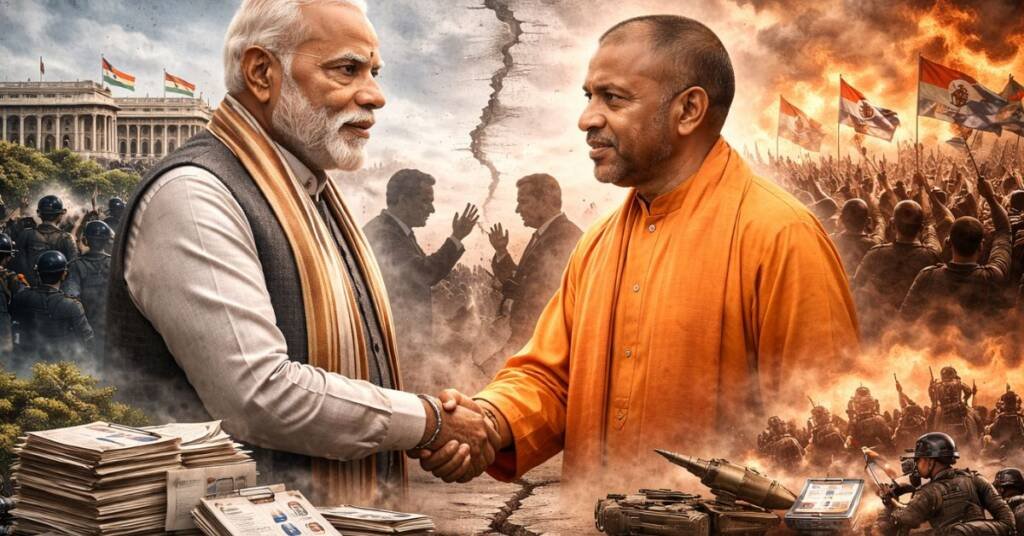
Summary
- As elections approach, familiar attempts are being made to portray India’s elected government as unstable and divided—most recently through the “Yogi vs. Modi” narrative. Similar confusion was earlier manufactured using names like Nitish Kumar, Chandrababu Naidu, and Nitin Gadkari.
- Alongside this, repeated false slogans such as “chowkidar chor hai,” “democracy is in danger,” and “vote theft” are being pushed to undermine trust in institutions.
- The reality is that India’s progress over the last 11 years has been driven by stable, team-based, outcome-oriented governance. Continuity under BJP/NDA at the Centre and in the states has improved law and order, strengthened internal security, expanded infrastructure, and accelerated economic growth.
- In contrast, the record of many opposition-led states reflects weak governance, slow development, and policy paralysis—raising serious doubts about their ability to govern the nation.
How False Narratives Threaten India’s Stability and Growth
Section 1: An Old Pattern—Names Change, the Script Remains
As elections draw near, a familiar playbook resurfaces:
- Portray the government as “unstable”
- Invent leadership “rifts”
- Spread rumours of alliances collapsing
Earlier versions of the same script included:
- Alleged differences between Narendra Modi and Nitin Gadkari
- Claims that Nitish Kumar would withdraw support
- Predictions that N. Chandrababu Naidu would destabilize the government
Each cycle ended the same way: governance continued, policies moved forward, and rumours collapsed under facts.
Section 2: Why Such Narratives Are Manufactured
These narratives gain traction when opponents lack:
- A unified national leadership
- A credible development blueprint
- A clear, long-term vision for India
When citizens see:
- Stable governance
- Clear decision-making
- Visible outcomes on the ground
then misinformation and fear-mongering become the last available tools.
Section 3: Disinformation as a Political Weapon—A Red Line
- Beyond leadership-split rumours lies a more dangerous tactic: delegitimizing democratic institutions themselves.
Repeated, evidence-free slogans include:
- “Chowkidar chor hai”
- “Democracy is in danger”
- “Vote theft / EVM manipulation”
- Imported foreign controversies projected as domestic proof
Why this is dangerous:
- It erodes trust in democratic institutions
- It casts doubt on elections without evidence
- It undermines the judiciary, Election Commission, and security agencies
- It creates perpetual instability, harming national interest
When such narratives are amplified by foreign media, vested interests, or ideologically aligned ecosystems, the goal shifts from political competition to institutional erosion—a red line no responsible democracy should cross.
Section 4: One Team, One Direction—Centre to States
India’s progress has been coordinated and deliberate:
Strategic policy direction at the Centre
Strong law and order with swift execution in the states
Key leadership contributions include:
- Yogi Adityanath: Structural law-and-order reforms, investor-friendly governance, rapid infrastructure growth, and systematic development of cultural and religious hubs.
- Himanta Biswa Sarma: Administrative firmness amid border challenges, action against illegal activities, and improved governance transparency.
- At the Centre, internal security coordination under Amit Shah has enabled decisive action within the constitutional framework against crime, extremism, and illegal activities.
Section 5: Security and Rule of Law—Firm, Fair, Constitutional
National security is strengthened not by slogans, but by:
- Clear policy direction
- Institutional coordination
- Firm action within law and due process
Crucially:
- Actions are not against any community
- They are against lawlessness, extremism, and threats to sovereignty
This balance preserves democratic legitimacy while safeguarding national interests.
Section 6: State-Level Records—The True Test of Capacity
Claims of national leadership must be judged by state-level performance. Across many opposition or thugbandhan-ruled states, a consistent pattern emerges:
- Weak economic outcomes
- Slow or stalled infrastructure
- Vote-bank–driven appeasement
- Recurrent scams, corruption, and policy paralysis
>This is not rhetoric; it is comparative governance assessment.
>If states cannot be governed effectively, the nation cannot be either.
Section 7: Pre-2014 vs. Today—A Structural Shift
Before 2014:
- Policy paralysis
- Large-scale corruption scandals
- Appeasement-led politics
- Softness on internal security
Today:
- Stable governance
- Rapid infrastructure expansion
- Law-based security action
- Stronger global standing
This transformation is the result of continuity, accountability, and institutional respect.
Appeal: Choose Stability and Growth Over Manufactured Chaos
This is a sincere appeal to all patriotic citizens of India:
Rise above rumours; judge by facts and results
- Recognize that stability enables growth
- Reject attempts to destabilize institutions
- Safeguard India’s safety, security, integrity, and sovereignty above partisan noise
In a democracy, the vote is not only a right—it is a responsibility to the Republic and to future generations.
“Yogi vs. Modi,” leadership-split rumours, and evidence-free slogans about democracy and elections are manufactured noise, not reality.
The choice before India is clear:
- Stability and growth vs. chaos
- Governance vs. perpetual agitation
- National interest vs. narrative warfare
Elections are not about rumours.
- They are about direction, stability, and the capacity to govern and grow.
🇮🇳 Jai Bharat, Vandematram 🇮🇳
Read our previous blogs 👉 Click here
Join us on Arattai 👉 Click here
👉Join Our Channels 👈