Introduction: A Turning Point in India’s Governance Journey
In 2005, when Sonia Gandhi walked out of Rashtrapati Bhavan with an angry, agitated expression, someone said:
“This woman is extremely vindictive, and from now on she will weaken India’s core institutions.”
And the four institutions most at risk were:
> The Army
> Intelligence Agencies
> Banking
> Civil Services
- Weakening banking and civil services was not difficult, because corruption was already deeply rooted there.
- Those who were honest were often harassed or suppressed by political pressure.
- But destroying the Army and the intelligence system was far more challenging — because these institutions are built on discipline, professionalism, and rigid protocol.
Still, the “game” soon began.
SECTION 1 — Systematic Weakening of the Defence Establishment (Congress Era)
1.1 Internal Sabotage and Loss of Professional Culture
- Certain “black sheep” inside the Army were pushed forward.
- Chandigarh social circles were empowered to dilute military ethics.
- The Army’s dignity and operational independence were compromised.
1.2 Stopping Critical Weapons and Ammunition Supply
- Weapons procurement was halted or delayed deliberately.
- The situation became so alarming that Army Chief General V. K. Singh had to express his anguish publicly: “We have ammunition for only seven days of war.”
- Instead of fixing the crisis, Prime Minister Manmohan Singh reprimanded the Army Chief in Parliament: “Money does not grow on trees.”
But was India truly short of money?
- Strangely, Congress proudly claims that under Manmohan Singh, India’s economy touched $2 trillion.
- So why was the defence budget always “insufficient”?
The truth:
- The defence budget was never the problem — corruption and diversion of funds were.
SECTION 2 — Defence Budget Reality in the Congress Era
- India was spending 2% to 2.5% of GDP on defence (higher than Modi-era in percentage terms).
- Defence allocations kept rising and touched ₹2 lakh crore by 2012.
- Yet the Army had no modern equipment.
- Ammunition was critically short.
- And “One Rank, One Pension” was repeatedly denied.
Congress supporters claim: “40% of the defence budget was spent on pensions.”
- But Modi inherited the same situation — and he still solved OROP, increased military honour, and modernised the Army.
SECTION 3 — Why Was the Army Starved of Weapons?
- One Answer: Middlemen and Commissions
Congress-era defence deals were built on commission cuts.
History is full of examples:
- The Jeep Scandal (Nehru era)
- Krishna Menon’s procurement fraud
- Bofors scandal (Rajiv Gandhi)
- Mirage kickbacks
- Gorshkov deal issues
- AgustaWestland helicopter scam
Even the Russian Mitrokhin Archives noted that Indira Gandhi was on the payroll of foreign agencies.
- During UPA, about ₹4–5 lakh crore worth of defence deals were signed — but only 40–45% were actually executed.
Why?
- Because no deal moved forward until the “commission” was fixed.
Meanwhile:
- Sonia Gandhi became richer than Queen Elizabeth
- Rahul Gandhi travelled first class 60+ times a year
- Their luxury lifestyle had no visible source of income
- The roots of this wealth trace back to decades of defence middlemen culture.
SECTION 4 — Modi Era: A Clean Break from Corruption
Modi’s government changed the defence landscape completely:
4.1 OROP Implemented
A promise abandoned for 40 years — fulfilled within one term.
4.2 Largest Defence Acquisition Drive
- Nearly ₹10 lakh crore in defence deals
- 90% contracts executed
- Direct government-to-government deals
- No middlemen, no lobbyists
Major acquisitions included:
- Rafale jets
- S-400 missile systems
- Apache and Chinook helicopters
- SIG Sauer rifles
- Tejas Mk-1A orders
- Massive ammunition replenishment
4.3 Transparency and Professionalism
For the first time:
- The defence ministry enforced strict procurement rules
- Middlemen were banned
- Payments were traceable
- Projects were completed on time
Modi government transformed India from:
- “A country short of ammo” → to → “A defence exporter.”
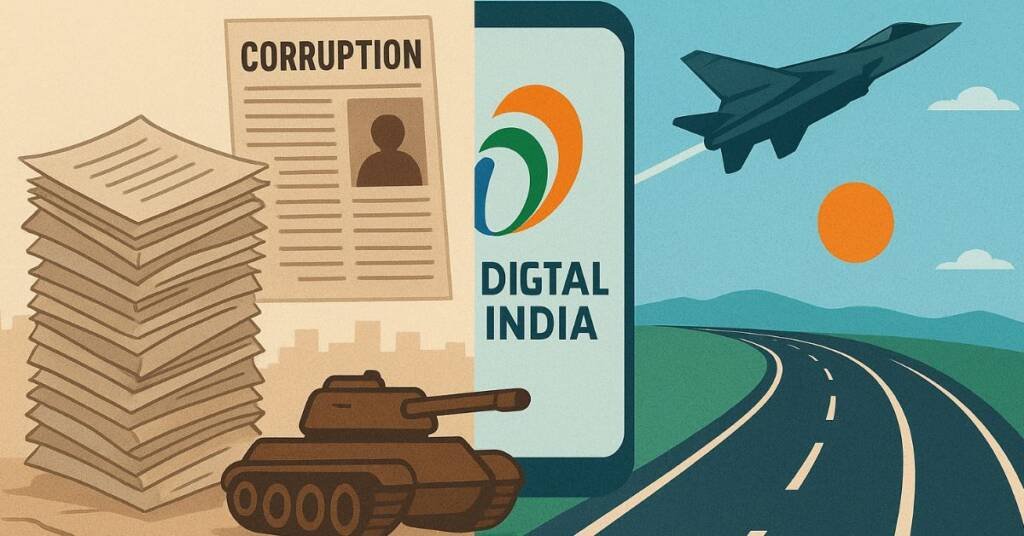
SECTION 5 — Corruption vs. Clean Governance: A Contrast Beyond Defence
- This is not only about defence —it reflects the entire governance structure.
Congress Era Governance Issues
- Rampant corruption
- Weak decision-making
- Delayed infrastructure
- Massive NPAs
- Policy paralysis
- Vote-bank politics
Modi Era Governance Strengths
- Honest leadership
- Fearless decision-making
- Fast reforms
- Infrastructure boom
- Global respect
- Digital transformation (UPI, DBT, Aadhaar)
- Strong financial discipline
India’s rapid growth over the past eleven years is rooted in clean governance — not luck.
- Where earlier governments feared losing votes, the Modi government focused on nation-first decisions, not political survival.
SECTION 6 — Final Thoughts:
- Money Doesn’t Grow on Trees — It Grows in an Honest System
- Congress used “money doesn’t grow on trees” as an excuse to hide corruption and inefficiency.
Modi proved the opposite:
- Money grows in India when:
- The system is honest
- Middlemen are removed
- Corruption is crushed
- Institutions are strengthened
- Defence is prioritised
- Tough decisions are taken without fear
The phrase “Money doesn’t grow on trees” was never the problem —
dishonest governance was.
- Modi era showed that when the leadership is clean, development automatically accelerates, and the nation rises with confidence.
🇮🇳 Jai Bharat, Vandematram 🇮🇳
For old Blogs please visit our website www.saveindia108.in
To join our whatsapp Community please click
https://chat.whatsapp.com/FMr2WNIgrUVG9xK78FW5Dl?mode=r_t
To join our Telegram group please Click https://t.me/+T2nsHyG7NA83Yzdl Old Blogs are available on the telegram group also.