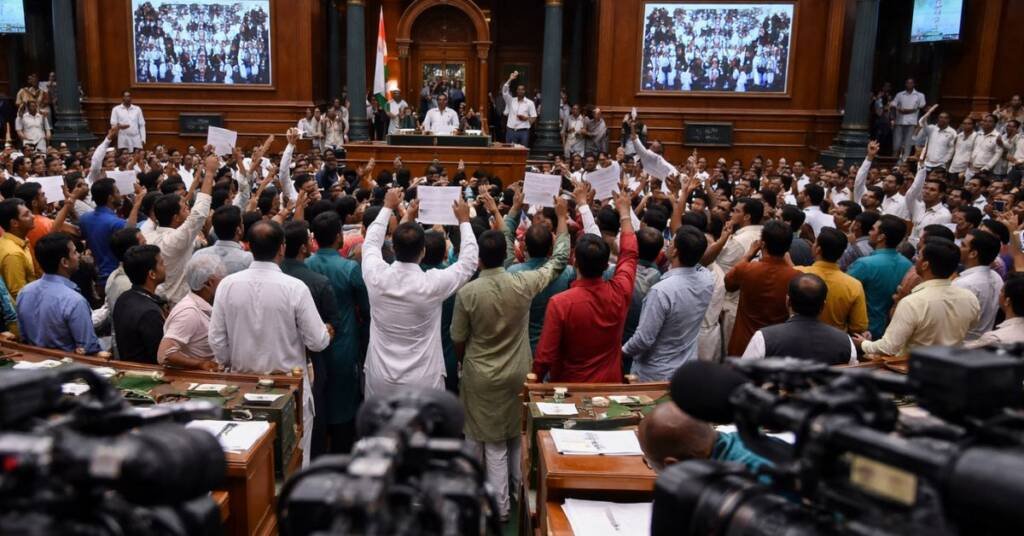
Summary
- This narrative explains why disruption persists despite public fatigue.
- It examines electoral incentives behind obstruction, the rise of narrative warfare that reframes illegality as “resistance,” and the hidden economic costs of repeated paralysis.
- The central warning is clear: when governance is stalled for optics, citizens, growth, and institutional trust pay the price.
How Electoral Desperation, Information Ops, and Disorder Feed Each Other
1) When Repetition Signals Strategy
- Disruption that repeats with the same scripts is not accidental—it is intentional.
Across recent sittings of the Parliament of India, a predictable cycle has emerged:
- Early chaos to wipe out Question Hour
- Sustained sloganeering to force adjournments
- Walkouts timed to block legislation
- Post-adjournment statements alleging “suppression”
Inference: paralysis has become a tactic, not a by-product.
2) Electoral Decline and the Politics of Obstruction
- In a democracy, elections confer mandate; Parliament enables governance. When electoral leverage declines, some actors switch arenas.
Observed incentives:
- If numbers don’t add up in the House, block the House
- If arguments don’t persuade voters, manufacture confrontation
- If policy debate fails, dominate the news cycle
This is desperation politics—substituting obstruction for persuasion.
3) Narrative Warfare: Rebranding Disorder as ‘Resistance’
- Mobocracy survives on messaging as much as on noise.
The narrative assembly line:
- Pre-scripted statements released ahead of disruptions
- Identical talking points amplified by influencers and sympathetic media
- Short clips circulated without procedural context
- International commentary echoing domestic claims
Objective:
- Convert obstruction into virtue
- Paint rule enforcement as repression
- Shift attention from lost hours to loud optics
This is information orchestration, not organic dissent.
4) Street–House Synchronization: Optics Over Outcomes
A troubling alignment often appears between:
- Protests outside institutions
- Chaos inside legislatures
Common features:
- Matching slogans and timelines
- Non-negotiable demands
- Escalation calibrated for visuals
Why it persists: resolution ends relevance; permanent agitation sustains attention.
5) The Economic Damage Few Discuss
- While cameras chase slogans, the real losses accumulate quietly.
Direct costs
- Delayed reforms requiring sustained debate
- Budget scrutiny cut short, hurting states and sectors
- Legislative backlogs that slow delivery
Indirect costs
- Investor caution due to policy uncertainty
- Executive time diverted to firefighting
- International perception of instability, regardless of fundamentals
Growth rarely collapses overnight—it bleeds through uncertainty.
6) Why Rising Economies Are Targeted
Historically, fast-growing, strategically autonomous nations face:
- Reputational pressure
- Institutional delegitimization
- Amplified internal discord
Disorder becomes a low-cost lever to slow momentum without direct confrontation.
7) The Democratic Irony
- Rights designed to protect speech are used to prevent speech inside the House.
The paradox:
- MPs shout so others cannot speak
- Proceedings are blocked “for discussion”
- Institutions are delegitimized using constitutional language
Rights without responsibility become weapons.
8) The Legal Line That Keeps Getting Crossed
- There is a clear boundary.
Protected
- Peaceful protest
- Dissenting speech
- Parliamentary debate
Not protected
- Willful obstruction of constitutional business
- Vandalism and intimidation
- Deliberate paralysis of governance
Calling illegality “politics” does not legalize it.
9) The Precedent Risk
Unchecked paralysis sets a dangerous rulebook:
- Electoral loss compensated by obstruction
- Governance stalled without consequence
- Mob pressure overriding mandate
Democracies erode when dysfunction is normalized.
Coming Next
- If the threat is real and persistent, what must the State do—lawfully and firmly—to defend democracy?
- Parliamentary discipline and deterrence
- The roles of marshals, courts, and law-enforcement
- How to be tough without becoming authoritarian
🇮🇳Jai Bharat, Vandematram 🇮🇳
Read our previous blogs 👉 Click here
Join us on Arattai 👉 Click here
👉Join Our Channels👈