Summary
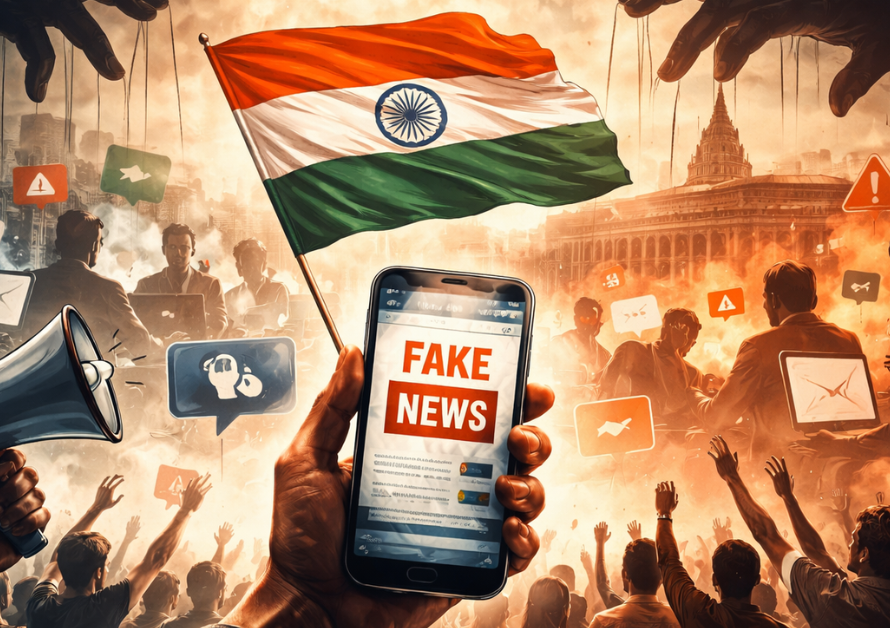
- India today is navigating not only political competition but also an intense battle of narratives, amplified by the speed and reach of social media.
- While criticism, debate, and dissent are essential pillars of democracy, the increasing spread of misleading narratives, selective facts, and unverified accusations poses a serious challenge to national unity, institutional trust, and global credibility.
- When political actors, alliances, or ideological ecosystems prioritize perception over truth, it can create confusion among citizens, deepen divisions, and weaken confidence in democratic systems.
- In such a scenario, safeguarding the safety, integrity, and sovereignty of the nation is not just the responsibility of institutions or leaders—it requires an aware, responsible, and vigilant citizenry that values truth and accountability above propaganda.
Narrative War & Democracy
1️⃣ The Evolution of Political Communication in the Digital Age
- The nature of political discourse has undergone a dramatic transformation.
Earlier:
- Information was filtered through editorial systems
- News dissemination was slower and relatively structured
- Public opinion evolved over time
Today:
- Social media enables instant communication
- Anyone can create and distribute content
- Narratives can go viral within minutes
This shift has created:
- A highly dynamic information environment
- Reduced barriers to content creation
- Increased vulnerability to misinformation
👉 Speed has increased, but verification has decreased.
2️⃣ Understanding Narrative Warfare
Narrative warfare refers to the strategic use of information to:
- Influence public perception
- Shape opinions
- Create political advantage
It is not always about facts or policies—it is about:
- How events are framed
- What is highlighted or ignored
- How emotions are triggered
Common techniques include:
- Repetition of selective information
- Emotional amplification
- Context removal
- Framing isolated incidents as systemic issues
👉 When perception is controlled, reality often becomes secondary.
3️⃣ Political Competition vs Misinformation
Democracy thrives on:
- Debate
- Accountability
- Constructive criticism
However, problems arise when:
- Criticism turns into continuous unverified accusations
- Political messaging relies on partial or distorted facts
- Narratives are built to discredit rather than inform
Such practices can:
- Confuse citizens
- Distract from real issues
- Reduce the quality of democratic debate
👉 Healthy opposition strengthens democracy; misinformation weakens it.
4️⃣ Social Media as a Force Multiplier
- Social media platforms operate on engagement-driven algorithms.
This leads to:
- Higher visibility for sensational content
- Rapid spread of emotionally charged narratives
- Amplification through coordinated networks
Typical patterns include:
- Viral posts without verification
- Edited or out-of-context content
- Misleading headlines shaping perception
As a result:
- False information often spreads faster than corrections
- Public opinion can be influenced before facts are verified
👉 In the digital age, virality often outweighs accuracy.
5️⃣ Impact on National Unity and Institutional Trust
- Repeated exposure to misleading narratives can have long-term consequences.
These include:
- Erosion of trust in democratic institutions
- Increased polarization among citizens
- Rise of suspicion and division
- Weakening of collective national confidence
When citizens begin to doubt:
- Their institutions
- Their systems
- Their national direction
the foundation of stability becomes vulnerable.
6️⃣ Global Implications of Domestic Narratives
- In a connected world, internal narratives rarely remain confined within national borders.
They can:
- Influence international media coverage
- Shape diplomatic perceptions
- Affect economic and investment decisions
- Impact the country’s global reputation
For a rising nation, perception matters as much as performance.
👉 Information credibility is now a strategic national asset.
7️⃣ The Responsibility of Political and Public Leadership
- Political actors and influencers have a critical role in maintaining discourse integrity.
Responsible conduct requires:
- Fact-based communication
- Avoidance of exaggerated or misleading claims
- Respect for democratic institutions
- Prioritization of national interest over short-term gains
Public figures must recognize that:
- Words shape perception
- Perception shapes reality
8️⃣ The Role of Citizens in the Information Ecosystem
Every citizen today is both:
- A consumer of information
- A distributor of information
- This creates a shared responsibility.
Citizens should:
- Verify sources before sharing
- Avoid forwarding unconfirmed messages
- Encourage rational discussion
- Be cautious of emotionally manipulative content
An informed citizenry acts as:
- A filter against misinformation
- A stabilizing force in democracy
9️⃣ Strengthening Democratic Resilience
To safeguard democracy and national integrity, a collective effort is required:
- Media must prioritize fact-checking over sensationalism
- Political discourse must remain responsible
- Institutions must communicate transparently
- Citizens must stay informed and engaged
Resilience comes from:
- Awareness
- Responsibility
- Participation
🔟 The Way Forward: Truth as the Foundation
The future of democratic stability depends on:
- Restoring trust in information
- Encouraging evidence-based debate
- Rejecting misinformation-driven narratives
India’s strength lies in:
- Its diversity
- Its democratic values
- Its collective consciousness
Protecting these requires a commitment to truth.
- India’s democratic system is strong because of its openness and diversity of voices. However, this strength must not be undermined by unchecked misinformation or narrative manipulation.
Political competition is essential, but it must not come at the cost of:
- National unity
- Institutional credibility
- Global reputation
Ultimately, the protection of India’s safety, integrity, and sovereignty depends not only on leadership but on a vigilant society that values truth, responsibility, and balanced discourse.
🇮🇳 Jai Bharat, Vandematram 🇮🇳
Read our previous blogs 👉 Click here
Join us on Arattai 👉 Click here
👉Join Our Channels👈