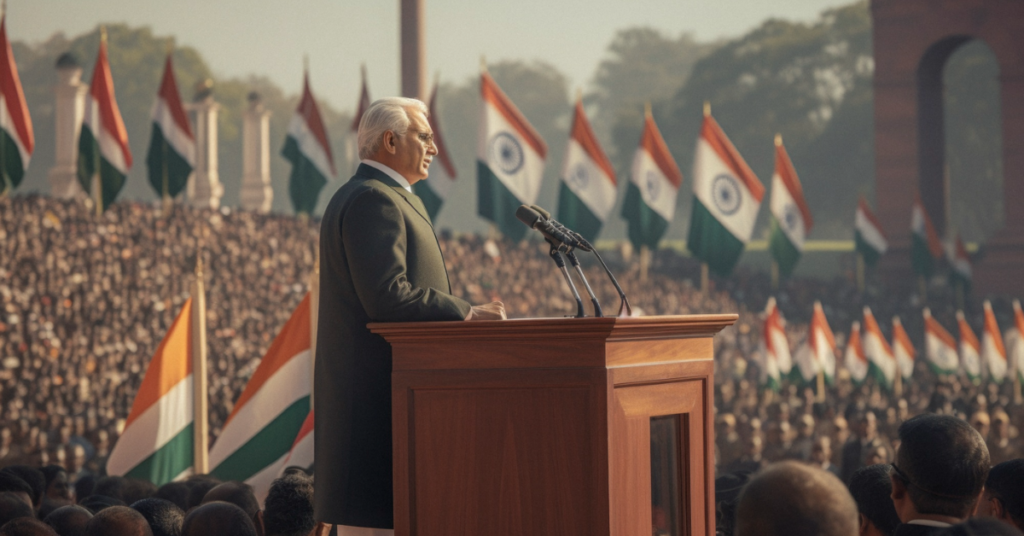
Pranab Mukherjee’s warning was not a momentary political remark, but a long-term reflection on India’s democratic and governance trajectory. He cautioned that when power becomes the primary goal and national interest takes a back seat, a country’s direction is put at risk. The political shift of 2014 is often seen as a response to this concern—marking a turn toward clearer leadership, decisive governance, and a renewed focus on national priorities.
Pranab Mukherjee’s Warning & the 2014 Turn
- Former President Pranab Mukherjee was among those rare leaders whose words carried the weight of long-term foresight rather than instant political impact.
- The renewed attention to one of his old remarks today suggests that his assessment of India’s political direction has only grown more relevant with time.
Before 2014: Power Over Nation
India’s political landscape before 2014 was shaped by clear trends:
- Personal and family-centric interests dominating decision-making
- Efforts to retain power as a hereditary right
- National interest subordinated to political survival
- Reluctance to take tough but necessary decisions
- Muslim appeasement–driven vote-bank politics, resulting in selective governance
This period was defined by policy paralysis, frequent scams, and weak leadership clarity.
An Insider’s Warning
- Pranab Mukherjee’s words did not come from a political opponent but from a senior insider.
His message was clear:
- When politics shifts from nation-building to power preservation, the country’s direction is put at risk.
2014: A Shift in Governing Philosophy
The year 2014 marked more than a change in government—it marked a change in priorities:
- National interest placed above political convenience
- A move from appeasement to equality before the law
- Clear leadership backed by strong political will
- Decisive action in security, diplomacy, and the economy
This shift accelerated growth, strengthened infrastructure and digital governance, and improved welfare delivery.
Disillusionment Within Congress
Many senior Congress leaders now appear disenchanted, realizing that:
- Dynasty- and vote-bank politics no longer resonate
- The party lacks a credible national vision
- This explains why several leaders are distancing themselves from a declining political structure.
Public Realisation and Electoral Verdicts
The most significant change has occurred among citizens. People have seen that:
- Honest and transparent governance is possible
- Corruption is not inevitable
- Development and decisive leadership can coexist
As a result, Congress and the so-called “thugbandhan” face repeated electoral rejection.
False Narratives and Their Backfire
As rejection has grown, so have:
- Fake and fear-driven narratives
But a politically mature electorate is increasingly rejecting recycled falsehoods, causing these narratives to backfire.
In hindsight, the question remains: Was Pranab Mukherjee right?
- Views may differ, but the post-2014 shift in priorities and governance has clearly reshaped India’s trajectory—arguably validating his warning.
🇮🇳 Jai Bharat, Vandematram 🇮🇳
Old Blogs: https://saveindia108.in/our-blog/