SUMMARY
- Trust in leadership today is no longer merely political—it is civilisational. For many Indians, confidence in Prime Minister Narendra Modi (and leaders such as Yogi Adityanath) reflects faith in a governance approach inspired by Sanatana Dharma, consciously adapted to the realities of Kaliyuga.
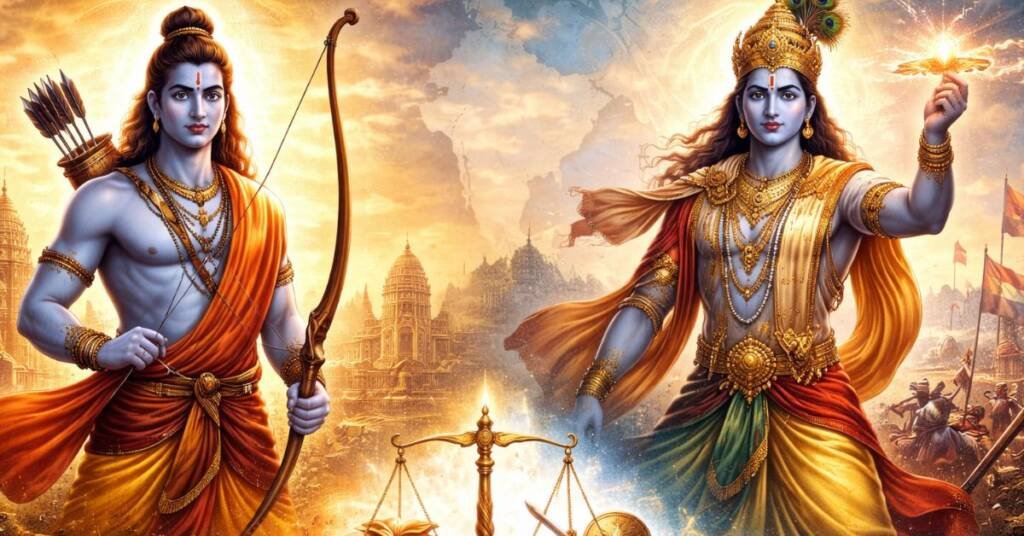
- Dharma is eternal, but its application must respond to time, threat, and scale. India today needs Ram-Rajya to morally educate society and Krishna-Neeti to strategically defend it—together.
- Supporting Modiji’s mission is thus not blind allegiance; it is a conscious choice for welfare, stability, and a responsible global role.
Why India Needs Moral Clarity and Strategic Resolve—Together
SECTION 1: Leadership Beyond Politics—A Civilisational Calling
- Every generation faces a defining choice that shapes its future.
- Leadership is measured not by slogans but by direction, intent, and outcomes.
- Over the past decade, India has witnessed a shift toward long-term national interest over short-term applause.
- This mission is not about an individual—it is about transforming a civilisation into a confident, capable, and compassionate force.
SECTION 2: Governance as Seva, Not Entitlement
- At the heart of this mission lies a simple principle: governance is seva (service).
The focus has been on:
- Empowerment over dependency
- Opportunity over entitlement
- Dignity over appeasement
- Institutions over personalities
When governance prioritizes the last mile, society rises together.
SECTION 3: Ram-Rajya—Moral Education by Example
In Treta Yuga, Maryada Purushottam Shri Ram embodied:
- Unwavering adherence to Dharma
- Personal sacrifice for social harmony
- Moral clarity reflected in daily conduct
Ram-Rajya is a civilisational ethic, not nostalgia:
- Rule by example
- Fairness and predictability in law
- Compassion guided by duty
- Trust built through conduct, not rhetoric
Many see these traits echoed today in:
- Personal austerity and discipline
- Consistency between belief and action
- Institution-building with dignity and fairness
- Patience for outcomes over popularity
This educates society morally, restoring faith in values, institutions, and national purpose.
SECTION 4: Krishna-Neeti—Strategic Wisdom in Action
Dwapar Yuga demanded Shri Krishna’s pragmatism:
- Strategy aligned with morality
- Flexibility without losing the goal
- Decisive action against organised Adharma
Krishna-Neeti teaches a hard truth:
- When Adharma is organised and aggressive,
Dharma must be intelligent, firm, and strategic—not passive.
In today’s world of:
- Narrative warfare and misinformation
- Organised crime and extremism
- Institutional manipulation
- Economic and geopolitical pressure
Moral lectures alone are insufficient.
SECTION 5: Kaliyuga Reality—Why Both Are Essential
Kaliyuga is marked by:
- Moral relativism and normalised wrongdoing
- Exploitation of compassion as weakness
- Coordinated attempts to weaken institutions
- Internal and external pressures on sovereignty
Therefore:
- Ram-Rajya alone cannot endure without protection
- Krishna-Neeti is indispensable for law, order, and stability
India needs moral education and moral protection—both are Dharma
SECTION 6: Complementary Dharmic Roles in Leadership
Supporters often view today’s leadership as complementary:
- Modi → Ram-Rajya
- Long-term vision
- Institution-building
- Global credibility with restraint
- Moral authority through conduct
- Yogi → Krishna-Neeti
>Firm law enforcement
>Clarity against disorder
>Decisive action within the Constitution
Together, they:
- Rebuild values
- Restore respect for the rule of law
- Reassure citizens that Dharma is not defenceless
SECTION 7: Compassion Without Complicity
Sanatana Dharma is not passive.
- Kshama (forgiveness) where reform is possible
- Dand (punishment) where Adharma threatens society
In Kaliyuga:
- Krishna-Neeti ensures compassion does not become complicity
- Firmness becomes an act of responsibility, not cruelty
This balance sustains social harmony and national resilience.
SECTION 8: Why Distrust Often Feels Like Self-Doubt
- Reflexive distrust reflects decades of broken governance and cynicism.
Many trust this leadership because they see:
- Ideological and spiritual preparedness
- Personal austerity, not dynastic entitlement
- Governance treated as seva, not privilege
When inner discipline aligns with public authority, trust follows.
SECTION 9: Why Public Support Is Indispensable
No transformation succeeds without citizen participation.
- Reforms require patience
- Stability needs unity
- Debate must be responsible
- Institutions need confidence
Support does not mean blind obedience. It means:
- Distinguishing criticism from sabotage
- Reform from chaos
- National interest from short-term emotion
A calm, informed, united society becomes the strongest shield.
SECTION 10: India’s Role in a Troubled World
- The world today faces conflict, uncertainty, and fragmentation.
India’s approach emphasizes:
- Peace through strength
- Cooperation without submission
- Dialogue without compromising sovereignty
- This positions India as a stabilising force, not a disruptive one.
Dharma United—The Path Forward
Sanatana Dharma unites ideals with action:
- Ram-Rajya elevates society
- Krishna-Neeti protects it
Leadership embodying both offers India:
- Integrity in governance
- Strength with restraint
- Growth with stability
Global respect rooted in civilisational confidence
>This is a historic moment.
>The opportunity is rare.
>The responsibility is collective.
🇮🇳 Jai Bharat, Vandematram 🇮🇳
Read our previous blogs 👉 Click here
Join us on Arattai 👉 Click here
👉Join Our Channels 👈