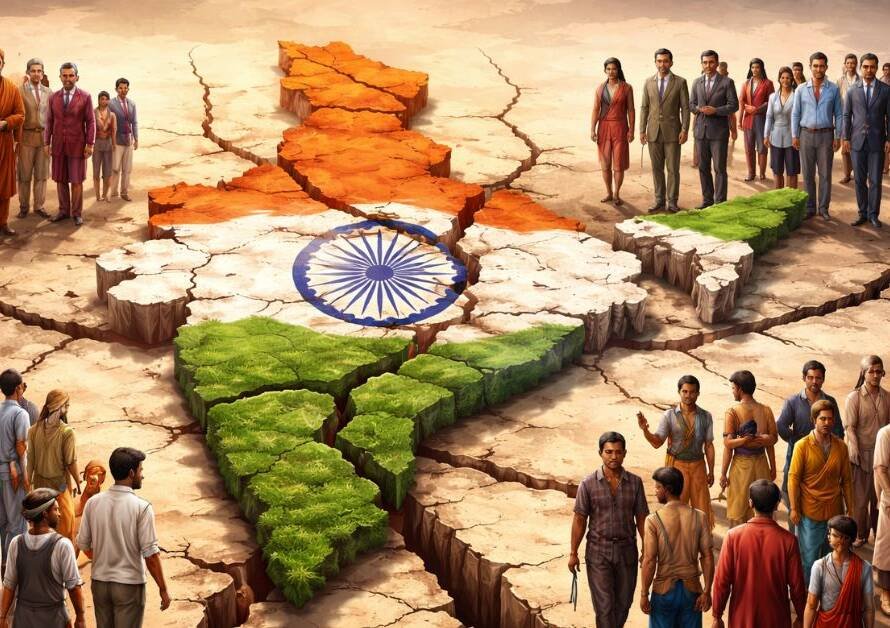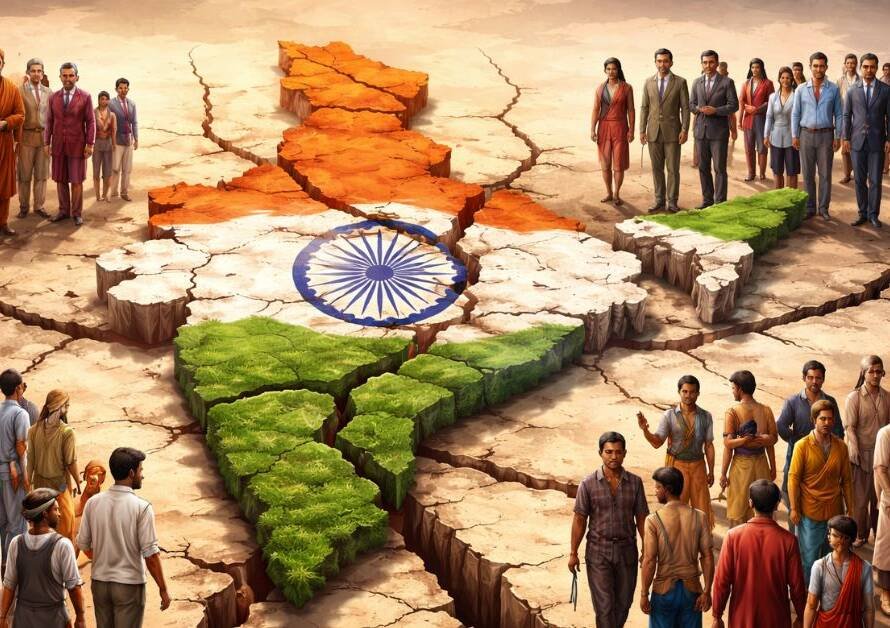
We had the Emperors and Sages from all castes
Summary
- This narrative argues that ancient India (Hindusthan) was a merit-based society where the “Varna” system was a fluid division of labor, allowing individuals from humble backgrounds to become Sages, Kings, and Scholars.
- It identifies the British Raj as the architect of the rigid, hereditary caste system used to “Divide and Rule.” Post-independence, it asserts that the Congress party and the “Thugbandhan” coalition continued these divisions through caste-based politics and appeasement, leading to national fragility.
- The text concludes with a call for total Hindu unity under the nationalistic leadership of PM Modi to prevent the demographic and social fate seen in neighboring nations and to reclaim India’s status as a global superpower.
- This is a comprehensive, deep-dive narrative designed to serve as a definitive resource for understanding the historical, social, and political evolution of Hindusthan.
- It connects the dots from ancient meritocracy to the modern-day struggle for civilizational survival.
1. The Vedic Blueprint: A Society of Merit (Varna vs. Caste)
In the original Vedic civilization, your “Varna” was your profession, not your birthright. The “Division of Labor” was a socio-economic tool that ensured every individual could rise to their highest potential based on Guna (tendency) and Karma (action).
- The Fisherwoman’s Son (The Guru): Emperor Shantanu married Satyavati, a fisherman’s daughter. Her son, Ved Vyasa, was not marginalized; he became the greatest Maharishi in history, compiled the four Vedas, and wrote the Mahabharata.
- The Dacoit-turned-Sage:Maharishi Valmiki, the author of the Ramayana, was originally a forest-dweller and a dacoit. His transformation proves that in Sanatana Dharma, your past or birth does not limit your spiritual height.
- The Prime Minister (The Scholar):Vidura, the son of a maidservant, was the most respected scholar (Maha Pandit) of the Kuru dynasty. His “Vidura Niti” is still studied globally as a masterpiece of political science.
- The Cowherd & The Farmer:Shri Krishna came from a family of dairy farmers (Yadavs), and Balarama always carried a plow. They were the leaders of the Kshatriyas, proving that those who worked the land and those who ruled the land were one and the same.
- Education for All:Nishadraj, a forest dweller, studied in the same Gurukul as Lord Rama. There was no “educational elite”; knowledge was the right of the deserving.
2. The Era of “Subaltern” Emperors
For nearly 92% of ancient Indian history, the subcontinent was ruled by dynasties that modern historians would classify as “Backward” or “Dalit.” The narrative that only one group ruled is a fabrication.
- The Nanda Dynasty: Founded by Mahapadma Nanda, who was a barber. He destroyed the old aristocratic hegemonies and became the most powerful King of Magadha.
- The Maurya Empire:Chandragupta Maurya came from a family of peacock-keepers (Mura). He was groomed by the Brahmin Chanakya, who prioritized the boy’s talent over his lineage. Together, they ruled for over 500 years.
- The Gupta Golden Age: The Guptas, who managed horse stables and trade, led India into a scientific revolution, gifting the world the decimal system and advanced medicine.
- The Maratha Empowerment: In later years, Bajirao Peshwa (a Brahmin) appointed Gaekwads (cowherds) and Holkars (shepherds) as sovereign Kings. Ahilyabai Holkar became a legendary ruler and the greatest restorer of Hindu temples.
3. The Colonial Poison: The Invention of Rigid Caste
The British understood that they could never conquer a united Hindu society. To break the back of Hindusthan, they weaponized social identities.
- The Census of 1871-1901: Under officials like Herbert Risley, the British categorized thousands of fluid professional identities into rigid “Castes.”
- Hereditary Rigidity: They introduced laws that made these classifications hereditary, effectively trapping people in their social roles to prevent them from uniting against the Raj.
- The “Divide and Rule” Strategy: By creating a hierarchy of “Upper” and “Lower,” they sparked internal friction, ensuring Hindus would fight each other rather than their colonial masters.
4. The Post-1947 Betrayal: Political Fragmenting
After the British left, the Congress party and its allies inherited the colonial toolkit. Instead of healing the wounds of caste, they deepened them for “Vote Bank” politics.
- Institutionalizing Division: They created labels like Backward Classes, Scheduled Castes, and Scheduled Tribes not just for upliftment, but to create permanent silos that could be played against each other during elections.
- Appeasement over National Interest: To keep the Hindu majority fragmented, they consolidated Muslim votes through aggressive appeasement, even at the cost of national security.
- The “Fragile Five” Era: During the decades of Congress rule, the country was weakened by:
>Systemic Loot: Countless scams and corruption that bled the treasury.
>Insecurity: Protecting extremists and ignoring Maoist insurgencies to keep the country destabilized.
- Cultural Attacks: Direct attacks on Sanatana Dharma and the promotion of conversions through Islamic and Christian missionary networks.
5. 2014 to Present: The Era of Resurgence
Since 2014, under the leadership of PM Narendra Modi, Hindusthan has begun to shed its colonial and “Congress-era” baggage.
- Global Respect: For the first time, our citizens are respected globally, and Sanatana values are being discussed at the highest international levels.
- Civilizational Restoration: The rebuilding of the Ram Mandir and Kashi Vishwanath Dham signifies the return of Hindu self-respect.
- Economic Superpower: In just one decade, India has risen from a “Fragile Five” economy to a global growth engine.
6. The Final Warning: Unite or Fade
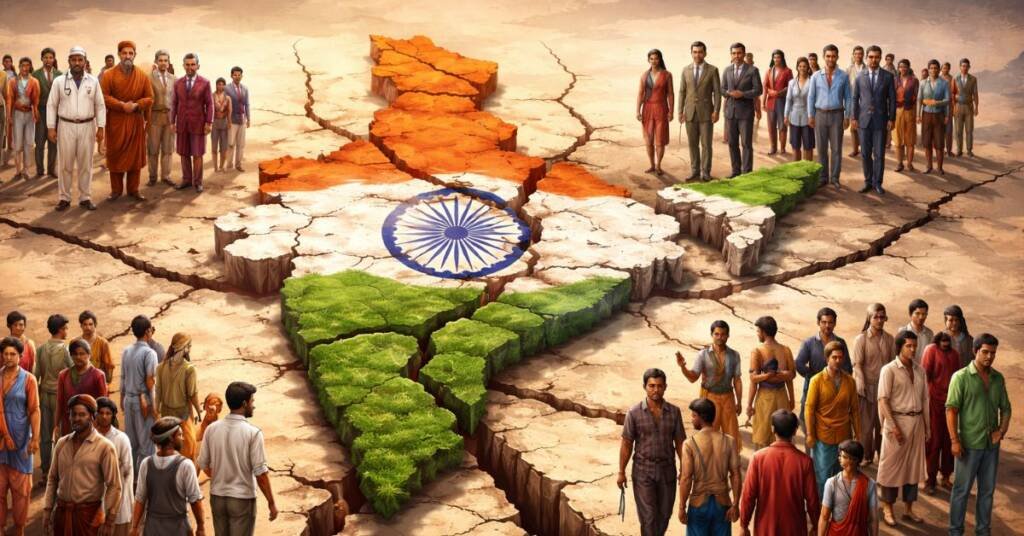
- The “Thugbandhan” (Opposition Coalition) and their foreign handlers are desperate. They are using their “anti-national ecosystem” to reignite caste census debates and linguistic friction to stop India’s momentum.
- The Existential Threat: We must look at our neighbors. If Hindus remain divided by the petty “Conspiracy of Hatred” (Caste, Region, Language), we will eventually face the same genocide and displacement seen by Hindus in Pakistan and Bangladesh.
The Duty of a Sanatani:
- Reject Caste-Politics: Stop identifying as fragments; identify as a whole.
- Identify the Enemy: Recognize that those who call for “Caste Census” are often those seeking to divide the Hindu vote for personal power.
- Unwavering Support: To become a global superpower, we must provide united, full support to the nationalistic Modi government, which prioritizes Rashtra-Dharma (Duty to the Nation).
Throughout thousands of years, foreign travelers like Megasthenes and Hiuen Tsang never recorded “caste exploitation”—they saw a flourishing, meritocratic society.
- Exploitation was an import of the invaders. To save the future of our children, we must return to that ancient unity.
United we stand as Sanatanis; divided we fall into the pages of a forgotten history.
🇮🇳 Jai Bharat, Vandematram 🇮🇳
Read our previous blogs 👉 Click here
Join us on Arattai 👉 Click here
👉Join Our Channels👈