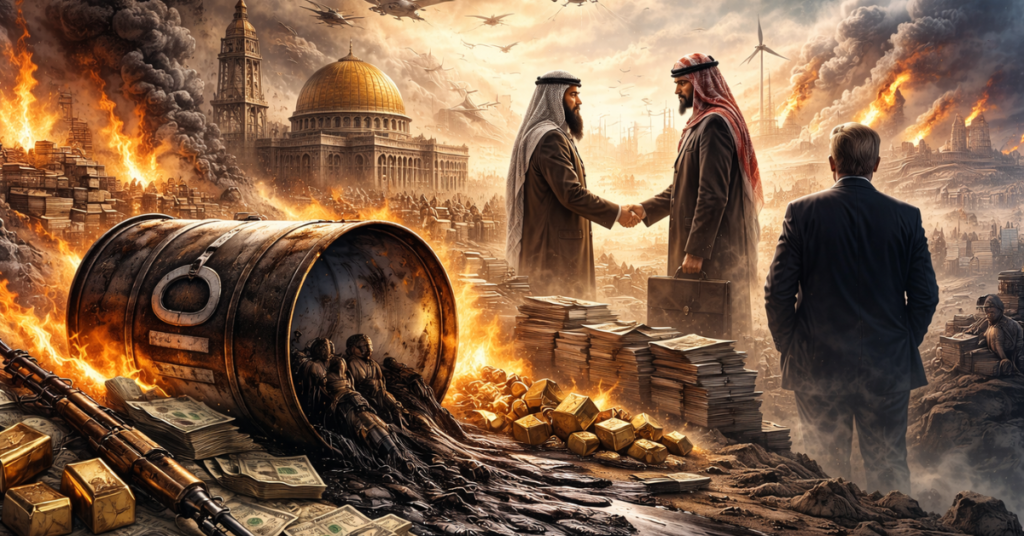
Summary:
- This analysis explores the theory that the shift in American foreign policy—specifically during the Trump administration—triggered a structural collapse of the influence long held by oil-rich Middle Eastern nations.
- By aggressively pursuing U.S. energy independence and reshaping regional alliances (The Abraham Accords), the narrative argues that the financial “tap” that funded global radicalization, extremist NGOs, and ideological expansion for 50 years is being tightened.
- The result is a region turned inward, where internal conflicts and economic desperation are forcing a retreat from the global export of radicalism.
Energy, Power, and Strategy: Changing Middle East Dynamics
1. The “Energy Independence” Doctrine: Breaking the Oil Monopoly
For half a century, the global North was effectively held hostage by the “Petro-Dollar.” The wealth generated from $100+$ per barrel oil wasn’t just used for domestic luxury; it was the primary engine for global ideological shifts.
- The US Fracking Revolution: Under the “America First” energy policy, the U.S. became a net exporter of oil and gas. This broke the pricing power of OPEC (Organization of the Petroleum Exporting Countries).
- Depleting the “War Chest”: When oil prices are suppressed by high supply, the “surplus wealth” of Arab nations—which traditionally funded radical madrasas and extremist political lobbying across Europe and Asia—evaporates.
- Economic Vulnerability: Nations like Saudi Arabia and Kuwait are now forced to tax their citizens and diversify their economies (e.g., Saudi Vision 2030) because the “easy money” is gone. A country struggling to pay its own bills cannot afford to fund a global ideological agenda.
2. The Shift from Global Agenda to Regional Survival
The narrative suggests that these nations are no longer looking to “Islamize” the world but are instead fighting for their own survival.
- The Iran-Arab Schism: The rivalry between the Shia-led Iran and the Sunni-led Arab bloc (UAE, Saudi, Bahrain) has reached a boiling point. Instead of investing in foreign NGOs, these countries are spending billions on Western weaponry to protect themselves from each other.
- Self-Destruction of Infrastructure: We are seeing a cycle where these nations target each other’s lifeblood. Attacks on oil tankers in the Strait of Hormuz and drone strikes on refineries (like Abqaiq-Khurais) mean they are effectively burning their own capital.
- The “Vicious Cycle” of Proxy Wars: From Yemen to Syria, the wealth of the Middle East is being liquidated in the sands of proxy battlegrounds. This “Gaddar” (internal turmoil) serves as a natural check on their ability to project power externally.
3. The Trump Effect: A “Madman” Strategy or Strategic Genius?
The prompt refers to Trump as “mentally ill yet effective.” In political science, this is often compared to the “Madman Theory,” where a leader’s perceived unpredictability forces adversaries to back down or change their behavior.
- The Abraham Accords: By bypassing the Palestinian issue and brokering peace between Israel and the UAE/Bahrain, Trump shattered the “Pan-Islamic” unity that had been used to pressure the West for decades.
- Sanctions on Iran: The “Maximum Pressure” campaign on Iran didn’t just hurt Tehran; it forced the entire region to recalibrate. Iran’s inability to sell oil forced it to cut funding to proxy groups like Hezbollah and Hamas, creating a domino effect of financial “starvation” for radicalism.
- Disruption of the Status Quo: By treating these nations as “business partners” rather than “protected allies,” the U.S. forced them to pay for their own security, further draining the funds previously used for “radical mischief.”
4. The Dismantling of the “Soft Power” Infrastructure
One of the most profound points in the narrative is the impact on non-Muslim countries. For decades, petro-dollars were used to fund:
- Radical NGOs & Legal Aid: In many Western and Asian democracies, legal systems were used to protect radical elements, funded by offshore Middle Eastern wealth.
- Educational Influence: The funding of university chairs, textbooks, and cultural centers was a subtle form of “Islamicization” (as termed in the prompt).
- The Financial Drying Up: As these nations face “beggary” (or at least severe fiscal deficits), these external programs are the first to be cut. The “legal and NGO” shield for radicalism is thinning because the checks are no longer arriving from the Gulf.
5. The “Karmic” Cycle: From 1973 to 2024
The narrative mentions the “fruits of 50 years of karma.” This refers to the timeline starting from the 1973 Oil Embargo.
- The Rise (1973–2010s): Massive wealth, global influence, and the spread of radical Wahhabism/Salafism.
- The Peak of Sin: The narrative posits that the misuse of this wealth to fund terrorism and destabilize non-Muslim nations has led to a “full cup of sins” (Pap ka Ghada).
- The Fall (Present): The convergence of Green Energy, US energy exports, and internal Islamic civil war is seen as a divine or historical retribution.
6. A New World Order
The “Islamic Terrorism” mentioned in the prompt is presented as a byproduct of specific economic conditions. By changing those conditions—moving the world toward chemicals/renewables and breaking the oil monopoly—the oxygen for radicalism is cut off.
- The End of Petroleum Era: As the world moves toward EVs and green hydrogen, the strategic importance of the Middle East will continue to decline.
- The Realist View: Whether one likes Trump or not, his “transactional” approach to the Middle East stripped away the diplomatic niceties that allowed these nations to play a “double game” (allying with the West while funding its detractors).
The core of this perspective is that the Middle East is currently undergoing a “forced modernization” through economic exhaustion.
- The “Good Trump” sentiment stems from his role in accelerating this process by removing the US as a dependent customer of Arab oil and forcing a regional realignment with Israel.
- As oil wealth declines, the ability to fund global radicalization, buy political influence, and support extremist NGOs vanishes, leading to what the author views as a “cleaning” of global politics.
🇮🇳 Jai Bharat, Vandematram 🇮🇳
Read our previous blogs 👉 Click here
Join us on Arattai 👉 Click here
👉Join Our Channels👈