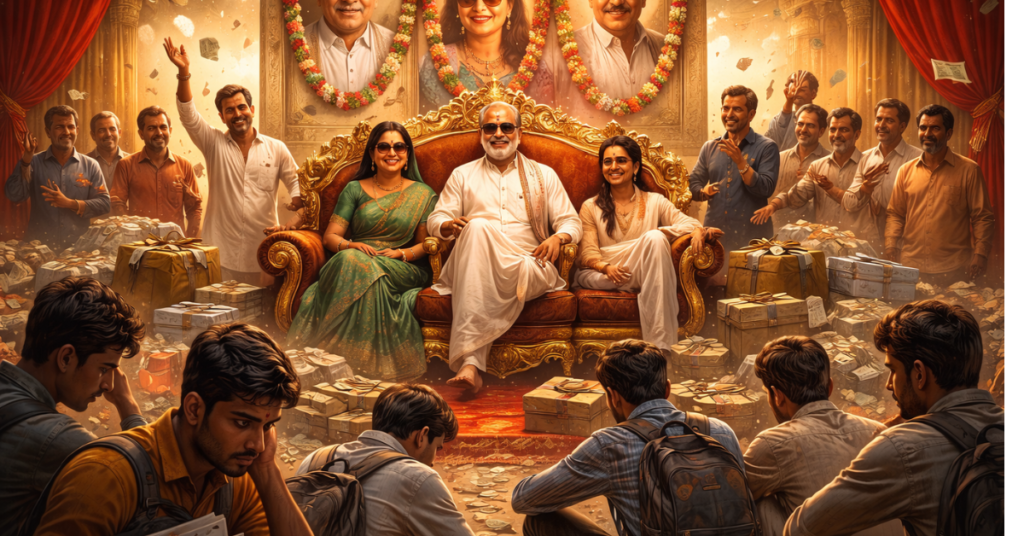
Summary:
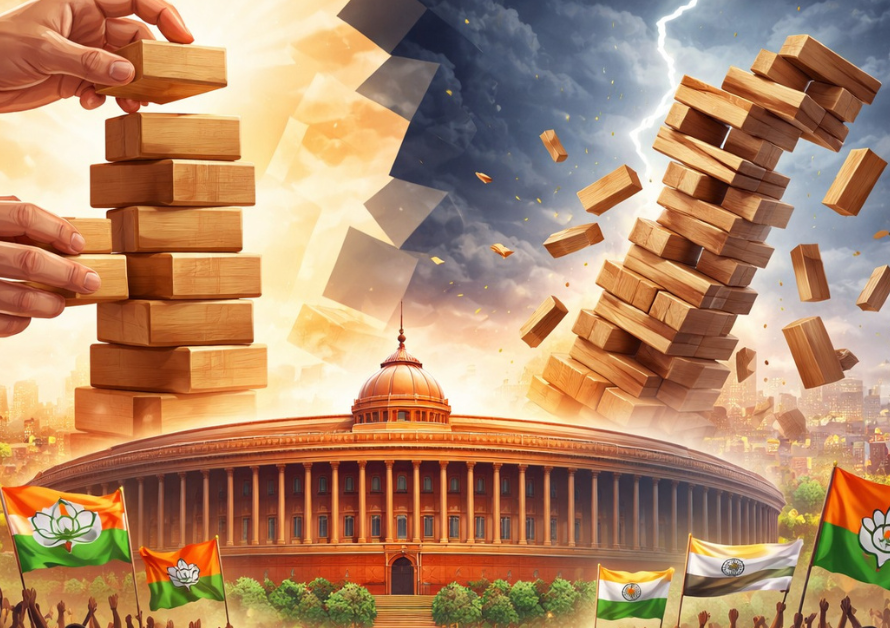
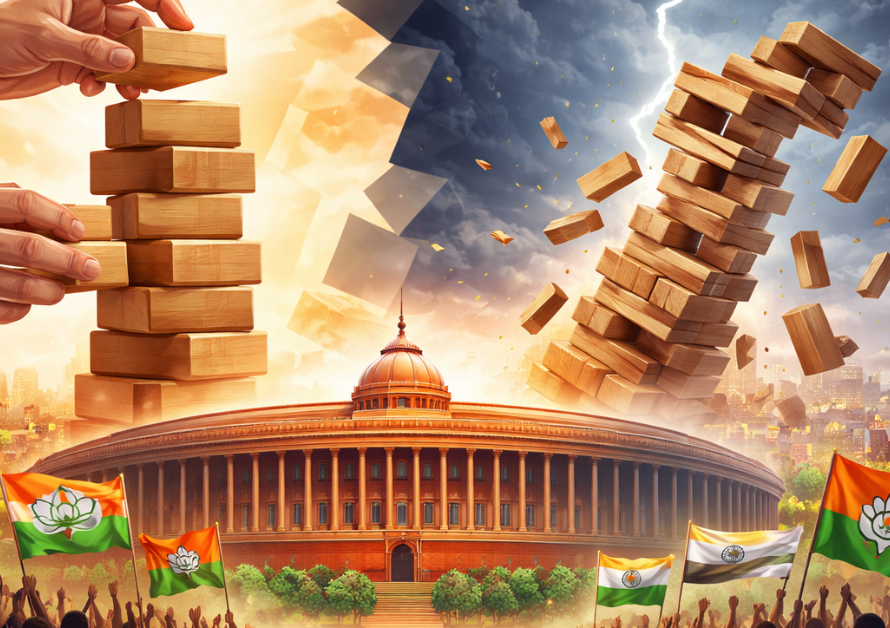
- This extensive analysis explores the structural decay caused by “Parivarvaad” (dynasticism) in the Indian political landscape. It details how a collective of regional and national entities—often referred to as the “Thugbandhan”—has hollowed out democratic institutions to create a “Private Limited” model of governance.
- From institutionalized “Rate Card” corruption and state-specific legacies of graft (RJD, SP, TMC, DMK, AAP) to the strategic sabotage of digital transparency and welfare reforms, this narrative reveals the cost of prioritizing family wealth over national sovereignty.
- It concludes that dismantling these “Loot Chains” is the essential prerequisite for India’s journey toward becoming a truly developed global power.
New India vs Dynastic Challenges
I. The Architecture of Entitlement: Power as a Family Heirloom
- The most corrosive element of dynasty politics is the fundamental shift in how power is perceived.
- In a healthy democracy, power is a “Public Trust” granted by the people for a limited tenure.
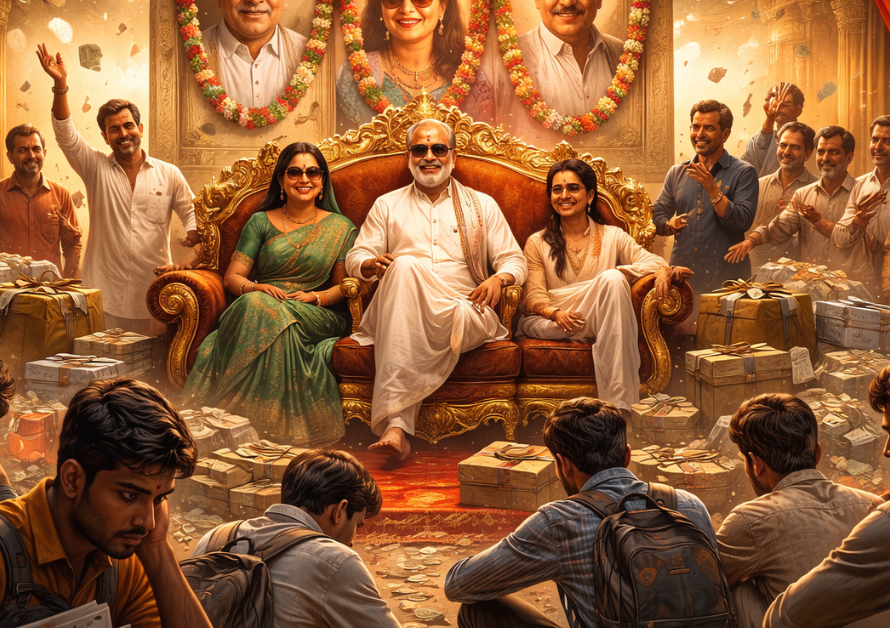
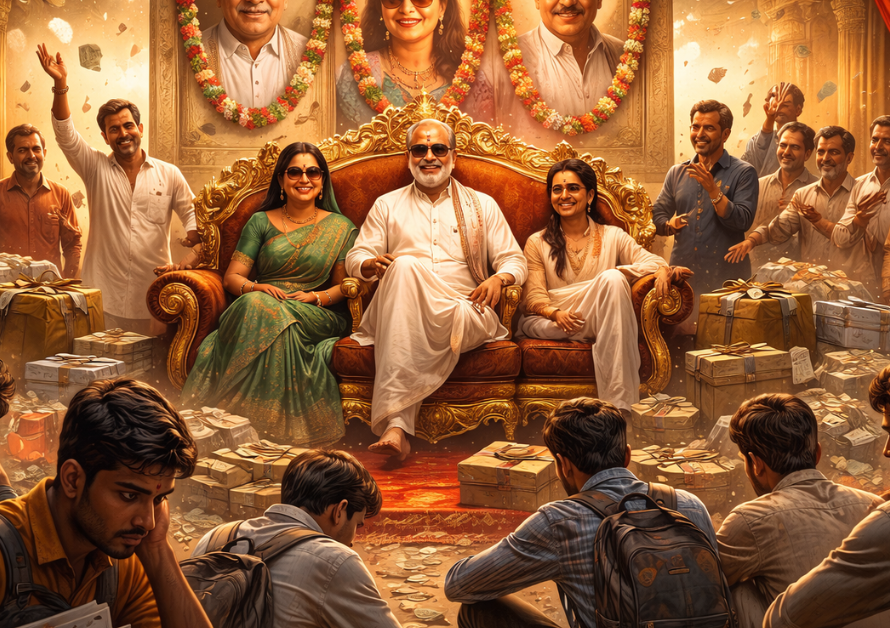
- Under the architecture of entitlement, however, power is viewed as a “Hereditary Asset”—an ancestral heirloom to be protected, harvested, and passed down through generations.
- The “Private Limited” Party Model: Most parties within the “Thugbandhan” operate like family-owned corporations. There is no internal democracy, no merit-based promotion, and no room for grassroots workers to reach the summit.
- Whether it is the Yadav dynasties in Bihar and Uttar Pradesh, the Banerjee clan in West Bengal, or the Karunanidhi family in Tamil Nadu, the top leadership is a “reserved seat.”
- This creates a glass ceiling for millions of talented Indians; a young person may join these parties with a desire for public service, but they soon realize they are merely foot soldiers for the “Prince” or “Princess” of the dynasty.
- The Institutionalization of the “Rate Card”: In these regimes, corruption is not a series of isolated incidents; it is the very engine of governance. Investigations and public discourse have often highlighted a literal “Rate Card” for state interactions:
- Administrative Postings: Critical roles like District Magistrates or Police Chiefs are allegedly “sold” to the highest bidder, ensuring that the officer serves the family’s interest rather than the law.
- Recruitment Extortion: Government jobs—the primary aspiration for the rural youth—become products for sale.
- Resource Monopolies: Natural resources like sand, minerals, and even liquor licenses are diverted to “shell companies” managed by proxies of the ruling family.
II. Regional Legacies: A Map of Systemic Decay
The “Grand Mess” left by decades of dynastic rule is best understood through the specific legacies of the parties that have prioritized family coffers over state development.
1. RJD (Bihar): The Erasure of Rural Aspirations
The legacy of the Rashtriya Janata Dal is etched in the “Fodder Scam,” but its modern manifestation is even more predatory.
- The Land-for-Jobs Scandal: This represents a dark pinnacle of exploitation. Investigations suggest that during their tenure in the Railways, the ruling family allegedly demanded that unemployed, poor youth transfer their ancestral land to the family in exchange for Group-D jobs.
- It wasn’t just money that was stolen; it was the very ground beneath the feet of the poor.
- De-industrialization: By fostering an environment of “Jungle Raj,” they ensured that no industry would enter Bihar, forcing millions into a cycle of migration and labor.
2. SP (Uttar Pradesh): The Patronage of Lawlessness
The Samajwadi Party’s era was characterized by the blurring of lines between the state machinery and criminal elements.
- Infrastructure Siphoning: The Gomti Riverfront project became a global case study in how “development” can be used as a front for looting the exchequer.
- Projects were announced with massive budgets, only for thousands of crores to disappear through inflated costs and sub-standard work.
- Caste-Based Nepotism: By filling every level of the state administration with loyalists, they ensured that justice was served based on political affiliation rather than the merit of the case.
3. TMC (West Bengal): The Extortion Economy
In West Bengal, the Trinamool Congress has replaced the industrial vacuum left by the Left with an organized system of “Cut-Money.”
- The SSC Recruitment Scam: The recovery of nearly 50 crore rupees in cash from the associates of a single minister was a visual testament to the “Cash-for-Jobs” industry.
- Thousands of deserving candidates who cleared exams were denied jobs because they couldn’t pay the “Rate Card” price.
- Predatory Chit-Funds: Scams like Saradha and Rose Valley thrived under political patronage, wiping out the life savings of millions of poor citizens while the leadership allegedly provided a protective shield to the scammers.
4. DMK (Tamil Nadu): The Vertical Monopoly
The DMK model is perhaps the most sophisticated, involving a “Vertical Monopoly” over the state’s economy.
- Family Control of Media and Film: By controlling the means of entertainment and information (Kollywood and television networks), the family ensures a constant narrative of self-glorification.
- Resource Capture: From sand mining to the education sector, the “Family” allegedly maintains a grip that makes it impossible for an independent entrepreneur to thrive without paying homage to the dynasty.
5. AAP (Delhi/Punjab): The “Nouveau Riche” of Corruption
Though they emerged from an anti-corruption movement, the Aam Aadmi Party has rapidly adopted the tactics of the “Thugbandhan.”
- The Liquor Policy Scam: Investigative agencies have detailed how a “South Group” cartel was allegedly formed to generate kickbacks.
- This proves that even “new-age” parties can quickly succumb to the allure of systemic loot to fund their political expansion.
III. The Sabotage of Progress: Blocking the “Clean-Up”
Since 2014, the central government has initiated a series of structural shifts to dismantle these “Loot Chains.” However, the “Thugbandhan” has reacted with a strategy of total obstruction, often acting against the national interest to protect their private interests.
Weaponizing “Street Vetoes”:
- Whenever a reform threatens to eliminate middlemen—the core financial backbone of many regional dynasts—the ecosystem triggers mass protests.
- The Farm Laws were a prime example. These laws aimed to give farmers the freedom to sell anywhere, bypassing the “Mandis” where local political “Dadas” extract fees.
- By spreading misinformation, the dynasts successfully stalled a reform that would have doubled farmer incomes.
The Sabotage of Digital India:
- Transparency is the natural enemy of “Parivarvaad.” The implementation of GST and Direct Benefit Transfer (DBT) has been attacked relentlessly. Why?
- Because DBT sends money directly to the bank account of the poor, leaving zero room for “Cut-Money.”
- By eliminating “Ghost Beneficiaries,” the government has saved over 2.5 lakh crore rupees—money that previously went into the pockets of the “Thugbandhan” ecosystem.
Welfare Blockades (The “Credit” War):
In states like West Bengal and Delhi, central welfare schemes are often blocked or re-branded.
- Ayushman Bharat: Denying the poor a 5-lakh rupee health cover simply because the “Prime Minister’s name” is associated with it is a crime against humanity.
- PM-Kisan: Certain states delayed the verification of farmer lists for years, preventing the direct transfer of 6,000 rupees to small farmers, solely to maintain the narrative of “government failure.”
IV. The Multi-Dimensional Cost to the Nation
The “Loot Chain” is not just about stolen money; it is about stolen opportunities and a compromised national future.
The Brain Drain of Merit:
- When government jobs are sold for 20-30 lakhs, merit dies a slow death. The son of a laborer who studies under a streetlamp cannot compete with the “Rate Card” of a dynast’s crony.
- This forces India’s most brilliant minds to migrate to other countries, where their talent builds someone else’s nation instead of their own.
Institutional Decay:
- By appointing “loyalists” to universities, police boards, and judicial commissions, dynastic parties have degraded the quality of Indian institutions.
- This decay ensures that the common man faces a wall of indifference or corruption whenever they seek justice.
National Security Risks:
- For the sake of “Vote-Bank” politics, some regional parties have been accused of encouraging illegal immigration and turning a blind eye to radical elements.
- When national integrity is traded for a few seats in a state assembly, the entire country pays the price.
Economic Paralysis:
- The trillions of rupees lost in the scams of the “Grand Mess” era could have built a world-class high-speed rail network, 500 new AIIMS-level hospitals, or provided high-speed internet to every village.
- Instead, that wealth is parked in offshore accounts, luxury hotels in London, or real estate in Dubai.
V. The Path to a “Viksit Bharat”
- The journey to a “Viksit Bharat” (Developed India) by 2047 is an uphill climb that requires us to shed the dead weight of “Parivarvaad.”
- The country cannot progress “by leaps and bounds” if the engine of growth is clogged with the grit of systemic corruption.
- The Maharashtra villagers who sacrificed their LPG for the nation and the millions who cooperated during the Corona lockdowns represent the “True India”—a responsible, understanding, and sacrificing citizenry.
- In contrast, the “Thugbandhan” represents a fading era of entitlement.
- If we choose Merit over Dynasty, Transparency over “Cut-Money”, and National Interest over Family Legacy, the difficulty of the moment will pass smoothly.
- The “New India” belongs to the 140 crore citizens who dream of a country where success is determined by hard work, not by whose son or daughter you happen to be.
- The era of the “Loot Chain” is ending; the era of the “Aspirational Indian” has begun.
🇮🇳 Jai Bharat, Vandematram 🇮🇳
Read our previous blogs 👉 Click here
Join us on Arattai 👉 Click here
👉Join Our Channels👈