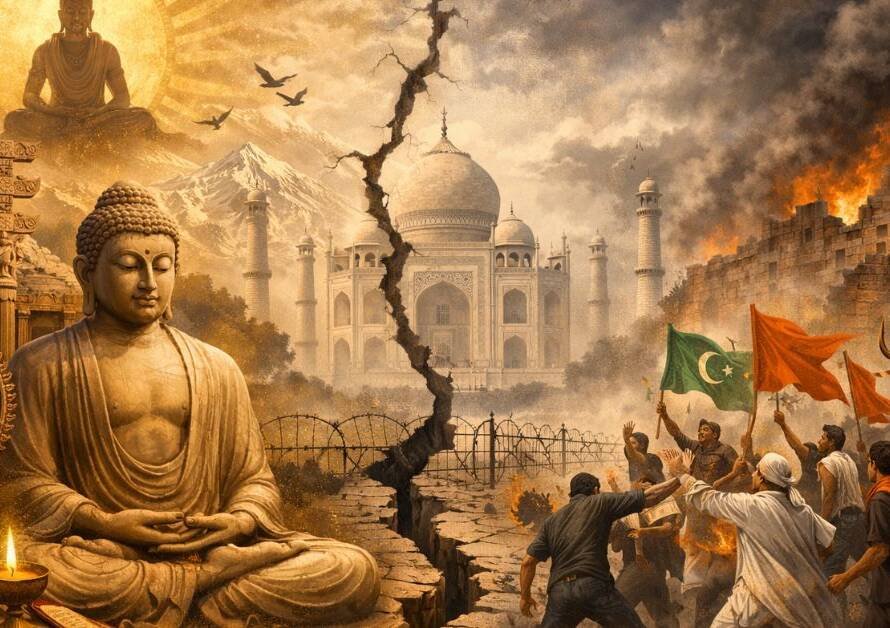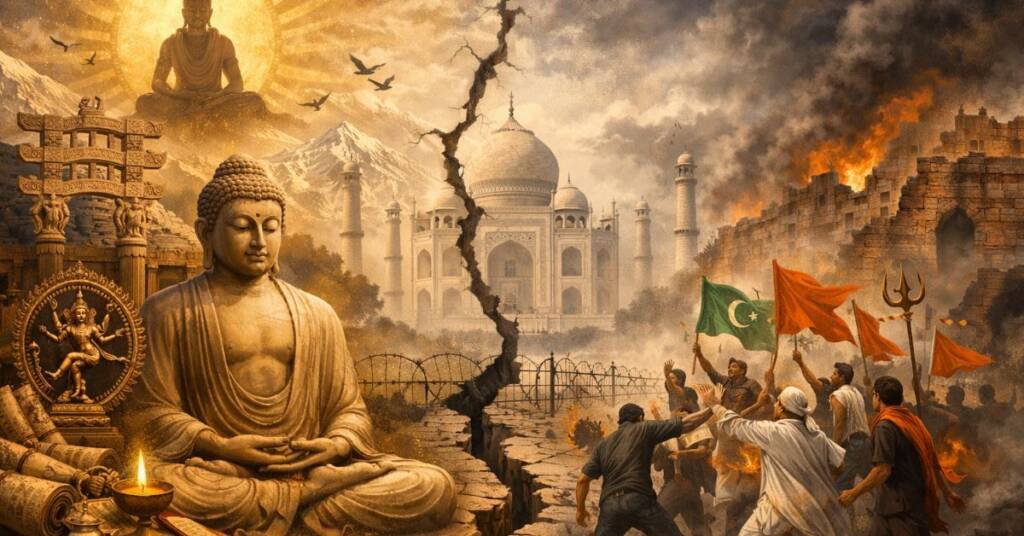
The Great Indian Irony
Summary
- Bharat is the birthplace of Sanatana Dharma, one of the world’s most profound philosophical and civilizational frameworks.
- It offers a complete blueprint for human life—balancing spirituality, ethics, governance, social responsibility, universal brotherhood, and liberation.
- It teaches duty over entitlement, sacrifice over selfishness, courage over complacency, and unity over division.
Yet today, a painful contradiction defines our society:
- We proudly claim the highest philosophy, yet practice shallow social responsibility.
- We speak of Vasudhaiva Kutumbakam, yet remain divided internally.
- We celebrate Dharma symbolically, yet neglect it in conduct.
- We expect national protection and prosperity, yet hesitate to participate actively in safeguarding them.
The greatest irony is not external opposition—it is internal complacency, division, ego, and self-centeredness. This narrative is a mirror for awakening—a call for unity, responsibility, and alignment between philosophy and practice.
1. The Unmatched Greatness of Sanatana Dharma
Sanatana Dharma is not merely religion—it is a civilizational living system.
At the Individual Level
- Self-discipline (Dama)
- Duty (Dharma) before personal gain
- Responsibility for one’s actions (Karma)
- Fearlessness rooted in truth
- Pursuit of Moksha (self-realization)
At the Social Level
- Protection of the weak
- Charity (Dana) and service (Seva)
- Ethical conduct in governance
- Collective harmony across diversity
- Balance between strength and compassion
At the Universal Level
- Vasudhaiva Kutumbakam – “The world is one family”
- Peace rooted in justice
- Universal coexistence
It offers a framework where:
- Spirituality and social duty coexist
- Personal growth strengthens society
- National integrity aligns with universal harmony
Yet the question remains:
- If our philosophy is so profound, why is our social behavior often so fragmented and self-focused?
2. The Social Reality: Comfort Over Commitment
Despite our philosophical inheritance, much of society is absorbed in:
- Wealth accumulation
- Family advancement
- Personal comfort and lifestyle
- Status and recognition
- Entertainment and consumption
Common attitudes include:
- “My family is secure; that is enough.”
- “Politics is dirty; I will stay away.”
- “Why should I sacrifice for society?”
- “Everything seems stable; there is no danger.”
This mindset creates:
- Civic apathy
- Political disengagement
- Social fragmentation
- Weak collective resilience
We enjoy stability—but rarely ask what sustains it.
3. Living in a Fool’s Paradise
- One of the gravest risks is complacency.
Many assume:
- National integrity is permanent
- Cultural identity is self-sustaining
- Institutions will always protect us
- Security requires no citizen participation
History teaches otherwise. Civilizations decline when:
- Citizens prioritize comfort over vigilance
- Internal division overrides unity
- Society becomes reactive instead of proactive
- Threats are dismissed as exaggerated
Complacency weakens nations quietly—before visible crisis emerges.
4. Division: The Perpetual Weakness
For decades, society has remained divided across:
- Caste
- Region
- Language
- Community
- Political loyalties
These divisions have:
- Reduced social cohesion
- Enabled manipulation
- Prevented unified national vision
- Turned identity into competition
When identity replaces Dharma, unity collapses.
- A divided society becomes vulnerable—not necessarily to one group—but to instability and fragmentation.
5. The Burden on Governance
Any government that seeks to protect national interest—regardless of political alignment—requires:
- Informed citizens
- Social unity
- Political participation
- Civic responsibility
When society is:
- Cynical
- Self-centered
- Fragmented
- Politically indifferent
Leadership struggles—even if intentions are sincere.
- A nation cannot be protected by government alone.
- Security, sovereignty, and integrity require societal alignment.
6. Ego, Greed, and the Collapse of Collective Spirit
- India is not lacking intelligence.
We are:
- Academically accomplished
- Entrepreneurially capable
- Technologically advancing
- Spiritually aware
Yet often:
- Ego blocks cooperation
- Greed overrides generosity
- Comfort suppresses courage
- Debate replaces action
We argue passionately—but act minimally. We criticize easily—but sacrifice rarely.
Sanatana Dharma emphasizes:
- Humility
- Charity
- Self-restraint
- Courage
- Service
When these decline, society weakens internally before facing external challenges.
7. The Neglect of the Poor and the Needy
True Dharma demands:
- Protection of the vulnerable
- Upliftment of the poor
- Shared responsibility
- Ethical wealth distribution
Yet:
- Inequality persists
- Community service remains limited
- Social charity is occasional, not systemic
- Personal comfort outweighs collective welfare
Donations alone are insufficient. Dharma requires sustained engagement.
8. Safety, Security, and Sovereignty
National stability depends on:
- Social cohesion
- Economic productivity
- Cultural continuity
- Civic vigilance
- Institutional trust
When society becomes:
- Politically passive
- Divided internally
- Distracted by personal pursuits
- National resilience gradually weakens.
Security is not merely military—it is social and cultural.
9. The Forgotten Ideal: Vasudhaiva Kutumbakam
- We proudly proclaim universal brotherhood.
But universal harmony requires:
- Internal unity
- Responsible citizenship
- Ethical governance
- Collective sacrifice
Without internal alignment, global ideals remain rhetorical.
- True Vasudhaiva Kutumbakam begins with unity at home.
10. The Required Shift: From Self-Centeredness to Civilizational Responsibility
At Individual Level
- Balance wealth with service
- Participate in civic processes
- Rise above caste and regional bias
- Support ethical institutions
- Help the needy actively
At Social Level
- Encourage unity over fragmentation
- Promote dialogue over polarization
- Strengthen trust-based communities
- Reject identity-based hostility
At Civilizational Level
- Live Dharma as conduct, not slogan
- Integrate spirituality with responsibility
- Align personal ambition with national welfare
- Promote peace through strength and justice
- The greatest irony is not that we have challenges. Every civilization does.
The greatest irony is:
- We possess the world’s most refined moral philosophy
- Yet fail to embody it consistently
Sanatana Dharma is not weak. It is under-practiced.
- The problem is not lack of intelligence. It is lack of unified will.
- The transformation required is not philosophical—it is behavioral.
Only when:
- Ego yields to unity
- Greed yields to generosity
- Comfort yields to courage
- Division yields to unity and collective responsibility
Can Bharat truly embody:
- Dharma
- Strength
- Harmony
- Vasudhaiva Kutumbakam
The philosophy already exists. The responsibility lies with us.
🇮🇳 Jai Bharat, Vandematram 🇮🇳
Read our previous blogs 👉 Click here
Join us on Arattai 👉 Click here
👉Join Our Channels 👈