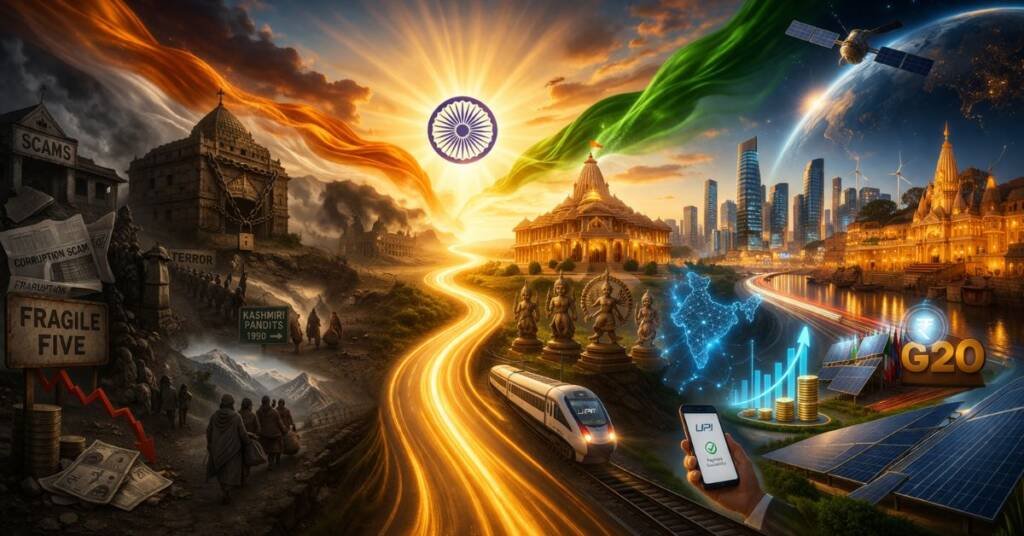
Summary:
- For nearly seven decades after the Partition, India’s trajectory was defined by systemic corruption, a “Fragile Five” economic status, and a political culture of appeasement that marginalized Sanatana values and compromised national security.
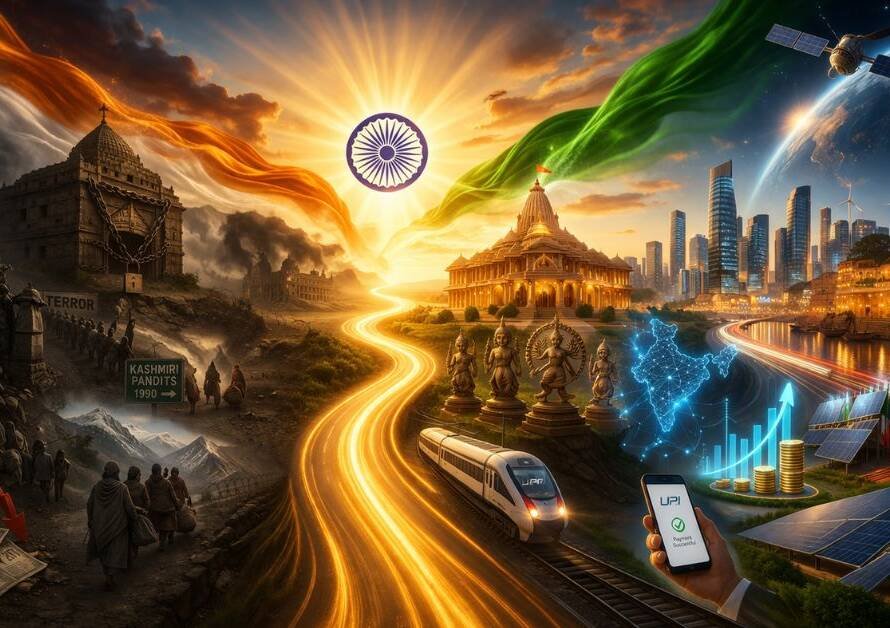
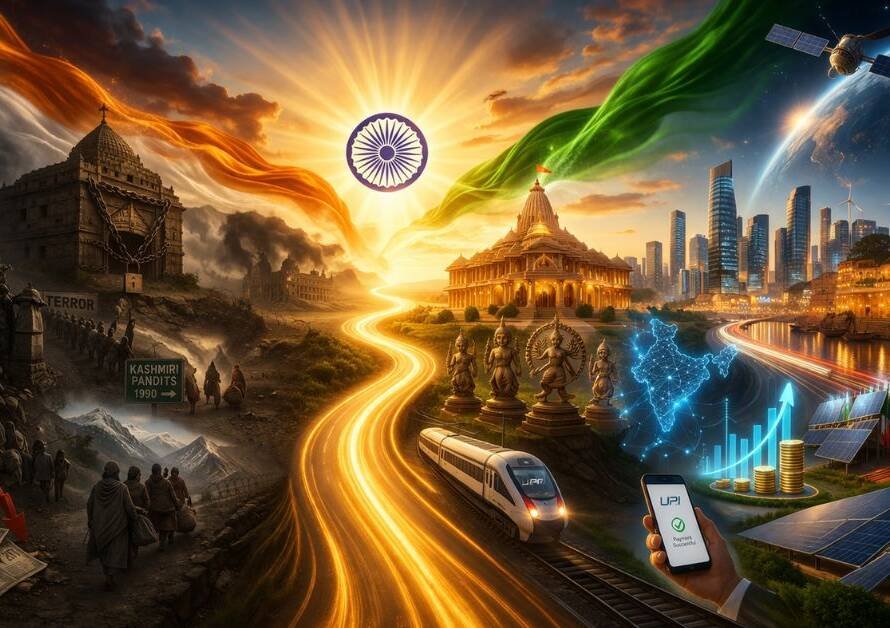
- The last 12 years (2014–2026) have witnessed a profound reversal. Through digital transparency that ended “systemic loot,” decisive military and legislative actions that secured sovereignty, and a monumental Sanatana Renaissance—marked by the Ram Mandir and Kashi Vishwanath Dham.
- India has stunned the world by emerging as the 4th largest global economy and a confident civilizational superpower.
I. The Long Shadows: An Era of Systematic Erosion (1947–2014)
The narrative of post-independence India is often viewed as an “epic” struggle where the nation’s core identity was suppressed under the weight of institutional decay. This period, largely dominated by the Congress, is characterized by critics as a time of missed opportunities and cultural alienation.
The Culture of Systemic Loot and Mega-Scams:
Corruption was not merely an occasional lapse but an institutionalized feature of governance. The “scam list” grew from the 1948 Jeep Scandal to the gargantuan frauds of the early 21st century.
- The 2G Spectrum and Coal-gate Scams: These alone cost the national exchequer hundreds of billions of dollars, hollowing out the economy and stalling industrial growth.
- Commonwealth Games (2010): A moment that should have showcased India’s rise became a symbol of global embarrassment due to rampant embezzlement and poor infrastructure.
- The “Fragile Five” Legacy: By 2013, India was categorized by global investors as one of the “Fragile Five” economies—burdened by double-digit inflation, a crumbling rupee, and “policy paralysis” that drove away foreign investment.
Appeasement Politics and Hindu Marginalization:
Under the guise of “selective secularism,” the state prioritized minority vote-bank politics. This led to the perception that the majority Hindu community was being treated as second-class citizens in their own ancestral land.
- Shah Bano Case (1985): The government’s reversal of a Supreme Court verdict to appease fundamentalist elements became a permanent symbol of sacrificing constitutional principles for electoral gain.
- State Control of Temples: While other religious institutions remained autonomous, Hindu temples were brought under heavy state control, with their resources often diverted to non-religious purposes.
- Educational Distortion: Curricula were designed to downplay the achievements of Vedic civilization while glorifying an era of invasions, leading to a “civilizational amnesia” among the youth.
Compromised Sovereignty and Security:
- Strategic Docility: The “soft-on-terror” approach led to repeated humiliations, most notably the 26/11 Mumbai attacks, where the state’s response was viewed as hesitant and weak.
- The Exodus of Kashmiri Pandits (1990): The state’s failure to prevent the ethnic cleansing of Hindus from the Kashmir Valley is cited as the ultimate failure of “anti-national” governance.
- Internal Extremism: The “Red Corridor” of Naxalism and separatist ecosystems thrived in academic and media circles, working to undermine the Union’s integrity from within.
II. The Twelve-Year Resurrection: Reclaiming Bharat (2014–2026)
The year 2014 marked a civilizational “unplugging” from the old system. The last 12 years have been dedicated to exhuming the truth and burying the “anti-national” structures that held the nation back.
Ending the Loot: The Digital Revolution:
- The JAM Trinity: By linking Jan Dhan accounts, Aadhaar, and Mobile phones, the government created an unshakeable digital spine.
- Direct Benefit Transfer (DBT): This eliminated the “middlemen” who had fueled the Congress-era loot. Over $450 billion has been transferred directly to the poor, saving the state billions in leakages.
- UPI and Financial Inclusion: India now leads the world in real-time digital payments, accounting for nearly 50% of global transactions in 2025. This transparency has forced the “black money” economy into the light.
The Sanatana Renaissance: A Nation Finds Its Soul:
- Ram Mandir, Ayodhya: The 2024 inauguration was more than a religious event; it was a “cultural reset” that ended 500 years of wait and restored national pride.
- Virasat Bhi, Vikas Bhi: The transformation of the Kashi Vishwanath Corridor and Ujjain’s Mahakal Lok proved that India can be a high-tech superpower while remaining deeply rooted in its Dharmic heritage.
- Repatriation of Heritage: Over 640 stolen idols and sacred artifacts have been brought back from foreign lands since 2014, signaling a global respect for India’s civilizational property.
Assertive Sovereignty and Security:
- The End of Article 370: In 2019, the government finally corrected the “historic blunder” of Partition by fully integrating Jammu & Kashmir into the Union, effectively ending the separatist ecosystem.
- Surgical and Balakot Strikes: These actions redefined India’s military doctrine. The world was stunned to see a Bharat that would cross borders to eliminate terror at its source, ending the era of “nuclear blackmail” by neighbors.
- Crushing the “Red Corridor”: By 2026, Left-Wing Extremism has been reduced to its lowest levels in history, with many former “liberated zones” now fully integrated into the developmental mainstream.
III. Stunning the World: India as a Global Formidable Power
- By 2026, the results of this 12-year labor have left the international community in awe. The “Fragile Five” label has been buried under the weight of record-breaking growth and innovation.
Economic Tectonic Shift:
India has officially surpassed Japan and Germany to become the 4th largest economy in the world, with a GDP exceeding $4.18 trillion.
- Vishwa Mitra: Through “Vaccine Maitri” and leading the G20, India has positioned itself as a “Friend to the World” and a bridge between the Global North and South.
- Infrastructure at Scale:The pace of building highways has tripled (to 34 km/day), and the railway network is seeing a “Vande Bharat” revolution that connects the nation like never before.
- Space and Nuclear Leadership: Opening these sectors to private participation has made India a hub for low-cost, high-efficiency technology, further stunning Western observers.
IV. The Ongoing Battle: Thugbandhan vs. Rashtra
Despite these national strides, the “digging of graves” continues in non-BJP ruled states. Proponents of this narrative view the opposition’s “thugbandhan” (Grand Alliance) as a desperate attempt to revive the old era of division.
- Attacks on Sanatana Dharma: Explicit calls by regional leaders to “eradicate” Sanatana Dharma are seen as a continuation of the anti-Hindu bias of the pre-2014 era.
- Protection of Infiltrators: In several non-BJP states, the protection of illegal immigrants for vote-bank purposes is viewed as an ongoing threat to the safety and sovereignty of the nation.
- The Final Stand: The current political struggle is framed as a battle between those who want to return to the era of “systemic loot” and those who wish to see a Viksit Bharat (Developed India) by 2047.
The “epic” of these last 12 years is still being written, but the theme is clear: the era of apology and decay is over; the era of Bhartiya Shakti (Indian Power) has arrived.
🇮🇳 Jai Bharat, Vandematram 🇮🇳
Read our previous blogs 👉 Click here
Join us on Arattai 👉 Click here
👉Join Our Channels👈