Summary
- This narrative explores the depths of human resilience through the lens of Jewish and Hindu history.
- It examines how centuries of external pressure failed to crush the “Atman” (cultural core) of these civilizations.
- Tracing the shift from ancient peaceful co-existence to the modern era of ego-driven religious dominance and political fragmentation, it issues a clarion call to Indian citizens.
- It urges them to recognize the current era under the Modi government as a pivotal moment of restoration—one that requires rising above personal ego, rejecting foreign-backed disinformation, and prioritizing national welfare to establish India as a global Vishwa Guru.
Global Propaganda
1. The Paradox of Resilience: Why Adversity Breeds Genius
Recent scientific reports (e.g., The Times of India, March 2026) highlight that chronic emotional stress and toxic environments accelerate physical aging. However, history presents a staggering paradox that medicine alone cannot explain.
- The Jewish Example: For nearly two millennia, the Jewish people faced systematic persecution and displacement. Despite this “toxic” environment, they produced intellectual giants like Albert Einstein and Richard Feynman, who altered the course of human understanding.
- The Hindu Example: Similarly, Hindus endured centuries of foreign rule during the Mughal and British eras. Instead of fading into oblivion, this era birthed spiritual suns like Adi Shankaracharya, Swami Vivekananda, and Ramana Maharshi.
- The Philosophical Key: The answer lies in the distinction between Body, Mind, and Soul (Atman). While stress damages the physical and mental layers, the Soul remains pure consciousness—untouched and indestructible.
- Adversity as a Catalyst: As the great Sages taught, suffering often forces a person to turn inward. When the external world becomes unbearable, the search for internal Truth begins. This “conscious suffering” dissolves the ego, allowing the Soul’s deep power to express itself through extraordinary creativity and spiritual insight.
2. Evolution, Co-existence, and the Great Divergence
For the vast majority of human history, diversity was not a source of conflict but a natural result of evolution and environment.
- Natural Evolution: Humans evolved differently based on geography, climate, and available resources. This created a beautiful tapestry of cultures, languages, and communities.
- The Era of Co-existence: For millennia, these groups co-existed peacefully. There was a fundamental respect for differences; communities understood that different paths could lead to the same Truth.
- The Rise of Ego-Driven Dogma: In the last 2,000 to 3,000 years, this harmony was disrupted. New ideologies emerged that were less about spiritual seeking and more about dominance, ego, and greed.
- The Shift Toward Exclusion: Ancient “Sanatana” principles of universality were challenged by ideologies that sought to expand “empires” at the cost of humanity, leading to centuries of religious wars and systematic intolerance.
3. The Systematic Erosion of the Indian Fabric
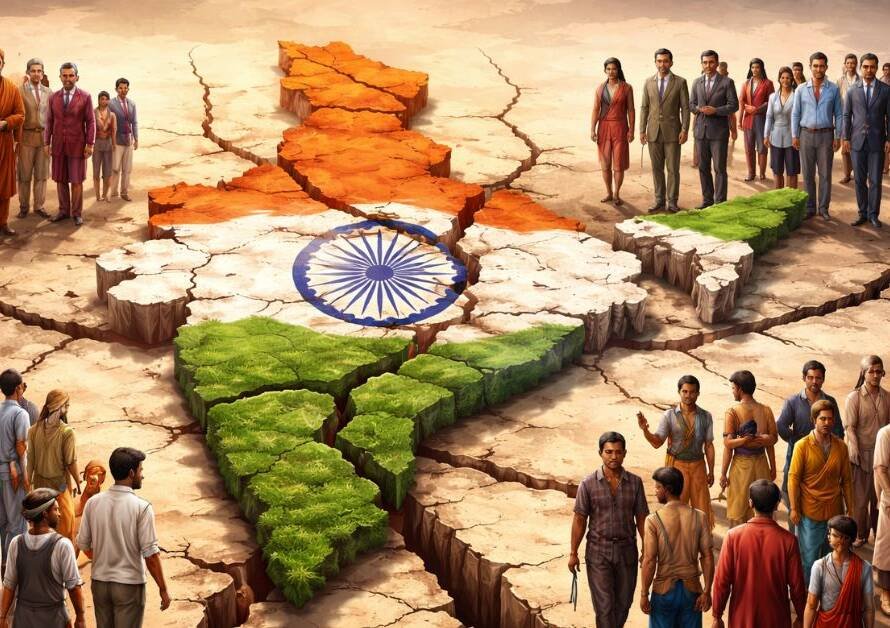
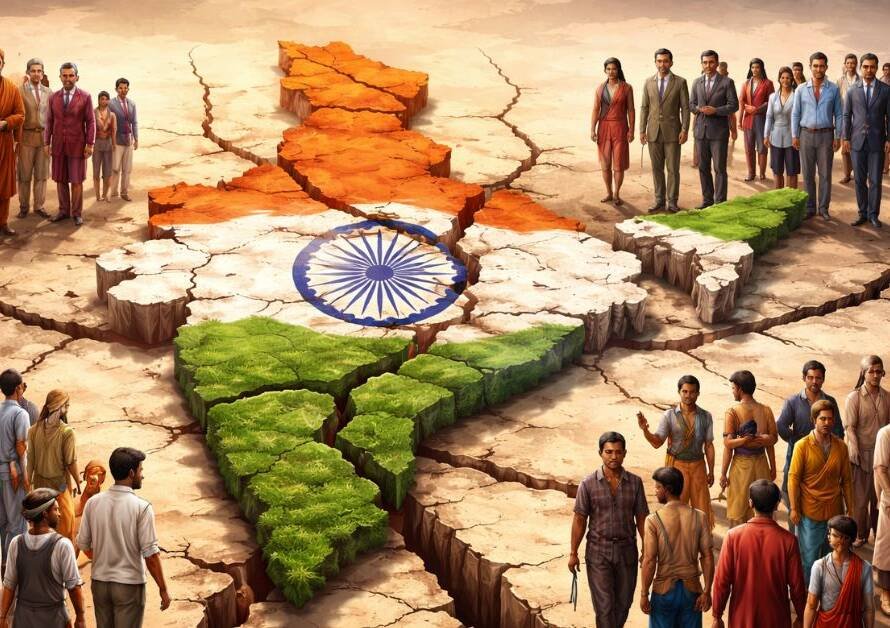
India, as the last great ancient civilization, became the primary target for these expansionist ideologies.
- Invaders and Colonizers: Islamic invasions and subsequent British colonialism were not just about land; they were about the destruction of the Indian psyche. They sought to dismantle our education systems, social cohesion, and cultural pride to make the population easier to enslave.
- The Power of Sanatana: Despite physical and economic plunder, the “Sanatana” bedrock was so strong that it acted as an invisible shield, keeping the core of Indian culture alive even when its exterior was damaged.
- Post-Independence Drifting: Unfortunately, “internal” damage continued even after 1947. For seven decades, the nation was led by those who prioritized political ideologies and economic gain over cultural restoration.
- The Failure of Hindu Religious Leaders: Even our spiritual and social guides often failed in their duty, focusing on building their own “empires” of followers. They reduced the profound wisdom of the Vedas to transactional rituals—prayers for worldly desires and donations for “heaven”—rather than focusing on individual and social ethical upliftment.
4. 2014: The Era of Restoration and the Global Challenge
The year 2014 marked a decisive shift in India’s trajectory, moving from a state of cultural amnesia to active restoration.
- Restoring Values: The Modi government has made the restoration of Sanatana Dharma, its values, and its culture a central pillar of governance. This is paired with an honest, nationalist approach that has led to rapid progress in technology, economics, and infrastructure.
- The Global Threat: As India becomes stronger and self-reliant, it poses a direct challenge to vested foreign interests who preferred a “weak India” they could exploit. Seeing India emerge as a global power, they are desperate to halt its progress.
- The Anti-National Ecosystem: To achieve this, foreign interests collaborate with internal opposition parties and an “anti-India ecosystem.” Their strategy is twofold:
- Dividing Hindus: Using caste, regionalism, and false narratives (like separating tribals from their Hindu roots) to fracture the majority.
- Appeasement: Using specific groups as political pawns to create social instability.
- The Propaganda War: We are currently in the midst of an intense information war. Social media is flooded with disinformation designed to mislead citizens and hide the progress that the world is currently applauding.
5. The Citizen’s Responsibility: Rising Above Ego
While the government has laid the foundation of “New India,” the ultimate success of the civilization depends on the character of its people.
- The Trap of Self-Interest: Many citizens, though supporters of national progress in elections, are still held back by personal ego. There is a tendency to prioritize individual “wants” over the collective “needs” of the country.
- Discernment: The people of India have shown great wisdom in rejecting the “plunder-culture” of the past seven decades, but they must go further. They must become resistant to the “traps” laid by those who wish to destabilize the nation.
- Prioritizing Society: It is time to understand that our individual well-being is inextricably linked to the well-being of the country. If the nation is destabilized, no amount of personal “wealth” or “merit” will protect the individual.
- Supporting the Vision: We must support the current nationalist regime not just at the ballot box, but on social and cultural fronts. This means countering disinformation, fostering unity among all sections of Hindu society (including our tribal and Dalit brothers), and practicing true Sanatana values of compassion and integrity.
6. Conclusion: India as Vishwa Guru
The ultimate goal of this resurgence is not just national prosperity, but global welfare.
The Path of the Sages: As suggested by Nisargadatta Maharaj and Eckhart Tolle, our struggles are meant to lead us deeper. We must use the friction of the present moment to awaken our inner spirit.
Irreversible Progress: We must ensure that the progress made in the last decade becomes irreversible. This can only happen when every citizen places the country above their ego.
A Global Mission: By applying Sanatana principles—the eternal laws of harmony and truth—India will not only become a global superpower but a Vishwa Guru. We will lead the world away from the ego-driven conflicts of the last 3,000 years and back toward a state of global harmony and peace.
🇮🇳 Jai Bharat, Vande Mataram 🇮🇳
Read our previous blogs 👉 Click here
Join us on Arattai 👉 Click here
👉Join Our Channels👈