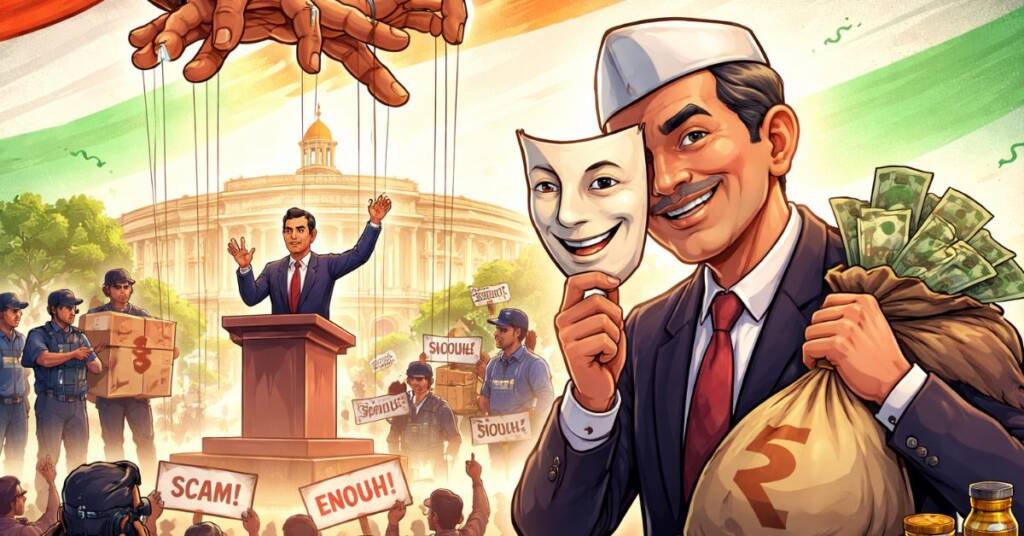
A Lesson for Indian Democracy
Summary
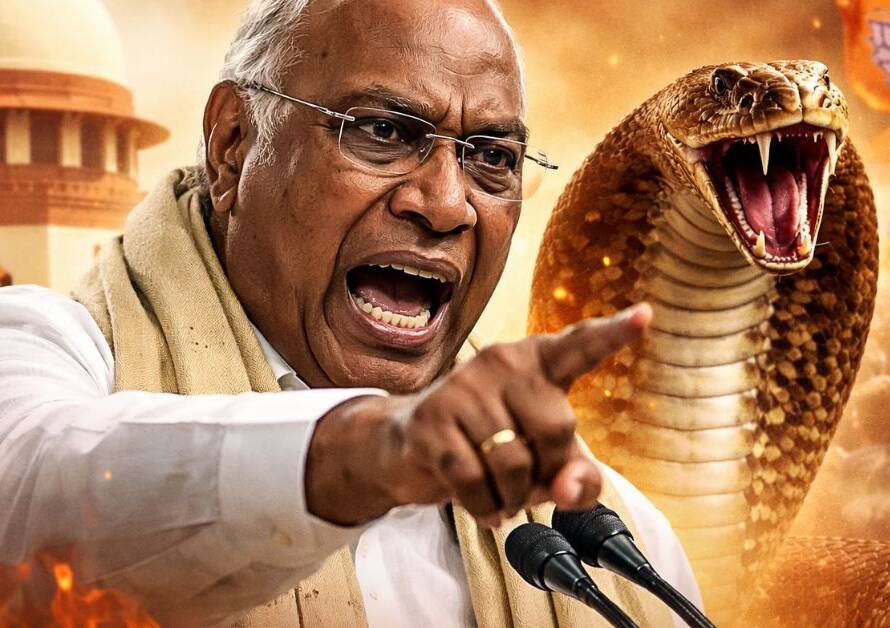
- This narrative portrays the journey of the Aam Aadmi Party (AAP) as a “Corporate Startup” gone wrong, illustrating the dangerous rise of political opportunism under the guise of anti-corruption.
- It analyzes how a movement that began with slogans of transparency and systemic change devolved by 2025–2026 into a web of scams, embezzlement, and severe legal battles.
- These “Political Startups,” which seized power through false pretenses and moral grandstanding, have not only destabilized the governance of Delhi and Punjab but have also committed a profound breach of trust with the Indian electorate.
I. The Seed Round: Ousting the ‘Angel Investor’ Anna Hazare
Every major “Unicorn” is built on the credibility of a trusted face. In this venture, the Angel Investor was Anna Hazare. His moral capital provided the “Seed Funding” that granted this startup instant market trust during the 2011 movement.
- Morality vs. Power: As soon as Arvind Kejriwal (Founder-CEO) secured his position, Hazare’s “non-political” conditions became a bottleneck for his ambitions.
- The Exit: By late 2012, once the brand was established, Hazare was pushed out of the boardroom. This was the first major act of opportunism—using a ladder to climb to the top and then kicking it away.
II. The Boardroom Coup: Suppression of Co-Founders and Internal Democracy
Following the landslide victory in 2015, a debate erupted over the company’s “Code of Conduct.”
- Prashant Bhushan & Yogendra Yadav (Intellectual Co-Founders): These pillars demanded transparency and high standards, such as the ‘Lokpal’ oversight, for candidate selection.
- Politics of Suppression: Kejriwal branded them “dissidents,” publicly humiliated them, and threw them out of the party. This proved that the leadership’s goal was not to eliminate corruption, but to enjoy unchecked power.
III. ‘Sheesh Mahal’ and the False Pretense of Luxury (2025–26 Audit Report)
The reality of the “Common Man” facade came to light in March 2026 when the CAG (Comptroller and Auditor General) report was tabled.
- Budget Violations: The initial estimate for the renovation of Kejriwal’s official residence (6, Flagstaff Road) was ₹7.91 crore, but the actual expenditure surged by 342% to ₹33.66 crore.
- Luxury Specifications: According to the report, ₹18.88 crore was spent solely on “superior specifications, antique, and artistic items.” This was a blatant “false pretense” by a leader who once feigned simplicity by wearing a blue muffler and driving a humble Wagon-R.
IV. The Web of Corruption and the Liquor Policy
The 2021–22 Excise Policy, marketed as a “Revenue-Boosting Model,” eventually turned out to be Delhi’s biggest Liquor Scam.
- Top Executives Jailed: Senior leaders like Satyendra Jain, Manish Sisodia, and Sanjay Singh spent months in prison.
- 2026 Legal Status: In recent developments as of March and April 2026, the CBI and ED have challenged the discharge of Kejriwal and Sisodia in the High Court. Investigating agencies allege a backroom game of “Illegal Gratification” (bribes) amounting to ₹90–100 crore.
V. Exodus of Experts and Loyalists: A Crumbling Empire
When the “CFO” and “Head of Governance” of an organization start fleeing, it is a sign that the foundation is hollow.
- Kapil Mishra (Former CFO): He directly accused Kejriwal of financial embezzlement.
- Swati Maliwal (Head, Corporate Governance): The assault on her at the CM’s residence in May 2024 exposed the hollowness of claims regarding women’s safety. By 2026, she stands completely isolated within the party.
- Raghav Chadha (Head of Legal & Strategy): In the latest April 2026 development, he was removed from his post as “Deputy Leader” in the Rajya Sabha. His long overseas stay during Kejriwal’s arrest and perceived “low brand loyalty” are cited as reasons for his sidelining.
VI. Adverse Impact on States and Country: The Plight of Delhi and Punjab
This opportunistic model has severely crippled governance in key regions:
- Defeat in Delhi (2025): In the February 2025 assembly elections, the people of Delhi recognized the betrayal and voted Kejriwal out of power. Corruption allegations and a lack of actual development led to total disillusionment.
- The Plight of Punjab: Power in Punjab is currently being exercised through “Remote Control” from Delhi rather than from Chandigarh. The state’s autonomy and law and order have been sacrificed at the altar of this political experiment.
VII. A Decisive Lesson for the Indian Voter
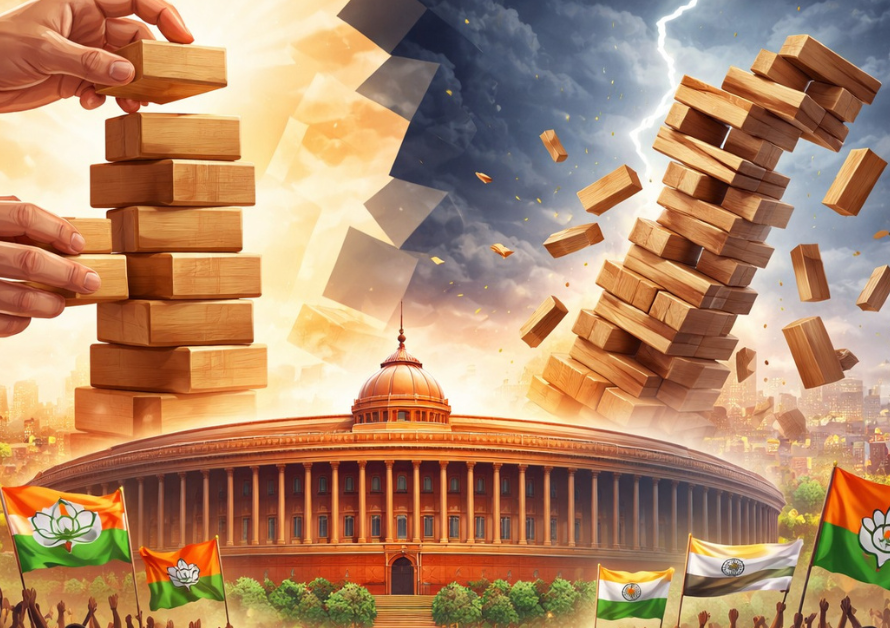
The saga of “The Mango Republic” is a landmark warning for Indian democracy. It clearly demonstrates how new opportunists can emerge in a form more lethal than the old system by simply slapping a “Clean Politics” label on themselves.
- Recognize and Reject: Voters must understand that those who use “anti-corruption” as a false pretense often end up at the epicenter of the largest scams.
- Root Out Corruption from Delhi to Punjab: The people of Delhi identified them in 2025 and threw them out of power. Now, the people of Punjab have the opportunity to recognize these opportunists and root them out completely.
In a democracy, slogans eventually fail; ultimately, it is the report card and morality that matter. A movement that started in the name of fighting corruption has today become synonymous with it. Its end can only be brought about by the power of the citizen’s vote.
🇮🇳 Jai Bharat, Vandematram 🇮🇳
Read our previous blogs 👉 Click here
Join us on Arattai 👉 Click here
👉Join Our Channels👈