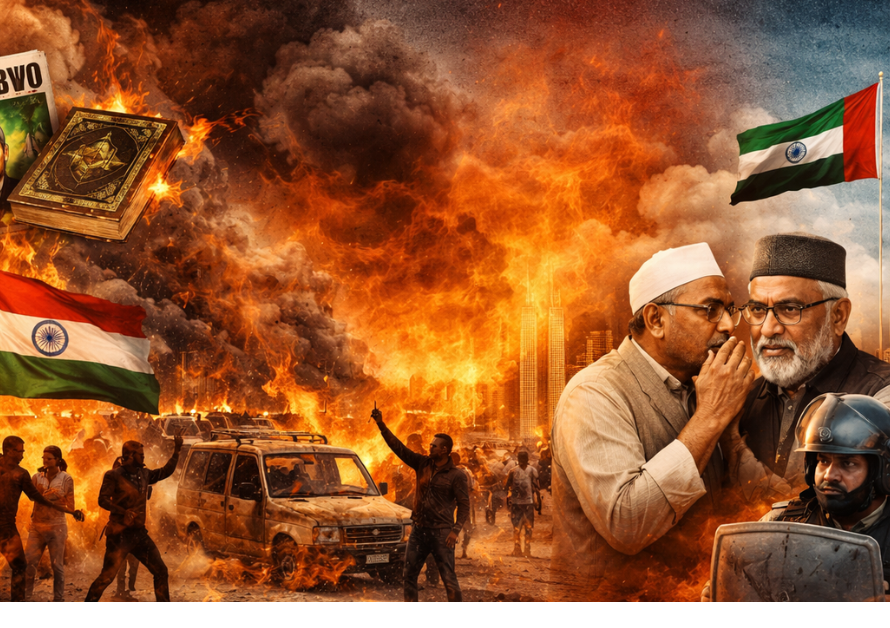
Why the World Must Act Decisively and United Against Terror and Its Support Systems
- Another Hindu boy brutally murdered in Bangladesh — the second in a single week.
This is not an isolated tragedy. It is part of a global pattern that has repeated itself for decades.
- 9/11.
- 26/11.
- Pahalgam.
- October 7.
- Sydney.
- Paris.
- London.
- Madrid and many more
Different countries. Same ideology. Same methods. Same innocent victims.
- Yet the response remains predictable: shock, condemnation, protests, hashtags — then silence. Until the next attack.
- It is time the world confronts an uncomfortable question:
Do condemnations and symbolic protests actually stop anything?
I. The Comfort Trap: Why Condemnation Has Lost Its Deterrent Power
Condemnation has become ritualistic. It offers:
- Emotional releaseMoral signaling
- Temporary unity
- The illusion of action
- But it rarely dismantles networks, disrupts funding, or neutralizes ideology.
In practice, condemnation functions as a pressure-release valve:
- Societies vent
- Leaders issue statements
- Media cycles move on
- Extremist machinery continues uninterrupted
- From the perspective of hardened extremists, condemnation is irrelevant.
- They do not fear outrage. They do not seek approval. They do not respond to shame.
II. Why Democratic Tools Alone Are Insufficient Against Ideological Terror
Democratic systems assume:
- Human life is universally valued
- Punishment deters behavior
- Public opinion matters
- Compromise is possible
These assumptions collapse when facing ideology-driven extremism, where:
- Death is glorified
- Violence is sanctified
- Martyrdom is celebrated
A person willing to murder civilians and die in the process does not fear:
- Prison
- Protests
- Press conferences
- International condemnation
This is not a failure of democracy.
- It is a failure to adapt democratic defenses to actors who reject democracy itself.
III. Ignoring Ideology Has Been a Strategic Mistake
For years, global discourse tried to explain extremist violence using everything except ideology:
- Poverty
- Marginalization
- Political grievances
- Foreign policy disputes
While such factors may influence individuals, they do not explain the scale, consistency, and global spread of the violence.
The hard truth:
- Many extremists act out of conviction, not desperation
- Beliefs motivate behavior
- Ignoring belief systems weakens counter-strategy
Understanding ideology is not endorsement — it is security realism.
IV. The Threat Is Global — But the Response Is Selective
Across Asia, Europe, Africa, the Middle East, and the West, tens of thousands of attacks have targeted:
- Children and families
- Religious minorities
- Tourists and commuters
- Journalists and first responders
Yet reactions remain inconsistent:
- Some attacks dominate headlines
- Others are dismissed as “local issues”
This selective outrage sends a dangerous message:
- some victims are geopolitically convenient; others are expendable.
Extremist networks notice this disparity — and exploit it.
V. The Exhausting Cycle That Favors Extremists
- Attack
- Media outrage
- Political statements
- Protests and vigils
- Fatigue and silence
- Next attack
- Societies burn out. Institutions hesitate. Communities live in fear.
- Extremists remain patient.
- You cannot protest indefinitely. You cannot mourn forever.
And they know it. They exploit it.
VI. What Real Action Means
Calling for action does not mean:
- Mob justice
- Collective blame
- Targeting innocent communities
- Abandoning rule of law
Those paths create chaos and strengthen extremist narratives.
- Real action means coordinated, lawful, intelligence-driven strategy, including:
1) Security Without Apology
- Proactive intelligence-led operations
- Pre-emptive disruption, not post-attack regret
- Clear identification of violent ideologies without euphemisms
2) Zero Tolerance for Terror Infrastructure
- Financial strangulation of terror networks
- Criminal accountability for recruiters, propagandists, and funders
- No immunity for institutions that incite or justify violence
3) Border, Identity, and Asylum Integrity
- Robust verification mechanisms
- Preventing exploitation of humanitarian systems by violent actors
4) Protection Before Tragedy
- Proactive safeguarding of vulnerable minorities
- Early-warning systems and rapid response
- Prevention over symbolic mourning
VII. A Global Appeal: Unite Experiences, Resources, and Resolve
- This threat does not belong to one country, one culture, or one religion.
Every society that has suffered — or could suffer — has a stake.
The global community must:
- Join hands across borders, beyond politics and selective outrage
- Share intelligence, experiences, and best practices
- Coordinate lawful joint operations to dismantle extremist and terrorist networks wherever they operate
- Choke funding, recruitment, and propaganda pipelines globally, not episodically
- Standardize consequences so terror is treated the same everywhere
This is not a call for indiscriminate force. It is a call for collective self-defense of humanity.
VIII. Accountability for State-Level Enablers: No More Free Passes
- Terrorism does not survive on ideology alone.
It survives because some states and regimes directly or indirectly enable it by:
- Providing safe havens
- Allowing fundraising and recruitment
- Turning a blind eye to training camps
- Using extremists as strategic proxies
- Offering diplomatic cover, denial, or obstruction must end.
Countries that support, sponsor, shelter, or excuse extremism must face consequences, including:
- Strict economic and trade sanctions
- Global financial isolation
- Diplomatic downgrades and international censure
- Trade boycotts and exclusion from global supply chains
- Suspension from international forums until verifiable compliance
Counter-terrorism fails if the attacker is punished but the sponsor is protected.
- There can be no normal relations with regimes that normalize terror.
IX. The Moral Reality the World Must Accept
- Peace cannot survive on one-sided restraint.
A civilization that refuses to:
- Name the threat
- Understand its motivations
- Act together decisively
- Penalize those who enable violence
is not being compassionate — it is being negligent.
- Condemnation without consequence is noise.
- Protest without policy is performance.
- Tolerance toward enablers is complicity.
X. Final Call
- Every innocent life lost is a warning. Every ignored warning lowers the cost of the next attack.
>Act — not emotionally, but strategically.
>Act — not selectively, but universally.
>Act — together, and hold enablers accountable.
Let the global community dismantle violent extremist networks, isolate their sponsors, and remove their ability to recruit, fund, and operate — so that the world becomes a safer, more humane place to live.
- Act before mourning becomes routine.
- Act before it is too late.
🇮🇳Jai Bharat, Vandematram 🇮🇳
For old Blogs please visit our website www.saveindia108.in
To join our whatsapp Community please click
https://chat.whatsapp.com/FMr2WNIgrUVG9xK78FW5Dl?mode=r_t
To join our Telegram group please Click https://t.me/+T2nsHyG7NA83Yzdl Old Blogs are available on the telegram group also.