Summary
- Recent episodes of violence against Dalit Hindu villages in West Bengal have exposed a deeper and more disturbing pattern—one that now affects all sections of Hindu society.
- What began with attacks on the most vulnerable has expanded into systematic marginalisation of Hindu life, property, faith, and civil rights, driven by selective governance and appeasement-oriented politics.
- This is not a narrative against any community. It is a constitutional indictment of state failure—where equal protection of law has been compromised, law enforcement hesitates, and citizens are left unprotected due to political calculations.
- The urgency of the moment requires immediate intervention by the Legislature and Judiciary to restore constitutional balance, protect Hindu citizens, and end governance by omission.
From Dalit Villages to Hindu Festivals: A Constitutional Crisis Demanding Urgent Action
1. Dalit Tragedy as a Warning Signal for All Hindus
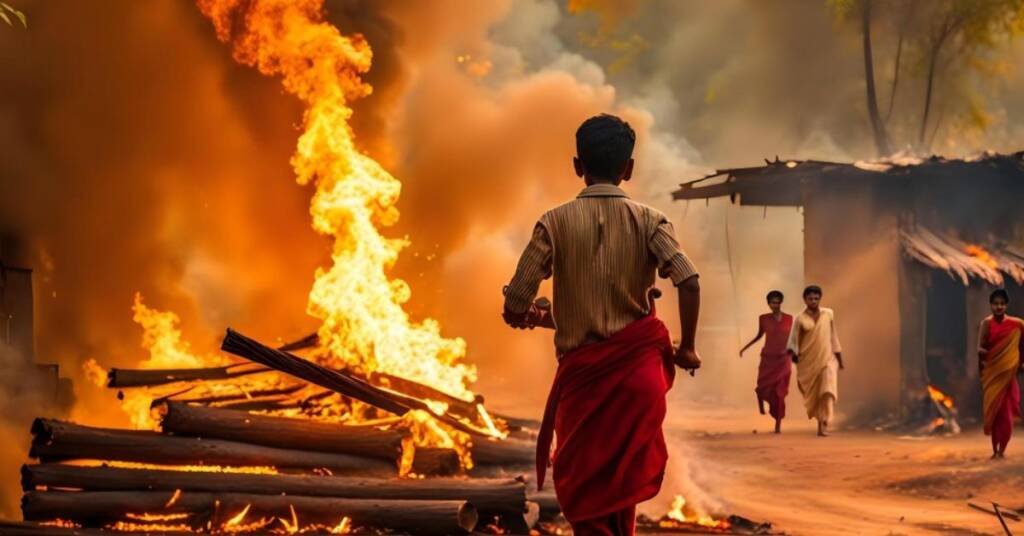
The burnt homes of Dalit women in Bengal are not isolated incidents. They are alarms.
- Charred houses
- Displaced families
- Women and children left defenceless
- Entire villages emptied through fear
- Dalits are suffering first because they are most vulnerable—not because they are alone.
What follows such neglect is predictable: the same indifference spreads to other Hindu sections.
- This is why the crisis must be understood not merely as a Dalit issue, but as a Hindu civil-rights issue.
2. From Dalit Marginalisation to Hindu Marginalisation
Across Bengal—and increasingly in other regions—Hindus from all social segments report similar experiences:
- Attacks on homes and livelihoods in Hindu localities
- Intimidation during religious festivals and processions
- Disruption of daily rituals and temple activities
- Delayed, diluted, or absent police response
Dalits, OBCs, tribals, and general-category Hindus face the same outcome when law and order is filtered through vote-bank considerations.
- This is not secular governance. This is selective application of the law.
3. Vote-Bank Politics and the Breakdown of Equal Protection
A hard truth must be addressed honestly:
- Preferential appeasement has reshaped governance priorities
- Illegal immigrants are regularised politically and converted into vote banks
- Repeat offenders feel insulated by electoral arithmetic
- Victims are discouraged from speaking up
In such an environment:
- Hindu grievances are dismissed as “inconvenient”
- Hindu self-protection is scrutinised more than criminal violence
- Law enforcement hesitates where firmness is constitutionally required
The result is lawlessness by design, not by accident.
4. One Pattern, Many Manifestations
- The burning of Dalit villages and the obstruction of Hindu festivals are not separate phenomena. They are expressions of the same administrative failure.
Common features include:
- Over-cautious policing driven by political pressure
- Failure to act preemptively despite intelligence inputs
- Delayed arrests and weak prosecution
- Normalisation of intimidation against Hindu religious life
Whether it is:
- A Dalit settlement being torched
- Durga Puja processions obstructed
- Ram Navami or Saraswati Puja targeted
The message conveyed on the ground is dangerous:
- Hindu life, property, and faith are treated as negotiable in the pursuit of power.
5. A Direct Violation of the Constitutional Promise
India’s Constitution guarantees:
- Equality before the law
- Freedom of religion and cultural practice
- Protection of life and property
When these rights are selectively enforced, governance ceases to be neutral.
- A state becomes unruly not by overt action, but by systematic omission.
Citizens receive an implicit message:
- Safety depends on political convenience
- Justice is conditional
- Silence is expected
This is not governance—it is constitutional betrayal.
6. This Is Not a Call for Conflict—It Is a Call for Law
This narrative must be understood clearly:
❌ Not a call for retaliation
❌ Not a call for hatred
❌ Not a call for extra-constitutional action
It is a call for:
- Firm, impartial enforcement of law
- Equal protection of all citizens
- Restoration of constitutional discipline
A democracy survives on justice, not appeasement.
7. An Urgent Constitutional Imperative: Legislature and Judiciary Must Act
- At this point, delay itself becomes dangerous.
- What began with Dalit Hindus now threatens the entire Hindu community.
- The situation demands immediate institutional intervention.
The Legislature must:
- Demand accountability from state governments
- Review failures of law and order
- Ensure that governance is not distorted by vote-bank compulsions
The Judiciary must:
- Take urgent cognisance of repeated failures to protect citizens
- Order time-bound, impartial investigations
- Direct deployment of forces where law and order has collapsed
- Enforce constitutional guarantees without fear or favour
Protecting Hindus through constitutional means is not communalism—
it is constitutionalism.
8. Hindus Must Demand Protection, Not Apology
Across caste, language, and region, Hindus must recognise:
- Silence has not delivered safety
- Appeasement has not produced peace
- Denial has not prevented violence
What is required is lawful, democratic assertion:
- Legal remedies through courts
- Institutional pressure via constitutional bodies
- Peaceful but firm civic mobilisation
Dalits, OBCs, tribals, and general-category Hindus are not separate victims
- They are one community experiencing unequal protection under political neglect.
9. The Question the Republic Must Answer
If:
- Dalit Hindus are burned today
- Other Hindus are intimidated tomorrow
- Festivals are disrupted next week
- And the state continues to look away
Then the question is unavoidable:
- How long can a democracy survive when one community’s safety depends on political convenience?
Injustice tolerated today becomes injustice normalised tomorrow.
Protecting Hindus Is Protecting Democracy
- This is not a Hindu-versus-anyone argument.
- It is a citizen-versus-state-failure argument.
A government that cannot—or will not—protect its Hindu citizens equally loses its moral and democratic legitimacy.
- The solution lies not in rage, but in law, unity, and constitutional resolve.
>Silence must end.
>Selective governance must be challenged.
>And justice must apply equally—or it ceases to be justice at all.
The time for decisive constitutional action is now.
🇮🇳 Jai Bharat, Vandematram 🇮🇳
Read our previous blogs 👉 Click here
Join us on Arattai 👉 Click here
👉Join Our Channels👈