From Partition to the Present: Broken Assurances, Appeasement, and the Need for Vigilant Citizenship
SECTION 1: Partition’s Broken Promise
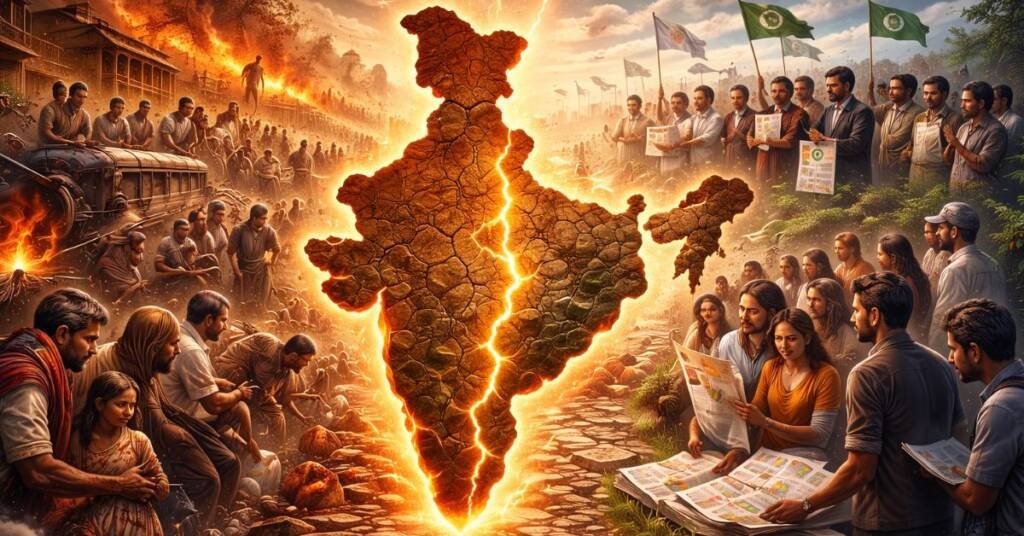
- The violence across Rawalpindi, Lahore, Sialkot, Multan, Noakhali, and Punjab was not random chaos—it was the collapse of trust built on assurances without protection.
- Communities that believed political promises were disarmed, isolated, and destroyed.
History delivered a harsh lesson: security cannot depend on words alone.
SECTION 2: The Two-Nation Theory and Its Contradictions
Partition was justified on the claim that Hindus and Muslims could not coexist, hence two nations. Yet after Partition:
- India retained a large Muslim population without enforcing truly equal laws and accountability.
- Hindus left in Pakistan faced continuous erosion of rights, largely ignored internationally.
India bore the humanitarian cost while political compromises reshaped internal balances.
SECTION 3: Congress, Assurances, and Appeasement
Post-Independence leadership offered repeated assurances of unity, but institutional protection for Hindus lagged. Critics argue Congress:
- Substituted security with symbolism,
- Practiced selective secularism,
- Used Muslims as a vote-bank, curtailing Hindu institutional rights.
This created a deep sense of betrayal—promises without accountability.
SECTION 4: Long-Term Cost of Vote-Bank Politics
Decades of appeasement allegedly resulted in:
- Hesitation to confront extremism,
- Unequal legal frameworks,
- Silence on persecution of Hindus in neighboring countries.
The outcome was polarization without protection.
SECTION 5: 2014—A Change in Approach
Since 2014, governance under Narendra Modi is seen by supporters as a correction:
- No appeasement, law above identity,
- Firm action against terrorism,
- Universal welfare and legal reforms,
- Cultural confidence within constitutional limits.
SECTION 6: External vs Internal Threats
- External threats are addressed by the government through military and diplomacy.
- Internal threats—radical networks, disinformation, and anti-national ecosystems—require active, lawful citizen participation.
A passive society weakens democracy from within.
SECTION 7: Dharma, Duty, and Law
Sanatana Dharma teaches ahimsa, not helplessness. The Bhagavad Gita emphasizes duty—resisting adharma through lawful and ethical means:
- Institutions, not mobs
- Justice, not vengeance
- Preparedness, not panic
Protecting Dharma today means protecting constitutional order and equal law.
Memory as Safeguard
- Remember Partition not to spread hatred, but to prevent repetition.
Assurances without action destroy societies.
The government can handle external enemies— only an alert, united citizenry can prevent internal decay.
🇮🇳 Jai Bharat, Vandematram 🇮🇳
Website: https://www.saveindia108.in
Email: info@saveindia108.com
Old Blogs: https://saveindia108.in/our-blog/
WhatsApp: https://tinyurl.com/4brywess
Arattai: https://tinyurl.com/mrhvj9vs
Telegram: https://t.me/+T2nsHyG7NA83Yzdl