Many people engage in superficial nationalism by repeatedly citing Nepal, Bangladesh, or Sri Lanka. But the real question is:
- Why was India strategically weak before 2014?
The Reality Before 2014
Politics during that period was driven by:
- Preserving personal and family-based power
- Vote-bank calculations over national interest
- Minority appeasement as a permanent strategy
- Import dependence and corruption treated as engines of growth
A strong, self-reliant India was inconvenient for such politics.
- As a result, national security and long-term strategic planning were sidelined.
Pearl String: China’s Encirclement and India’s Apathy
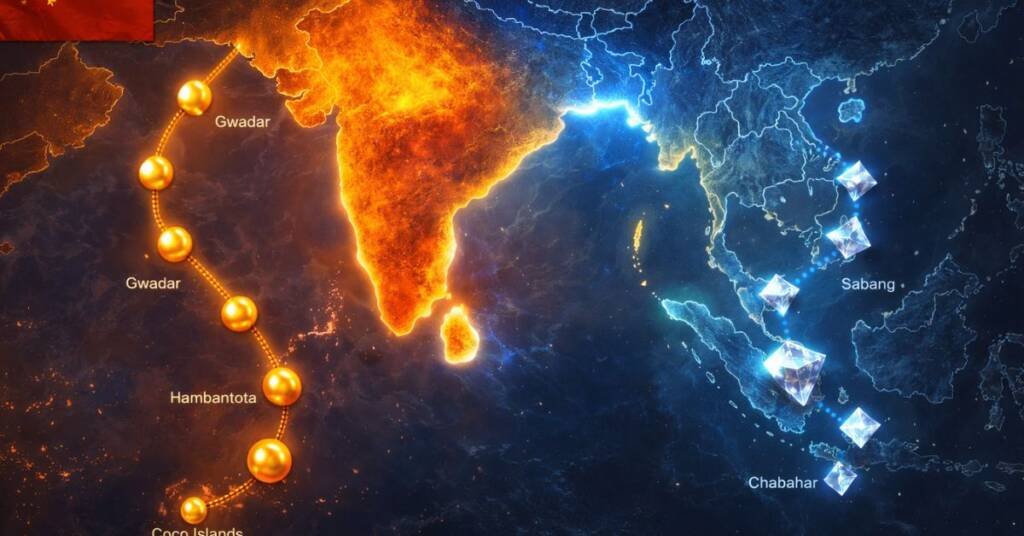
- China’s Pearls String Strategy was designed to encircle India in the Indian Ocean.
It consisted of ports that:
- Appeared commercial
- But functioned as military and surveillance hubs
Key “pearls” included:
- Coco Island (Myanmar) – 58 km from Andaman, used for surveillance
- Chittagong (Bangladesh) – pressure point in the Bay of Bengal
- Hambantota (Sri Lanka) – leased to China for 99 years
- Gwadar (Pakistan) – part of CPEC and a future naval base
This posed a serious threat, yet remained politically convenient for earlier governments because:
- Import dependence enabled corruption
- Instability helped retain power
The Post-2014 Shift: Diamond String Strategy
- After 2014, it wasn’t just the government that changed—India’s priorities changed.
Key shifts:
- Appeasement politics abandoned
- National interest placed at the centre
- Security and self-reliance prioritised
This led to the Diamond string Strategy, built on:
- Andaman–Nicobar Islands – leverage near the Malacca Strait
- Sabang Port (Indonesia) – control at Malacca’s other end
- Chabahar Port (Iran) – a counter to Gwadar
- Duqm Port (Oman) – Indian presence in the Arabian Sea
Along with:
- QUAD cooperation, and
- Strategic maritime partnership with France
India emerged as a decisive Indo-Pacific power.
Then vs Now
Then:
- Imports + corruption = power
- Appeasement = votes
- Weak India = political comfort
Now:
- Self-reliance = growth
- National interest = priority
- Strong India = global respect
The Pearl string was not just China’s strategy—it reflected India’s lack of political will at the time.
- The Diamond string is not merely maritime doctrine— it represents India’s transformed national consciousness.
Today, India:
- Does not merely react
- Shapes strategy
- Sets direction
And moves steadily toward becoming a Vishvguru.
🇮🇳 Jai Bharat, Vandematram 🇮🇳
Website: https://www.saveindia108.in
Email: info@saveindia108.com
Old Blogs: https://saveindia108.in/our-blog/
WhatsApp: https://tinyurl.com/4brywess
Arattai: https://tinyurl.com/mrhvj9vs
Telegram: https://t.me/+T2nsHyG7NA83Yzdl