Summary
- This narrative exposes the strategic marginalization of Sanatana identity through decades of institutionalized appeasement and the systematic suppression of Bharat’s civilizational roots.
- It highlights the symbolic and physical entrenchment of minority-first politics—exemplified by the mosque within Rashtrapati Bhavan—as evidence of a “Pseudo-Secular” power structure designed to favor specific vote banks.
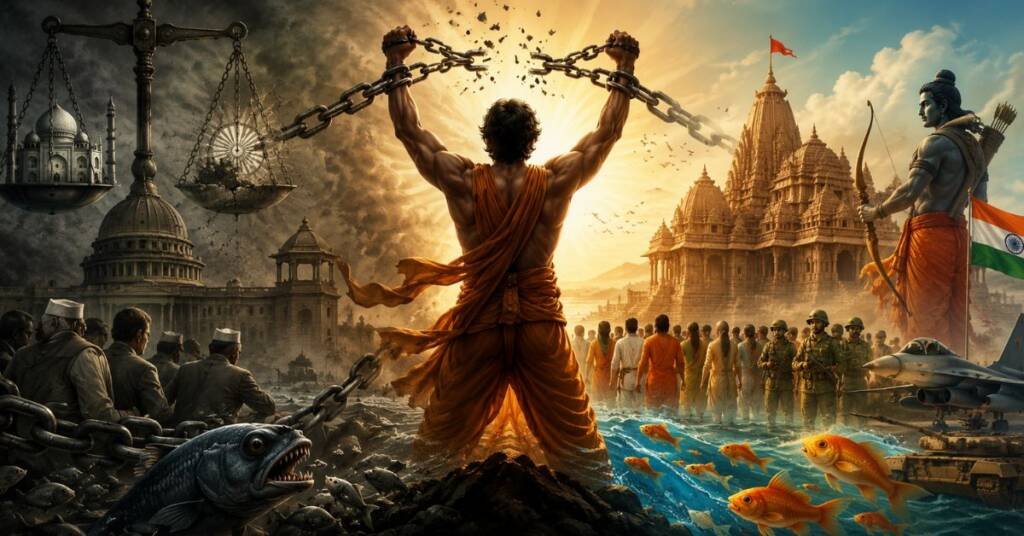
- The text warns of “Matsya Nyaya” (the law of the jungle), where a fragmented and demographically declining majority is consumed by organized aggression.
- Contrasting the legacy of the “Thugbandhan” era with the civilizational resurgence of the Modi era, it advocates for a synthesis of “Ram Neeti” (Governance and Restoration) and “Krishna Neeti” (Decisive Deterrence).
- The final appeal calls for the total dissolution of caste-based divisions to form a unified Sanatani force capable of protecting the nation’s sovereign and spiritual future.
1. The Architecture of Appeasement: The Mosque in Rashtrapati Bhavan
For decades, the highest constitutional seat in India was utilized to institutionalize a lopsided version of secularism that prioritized specific religious identities over the nation’s civilizational foundation.
- Territorial Assertion at the Zenith: The construction of a mosque within the Rashtrapati Bhavan complex—the official residence of the Head of State—stands as a permanent monument to institutionalized appeasement.
- The Zakir Husain Legacy: Established during the presidency of Dr. Zakir Husain, this act moved private religious identity into the permanent, taxpayer-funded fabric of a national landmark.
- The Asymmetry of Secularism: In a truly secular republic, national monuments should remain free of sectarian structures; the exclusivity of this mosque demonstrates that “Secularism” was used as a one-way street to favor a specific group.
- Symbolic Subjugation: Placing a mosque at the apex of Indian sovereignty sent a psychological message that the “Dharma of the Land” was secondary to the demands of a strategic minority.
2. The “Thugbandhan” Era: Systematic Marginalization of Sanatana
The era of Congress-led politics was defined by policies that sought to suppress Sanatana identity while empowering an anti-national ecosystem.
- The “First Claim” Doctrine: The ideological foundation was laid by the assertion that minorities had the “first claim” on the nation’s resources, codifying the marginalization of the majority.
- Legislative Sabotage: Laws like the Waqf Act were weaponized to allow religious bodies to claim vast tracts of land, effectively creating a “state within a state” protected by the government.
- The Places of Worship Act (1991): This legislation served as a legal “knife on the table,” freezing the civilizational claims of Hindus and preventing the restoration of desecrated holy sites.
- Fabricating Narratives: The ecosystem actively worked to demonize Hindus by inventing terms like “Saffron Terror,” while turning a blind eye to radicalism and physical threats posed to the majority community.
3. The Warning of “Matsya Nyaya”: The Law of the Jungle
A critical warning to the Sanatani society lies in the ancient concept of Matsya Nyaya—the law of the fish, where the big fish consumes the small fish in the absence of a strong, unified governing force.
- The Demographic Trap: Democracy is a game of numerical strength; when a society’s demographic weight dwindles, its culture, temples, and traditions are eventually consumed by more organized and growing groups.
- The Irrelevance of Passive Piety: As warned by Jain Muni Naypadmasagar Ji Maharaj, personal rituals like non-violence, vegetarianism, or religious fasting will not save a society if it loses its collective “strength” and “vote bank” power.
- Organized Aggression vs. Fragmented Goodness: Matsya Nyaya dictates that unorganized “goodness” is no match for organized “aggression”; a society divided by caste and sect becomes the “small fish” in the political ocean.
- The Threat to Dignity: If the Sanatani society remains fragmented, it faces a future where individuals will be forced to surrender their dignity and the safety of their families just to survive.
- Numerical Deterrence as Survival: Peace is not maintained by goodness alone, but by a demographic and strategic equilibrium that makes aggression unprofitable for the enemy.
4. The Psychological “Knife”: Fear as a Tool of Control
Under the guise of “peace,” previous political eras allowed an environment where symbolic and actual violence were used to keep the Sanatani society in a state of submission.
- The Silent Ultimatum: In the sociopolitical “dialogue” of the past, the aggressor often placed a metaphorical “knife on the table”—signaling that the price of Hindu disagreement was immediate violence.
- Virtual Terror: In the modern age, this has evolved into “Virtual Knives”—the viral dissemination of horrific acts to ensure Hindus self-censor out of fear.
- Institutional Silence: The state often stood as a silent spectator to these threats, allowing a chilling effect to settle over the majority’s expression and cultural pride.
5. The Modi Era: A Civilizational Resurgence
The transition to the current era marks a decisive break from the politics of “Tushtikaran” (appeasement) toward the restoration of Bharat’s sovereign and spiritual identity.
- De-colonizing the National Mind: The restoration of the Ram Mandir and the development of the Kashi Vishwanath Corridor signify that the state finally honors the 5,000-year-old identity of the land.
- Economic and Military Might: India’s rise to the world’s fourth-largest economy provides the “Kavach” (shield) necessary for cultural resurgence and global respect.
- The End of “First Claim” Politics: The era of specific religious groups having a “first claim” has been replaced by a framework of “Subka Saath, Subka Vikas,” where governance is based on merit and citizenship.
- Practical Sanatana: Sanatana is no longer a theoretical principle of “passive tolerance”; it is demonstrated through strength, infrastructure, and the global spread of Indian values.
6. The Synergy of Ram Neeti and Krishna Neeti
To secure the future against the anti-national ecosystem, the society must adopt a dual-strategy of progress and deterrence.
Ram Neeti (Governance and Cultural Restoration):
- Building a prosperous nation that honors its ancestors and restores its lost glory through grand institutional projects.
- Demonstrating the practical benefits of a Sanatana-aligned state through economic growth and social welfare.
Krishna Neeti (Deterrence and Decisive Action):
- Using the firm hand of the state (the “Yogi Model”) to dismantle criminal and extremist structures that terrorize the innocent.
- Establishing “Zero Tolerance” for those who attempt to “stab the knife on the table” or use symbolic violence to suppress the majority.
- Ensuring that “Adharma” is met with such force that aggression becomes an unthinkable option for the enemy.
7. The Way Forward: Absolute Unity Beyond Caste
The ultimate survival of Bharat depends on the total dissolution of internal fractures and the formation of an indomitable Sanatani force.
- Bury the Caste Divide: The enemy does not ask for your caste before placing the “knife on the table”; they only see a target for subjugation.
- Equipped with Shastra and Shaastra: A society must be intellectually grounded in its scriptures (Shaastra) while being physically and strategically equipped (Shastra) to deter threats.
- Rejecting “Hindu Foolishness”: The majority must stop mistaking passive submission for “tolerance” and embrace a muscular, practical Sanatana capable of total self-defense.
- Countering Matsya Nyaya: To avoid becoming the “small fish,” the society must achieve absolute organizational and demographic readiness.
The “Thugbandhan” era relied on institutionalized appeasement and the threat of Matsya Nyaya to win without fighting by keeping the Sanatani society fragmented.
- By embracing the resurgence of the current era and uniting as one indomitable force under the banners of Ram Neeti and Krishna Neeti, we can ensure that Bharat’s glory is never again sacrificed at the altar of vote-bank politics.
🇮🇳 Jai Bharat, Vandematram 🇮🇳
Read our previous blogs 👉 Click here
Join us on Arattai 👉 Click here
👉Join Our Channels👈