A comprehensive reflection on the role of the opposition, respect for public mandate, and the maturity of democracy
- Indian politics today stands at a critical juncture where leadership must be judged not by rhetoric or allegations alone, but by vision, responsibility, and commitment to national interest.
- The debate surrounding Rahul Gandhi—vision or controversy—is in reality a larger discussion about the role of the opposition, constructive criticism versus blind obstruction, taking domestic politics to international forums, and respecting the people’s mandate.
- This article examines these issues from a balanced, fact-based, and democratic perspective.
1️⃣ Background — Why This Debate Matters
- From social media to Parliament and even international platforms, one name dominates political discussions—Rahul Gandhi.
To supporters, he represents justice, equality, and compassionate politics; to critics, his politics appears increasingly opposition-centric and controversy-driven.
- This debate is not limited to one individual
- It reflects the direction, maturity, and responsibility of Indian politics
The core question: Is the opposition acting in national interest through a constructive role or just opposing blindly?
2️⃣ Clash of Ideologies — Policy vs Narrative
India is currently witnessing intense ideological competition:
- One stream emphasizes development, decisive governance, national security, and cultural identity
- The other prioritizes social justice, criticism of power, and inclusion
The key question is:
- Is criticism aimed at improving policies?
- Or has opposition been reduced to narrative-building for power alone?
3️⃣ Constructive Criticism vs Blind Opposition
- In a democracy, the opposition is indispensable—but its quality determines outcomes.
Constructive criticism means:
- Identifying policy gaps
- Proposing concrete amendments
- Presenting alternative roadmaps
Concerns of recent years:
- Ideological and blanket opposition to government policies and development plans
- Continuous roadblocks in Parliament, courts, and public discourse
- Resistance over reforms rather than engagement for improvement
Consequences:
- Unnecessary delays in reforms
- Slower policy execution
- National development energy consumed by political confrontation
➡️ Constructive criticism strengthens democracy; blind opposition weakens it.
4️⃣ Domestic Politics on International Platforms — Strategy or Self-Defeat?
- A sensitive issue is the opposition’s tendency to criticize the government and Indian institutions on international forums.
Risks involved:
- Negative portrayal of India’s image
- Damage to diplomatic standing
- Erosion of global investor confidence
Democratic dissent must be exercised:
- Within constitutional and domestic frameworks
- With national interest placed above political rivalry
➡️ Short-term headlines should not come at the cost of long-term national interest.
5️⃣ Civilization, Culture, and National Discourse
When politics engages with civilizational identity, culture, and national unity, its impact extends far beyond one government.
- These issues shape future generations
- They require responsibility, not political opportunism
- Leadership must balance critique with constitutional restraint and clarity
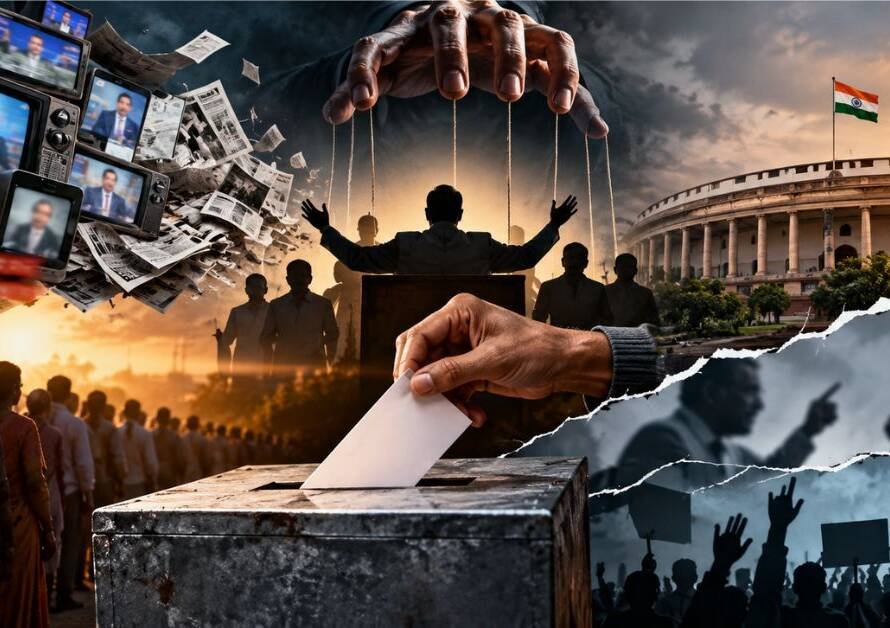
6️⃣ Respecting the Public Mandate — The Soul of Democracy
The foundation of democracy is the people’s verdict.
- Voters have repeatedly expressed their preferences through state and national elections
- Change was chosen where desired
- Stability and development were endorsed where preferred
A mature opposition is expected to:
- Accept the mandate gracefully
- Treat defeat as an opportunity for introspection
- Offer policy alternatives instead of constant accusations on social media and global platforms
➡️ The mandate may be uncomfortable, but it remains democracy’s final truth.
7️⃣ Vision or Controversy — The Measure of Leadership
Leadership must be evaluated:
- Not by slogans
- Not by emotional appeal
- But by vision, conduct, and accountability to national interest
This judgment is delivered not by parties—but by time and the people.
8️⃣ The Citizen’s Role — Not Spectators, but Participants
Democracy does not end with elections. It becomes stronger by
- Asking questions
- Verifying facts
- Participating in responsible discourse
- Rising above emotional manipulation
➡️ An informed and active citizenry is democracy’s greatest strength.
Responsibility Over Confrontation
India today needs an opposition that:
- Holds the government accountable
- Contributes to better policy outcomes
- Places national interest above political gain
Strong democracies are built not on perpetual confrontation,
but on responsible and constructive dialogue.
🇮🇳 Jai Bharat, Vandematram 🇮🇳
- Website:https://www.saveindia108.in
- Old Blogs: https://saveindia108.in/our-blog/
- Arattai: https://tinyurl.com/mrhvj9vs