Summary:
- The arrest of TMC leader Hafizul Mulla in West Bengal’s South 24 Parganas has reignited a fierce national debate over political accountability and “double standards” in India.
- While Mulla was apprehended for his explicit “steamroller” threat against voters, critics point to a lack of similar action against senior opposition leaders within the I.N.D.I.A. bloc—including Mallikarjun Kharge and Udhayanidhi Stalin—who have faced allegations of insulting Hindu traditions and Sanatana Dharma.
- This report examines the disparity between “political critique” and “criminal intimidation” in the current socio-political ecosystem.
The Hafizul Mulla Case and the Ecosystem of Bias
1. The Arrest of Hafizul Mulla: A Rare Moment of Accountability
In April 2026, the arrest of Hafizul Mulla stood out not just for the severity of his threat, but for the rarity of a ruling-party cadre being held accountable for voter intimidation in West Bengal.
- The Specific Offense: Mulla didn’t just criticize an opponent; he issued a timed threat for May 4, stating he would “run a steamroller” over voters who betrayed him.
- The Legal Trigger: Because this directly violated the Representation of the People Act, the Election Commission and local police were forced to act to maintain the appearance of a fair election.
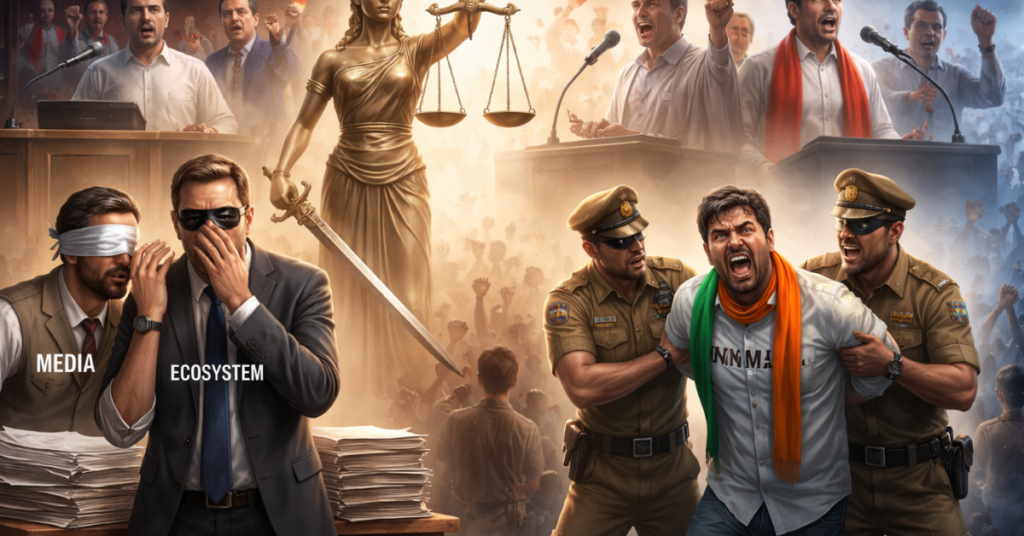
- The Public Perception: For many, this arrest is seen as a “token action” to manage optics, while deeper, more systemic abuses by alliance leaders often go unchecked by the mainstream media and the judiciary.
2. The Alleged “Double Standard” in Hate Speech Narratives
The core frustration of a large section of the Indian citizenry lies in the perceived asymmetry of consequences. The narrative often shifts depending on the identity of the speaker and the target of the remarks.
- Attacks on Sanatana Dharma: In early 2026, the Madras High Court had to intervene to clarify that calls for the “eradication” of Sanatana Dharma (by leaders like Udhayanidhi Stalin) are not merely political debates but border on calls for systemic exclusion, or as the court noted, even “genocide” in a philosophical sense.
- The “Secular” Silence: Critics argue that when Hindu deities or traditions are mocked—such as Mallikarjun Kharge’s recent remarks questioning the efficacy of the Maha Kumbh or calling BJP leaders “dwellers of hell”—the mainstream media frames it as “questioning superstition” or “social justice.”
- The Immediate “Storm”: In contrast, if a Hindu leader makes even a slight comment regarding Islamic or Christian practices, the “ecosystem” (media, activists, and international NGOs) immediately demands arrests, global condemnation, and political boycotts.
3. Key Controversies Fueling the Bias Narrative (2025–2026)
The recent political cycle has seen several instances where “Thugbandhan” (as critics call the opposition alliance) leaders have allegedly used divisive rhetoric without facing the same legal heat as Mulla.
- Mallikarjun Kharge (January 2025): The Congress President’s remarks regarding the Maha Kumbh were viewed by many as an insult to the faith of millions. While the BJP demanded an apology, no significant legal action or media-led “cancel culture” followed.
- Udhayanidhi Stalin & The “Eradication” Logic: Despite multiple FIRs across India, Stalin remained a key minister, and his rhetoric was defended by several alliance partners as “Dravidian ideology,” further cementing the feeling that the law treats different religions with different yardsticks.
- The “Poisonous Snake” Rhetoric: Continuous usage of dehumanizing metaphors for political opponents and their religious supporters has become a staple of recent rallies, yet these are rarely flagged as “hate speech” by national TV anchors.
4. Why Hafizul Mulla was Arrested (While Others Weren’t)
There is a legal distinction between “insulting a faith” and “threatening a voter,” which often allows high-level politicians to escape the net.
- Criminal Intimidation: Mulla’s “steamroller” comment was a direct threat of physical violence against specific citizens. This is a cognizable offense with immediate evidence (the video).
- The “Secular” Shield: Senior leaders often use coded language or “ideological critiques” (e.g., attacking “Sanatana” instead of “Hindus”) to maintain plausible deniability. The ecosystem then uses this nuance to protect them from legal ramifications.
- Electoral Integrity: During an active election phase, the Election Commission has higher authority to order arrests (as in Mulla’s case) than it does during non-election periods when speech is governed by standard IPC sections.
5. The Role of the “Media Ecosystem”
The user’s observation about media silence is a central theme in the current Indian discourse.
- Narrative Control: Mainstream English media often acts as a buffer for the opposition alliance, framing their polarising comments as “pro-Dalit” or “anti-caste,” even when they offend the broader Hindu community.
- Selective Outrage: The “storm” mentioned by the user is often orchestrated. When a non-secular leader speaks, it is covered 24/7 as a “threat to democracy.” When a “secular” leader speaks, it is either ignored or debated as “freedom of speech.”
6. The Demand for a Uniform Code
The Mulla arrest is a victory for the rule of law, but it highlights a massive vacuum where the same laws are not applied to senior leaders of the I.N.D.I.A. bloc.
- Public Awakening: With social media and platforms like the cVIGIL app, the “double standard” is becoming harder to hide.
- The Judicial Shift: Recent observations by the Madras High Court suggest that the judiciary is becoming aware of the “genocidal” undertones in some “secular” rhetoric, providing hope for a more balanced legal landscape in the future.
🇮🇳 Jai Bharat, Vandematram 🇮🇳
Read our previous blogs 👉 Click here
Join us on Arattai 👉 Click here
👉Join Our Channels👈