Summary:
- This comprehensive analysis uncovers the deeply suppressed history of the 1986 Delhi court case State vs. Indrasen Sharma.
- While mainstream historical discourse frequently highlights the Calcutta Quran Petition, this narrative delves into the lower judiciary’s profound examination of 24 specific Quranic verses.
- It details how Metropolitan Magistrate Z.S. Lohat investigated the ideological roots of communal violence, the absolute silence of the Islamic clergy when summoned to provide context, and the subsequent institutional media blackout designed to preserve a fragile, state-sponsored version of secularism and secure vote-bank politics.
A Trial Was Held on the Ideological Source of Violence
1. The Invisible Threshold of Judicial Scrutiny
- In the theater of Indian socio-politics, public discourse is meticulously policed by an ecosystem of mainstream media, political gatekeepers, and left-leaning intellectuals. For decades, the standard narrative surrounding communal disharmony has laid blame squarely on socio-economic disparities, political instigation, or Hindu nationalist groups.
- However, deep within the archives of the Indian judiciary lies a forgotten verdict that shattered this convention by looking past the symptoms of violence and targeting its ideological source.
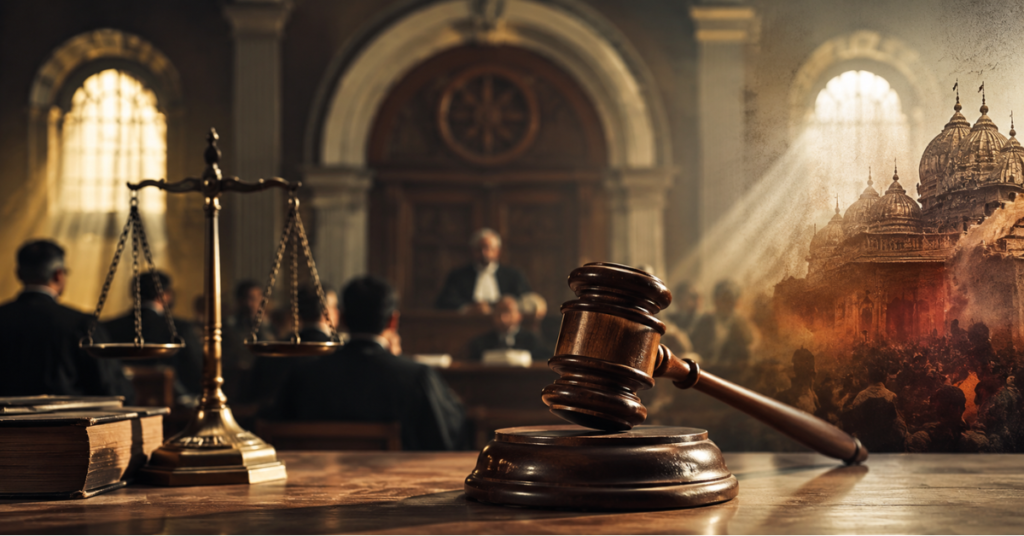
- Key Takeaway: On July 31, 1986, a small courtroom in Delhi became the epicenter of a profound theological and legal debate. Metropolitan Magistrate Z.S. Lohat delivered a judgment that fundamentally questioned the absolute immunity granted to religious texts under the guise of secular protection.
- This case, largely erased from public memory, remains one of the most daring moments in judicial history—where a court sought to determine whether a holy text could legally double as a manual for civil unrest.
2. The Genesis: The Poster, the Riots, and the State’s Crackdown
The conflict began in the highly volatile socio-political climate of the mid-1980s. Indrasen Sharma, a representative of the Hindu Raksha Dal, alongside Secretary Rajkumar Arya, published and distributed a highly provocative poster across Delhi.
- The Core Question: The poster did not rely on standard political rhetoric. Instead, it explicitly asked why Hindu-Muslim riots were a recurring feature of the Indian subcontinent. To answer its own question, the poster printed 24 specific verses from the Quran, asserting that these literal commands were the direct ideological drivers of communal hatred.
- The Violent Backlash: The public display of these verses triggered immediate outrage within Islamic organizations. The tension rapidly escalated into localized violence and rioting, prompting the state machinery to step in.
- The Legal Weaponization: Rather than addressing the theological questions raised, the state government moved to suppress the publishers. Indrasen Sharma and Rajkumar Arya were arrested and charged under Sections 153A and 295A of the Indian Penal Code (IPC). These sections penalize promoting enmity between different groups and committing deliberate, malicious acts intended to outrage religious feelings.
- The Prosecution’s Stance: The government’s legal team argued fiercely that the poster was a malicious fabrication, claiming either that no such violent verses existed in the authentic Quran or that they were being deliberately distorted to incite hatred against the minority community.
3. The Trial: Uncompromising Evidence and the Silence of the Clergy
When the case reached the courtroom of Judge Z.S. Lohat, the defense adopted a highly unconventional and rigorous strategy. Instead of backing down or apologizing, they chose to prove their claims using standard, recognized Islamic literature.
- The Definitive Evidence: The defense produced an authentic, widely distributed Hindi translation of the Quran compiled by Muhammad Farooq Khan from the Makhtaba-al-Hasnam in Rampur, Uttar Pradesh. This text featured the original Arabic verses alongside literal, word-for-word translations in Hindi and English.
- Verification by the Court: Judge Lohat painstakingly cross-referenced the 24 verses displayed on the controversial poster with the official text provided by Farooq Khan. The court found that the verses were not fabricated; they were perfectly accurate, literal translations of the Islamic scripture.
- The Judicial Summons: Recognizing the gravity of the situation, Judge Lohat extended an extraordinary opportunity to the Islamic leadership. He issued formal summons to numerous Mullahs, Maulvis, and prominent Islamic scholars from Delhi and Uttar Pradesh. The court requested them to take the stand, provide context, and offer an alternative, peaceful interpretation (Tafsir) that could legally defuse the literal interpretation presented by the defense.
The Flight from the Courtroom: In a stunning turn of events, not a single Islamic scholar or cleric appeared in court to defend the text. Rather than engaging in a legal and theological defense, the religious leadership attempted to use back-channel political pressure on the administration to have the case summarily dismissed or transferred.
4. The “Lohat Judgment” (July 31, 1986): A Direct Verdict
- Faced with an evidentiary vacuum from the prosecution and the complete absence of Islamic scholars, Judge Lohat conducted his own exhaustive review. He studied multiple historical English and Arabic commentaries, and evaluated British-era precedents—most notably the historic Lahore High Court proceedings regarding the book Rangeela Rasool.
- On July 31, 1986, Judge Lohat delivered his final judgment, fully acquitting Indrasen Sharma and Rajkumar Arya. The text of his ruling contained an indictment of the ideological material under review:
- The Court’s Observations: The judge noted that a close reading of the 24 specific verses revealed clear commands that, on the face of it, encouraged hatred, enmity, intolerance, and violence against non-believers.
- The Verdict on Violence: The court explicitly stated that because these verses command followers to wage war against other faiths, they serve as a primary catalyst for riots not only in India but across the globe.
- The Fundamental Question: In a moment of unprecedented judicial candor, the verdict raised the question of how a text containing such rigid, uncompromising, and hostile commands against non-Muslims could be universally categorized as a book of peace or a direct message from God.
5. Anatomy of the 24 Verses: The Literal Commands
To understand why the court arrived at this conclusion, it is necessary to examine the specific scriptural citations that Judge Lohat entered into the judicial record. The court highlighted verses that explicitly mandated hostility toward non-believers:
- Surah 9, Verse 5 (The Sword Verse): “Kill the idolaters wherever you find them, and take them captives, and besiege them, and lie in wait for them in every ambush.”
- Surah 9, Verse 28: Labeling non-believers and polytheists as inherently “filthy” or unclean, thereby creating a permanent social barrier between communities.
- Surah 9, Verse 29: Directing believers to fight those who do not believe in Allah or the Last Day, including Christians and Jews, until they pay the Jizyah (tax) with willing submission and feel themselves thoroughly subdued.
- Surah 9, Verse 123: “O you who believe! Fight those of the disbelievers who are near to you, and let them find hardness in you.”
- Surah 21, Verse 98: Explicitly declaring that idolators and the statues they worship are nothing but the “fuel of Hell.”
- Surah 33, Verse 61: Commanding that non-believers be treated as accursed, stating that wherever they are found, they should be seized and “slaughtered with a fierce slaughter.”
The court concluded that while these represented only 24 selected verses, the text contained numerous other passages of a similar nature that actively barred peaceful coexistence with non-Muslims.
6. The Mechanics of the Institutional Blackout
The most extraordinary aspect of the 1986 Lohat judgment is not just what happened inside the courtroom, but what happened outside it immediately afterward. In any standard democracy, a judicial ruling that links a major religious text to global communal violence would be front-page news. Instead, it was met with total silence.
- The Left-Congress Ecosystem: During the mid-1980s, the Rajiv Gandhi administration was heavily invested in minoritarian appeasement politics—symbolized perfectly by the legislative overturning of the Shah Bano Supreme Court judgment that same year. Acknowledging the Lohat verdict would have completely shattered the carefully curated facade of secularism that kept the Congress party’s vote-bank intact.
- Media Gatekeeping: In the pre-digital era, information was strictly controlled by a few elite editors who operated hand-in-hand with the political establishment. The mainstream media voluntarily enacted a total blackout of the case. By refusing to print or discuss the verdict, they successfully buried a certified legal precedent.
- The Double Standard Exposed: This case perfectly highlights the hypocrisy of the intellectual class. While Hindu traditions, literature, and organizations are routinely subjected to intense scrutiny, deconstruction, and legal action for “intolerance,” a judicial verdict pointing out the actual scriptural roots of communal riots was hidden away in the shadows to protect the image of Islam.
The Enduring Legacy of an Uncomfortable Truth
- The 1986 judgment by Metropolitan Magistrate Z.S. Lohat remains a vital, yet hidden, monument in the landscape of Indian jurisprudence. It stands as a testament to a brief moment when an ordinary judge refused to bow to political correctness and instead prioritized the secular laws of the land over the sensitivities of religious dogmatism.
- For contemporary patriots and defenders of indigenous Indian civilization, this case serves as an invaluable intellectual weapon. It exposes the historical reality that the conflict plaguing the Indian subcontinent is not a product of modern political polarization, but is rooted deeply in historical texts that have never been reformed or reconciled with modern democratic values.
- Until the intellectual elite and the media display the honesty to confront these hidden truths, the cycle of conflict will remain unbroken.
🇮🇳Jai Bharat, Vandematram 🇮🇳
Read our previous blogs 👉 Click here
Join us on Arattai 👉 Click here
👉Join Our Channels👈