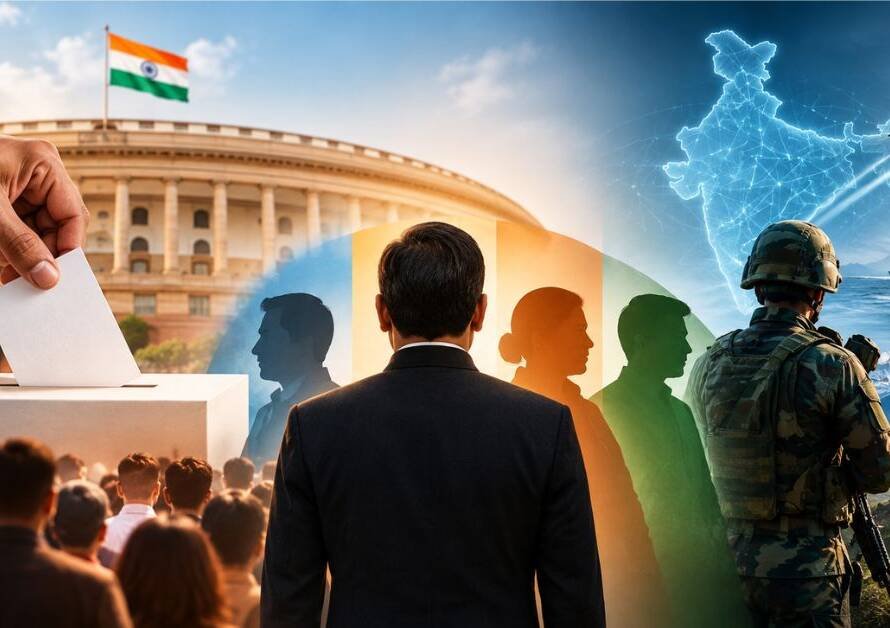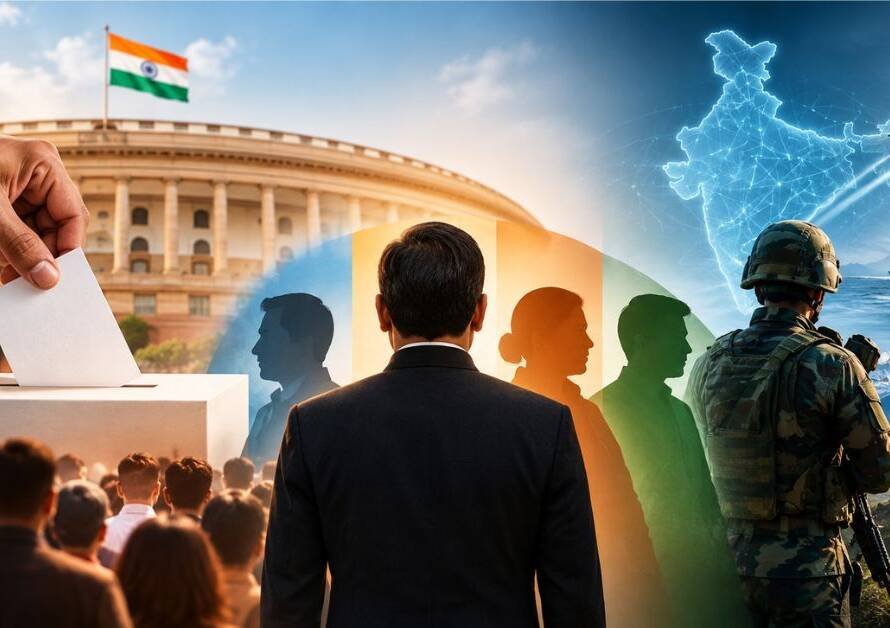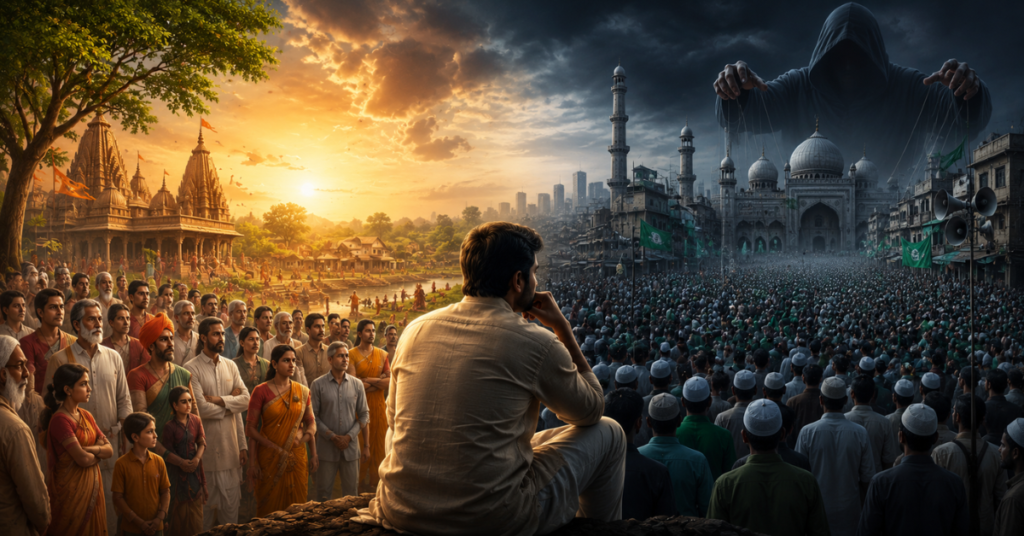
Summary:
- This extensive and deeply philosophical narrative provides a point-by-point analysis of the current mental and social state of Indian society—specifically its 900-million-strong majority population.
- The piece unmasks the bitter truth of how a vast community has turned into passive spectators, mistakenly believing that material wealth, luxury cars, and high bank balances serve as shields against systemic vulnerabilities.
- It decodes the brutal mathematical principle of democracy, where ideological “quality” is consistently overridden by organized “quantity.”
- Striking hard at the demographic imbalances born from the selective adherence to family planning advertisements, the escapist mindset of the middle class, and the hollow nature of digital nationalism, this narrative issues a powerful call to adopt Dr. Kalam’s “culture of contribution” and organize society effectively on the ground.
The Ideological Defeat of Indian Society
1. The Pseudo-Shield of Protection: The Crisis of Over-Dependence on the ‘State’
The greatest contemporary challenge facing Indian society is that it has outsourced the entire responsibility of its security, identity, and future to the “system” and the “leadership.” This mental subservience is the very first step toward the decline of any living civilization.
- The Illusion of Institutional Reliance: An average citizen rests easy, assuming that:
“The police are deployed round-the-clock to ensure my safety.”
“The army protects our borders, so why should I worry about internal fronts?”
“Strong leaders are sitting at the helm; they will handle everything.”
- The Lack of Civic Backbone: History bears witness that empires and nations are kept secure not merely by the valor of rulers, but by the intellectual and physical backbone of ordinary citizens. When a citizen reduces themselves to a mere “consumer” and views the government as a “service provider,” the collective resistance of society vanishes.
- The Self-Destructive Psychology of Helplessness: If every single individual within a population of 900 million feels isolated, helpless, and fearful, the flaw lies not in the law books but in a mindset that has fractured society into castes, sub-castes, and personal self-interests, completely breaking its collective spine.
2. The Escapism of the Middle and Upper Classes: The Comfortable Life of the ‘Audience Gallery’
Today’s educated, tax-paying, and air-conditioned middle-to-upper class has completely disconnected itself from the real struggles of the nation. They have reduced democracy to a Roman Colosseum where they function merely as spectators—good only for clapping or jeering.
- The Exit-Route Mindset: A fixed life-cycle has been established for this segment:
> Grooming children from childhood so they can leave the country to settle in the US, Canada, or Europe.
> Treating India merely as a “rental property” or an investment avenue to extract wealth, while refusing to invest any personal effort into its social fabric.
- “Why Doesn’t Someone Do Something?”: Whenever a crisis strikes the nation, culture, or local community, this very class sits in their drawing rooms, sipping tea, and cursing the system. Their patriotism dies a quiet death at the phrase “Someone should do something,” but they never include themselves in that definition of “someone.”
- The Emptiness of Expensive Fortresses: A massive chunk of society mistakes its BMWs, Audis, and the high gates of posh residential societies for their ultimate defense. They forget that when social and demographic balances tip, these concrete palaces and security guards are the first to fail. Without the organized strength of society, personal wealth remains nothing more than a temporary illusion.
3. The Brutal Math of Democracy: The Principle of ‘Quality’ vs. ‘Quantity’
We live within a democratic architecture that is entirely unaffected by emotions, historical glory, or intellectual brilliance. Democracy is strictly a game of headcount, and the rules of this game are utterly ruthless.
- The Truth of Vote Equality: In the democratic weighing scale, your wisdom, the crores you pay in taxes, or your social prestige carry absolutely no extra weight.
The vote of the nation’s greatest scientist, industrialist, or intellectual is worth exactly.
The vote of a person fixing punctures on the roadside, someone who is uneducated, or an individual entirely dependent on state welfare is also worth exactly.
- Numerical Strength is Sovereign: Laws in parliaments and assemblies are not made based on who is more educated; they are forged based on who commands the larger, more organized vote bank. A society that fails to understand this mathematics inevitably loses its right to influence policy.
- Ideological Defeat: When one class, blinded by the arrogance of its intellectual superiority, treats election day as a holiday for a picnic, while another community stands patiently in long queues under the blazing sun to register 100% voting, the latter wins the government that serves its interests. Crying later that “nobody listens to us” is nothing short of foolishness.
4. Demographic Imbalance: The Selective Adherence to Advertisements
The most sensitive and critical aspect of this narrative is the demographic policy, which one community embraced to its own shrinking detriment while another converted it into its greatest strategic asset.
- The Trap of “Hum Do, Humare Do”: The government slogan of the seventies and eighties (“We two, our two”) was accepted with absolute sincerity by a specific majority community in India as the ultimate benchmark of patriotism, modernity, and good parenting. Consequently, they shrunk and limited their families.
- Strategic Disregard of the Rules: Conversely, another community in the country treated these policies as mere paper advertisements and completely rejected them based on their social and religious beliefs. They viewed and expanded their population as a strategic asset.
- The Outcome and the Complaint: Today, the demographic equilibrium has completely shifted in numerous regions. Now, the very community that voluntarily limited its numbers complains that its political leverage is eroding and its cultural identity is under threat. In a democracy, when you voluntarily reduce your “quantity,” your “voice” is bound to weaken.
5. The Pseudo-Nationalism of Social Media: Mindset Revolution vs. Digital Effervescence
In the modern era, nationalism and social consciousness have found a new epicenter: the smartphone screen. However, rather than genuinely awakening society, this medium is providing a false sense of accomplishment.
- The Illusion of Digital Martyrdom: People write a fiery post on Facebook, run a trend on X (formerly Twitter), or forward a patriotic message on WhatsApp, and instantly believe they have fulfilled their duty toward the nation. This is called slacktivism—where the actual physical effort is zero, but the mental gratification is absolute.
- Short-Lived Rage: A tragic or infuriating event generates massive outrage on social media for about two days, trends peak, and by the third day, society moves on, completely absorbed in a new meme or entertainment trend. Systems and policies do not change through such superficial, short-lived outrage.
- Ground-Level Zero: Until this digital effervescence translates into an organized, disciplined, and conscious social movement on the ground, it remains nothing more than ideological entertainment. Real change demands footsteps on the ground, not just fingertips on a keyboard.
6. Kalam’s Vision: From the Politics of Complaints to a Culture of Contribution
The path out of this ideological darkness is found in the life philosophy of India’s most beloved President and scientist, Dr. A.P.J. Abdul Kalam. He constantly held a mirror up to society.
- The End of a Complaining Society: Dr. Kalam often noted that we have become a society that blames everyone else for every minor or major flaw. Our government is bad, our municipality doesn’t pick up trash, our roads are broken—but what are we doing about it individually?
- The Principle of Contribution: Dr. Kalam taught that great nations are not built on the foundation of complaints, but through the individual and collective contributions of their citizens. Whether you are a doctor, engineer, businessman, or teacher—are you practicing your profession with absolute honesty while empowering the last person in society?
- The Revolution of Mindset: The country will not change until we revolutionize our internal thinking. We must transcend the “What can I get?” mindset and firmly adopt the core philosophy of “What can I give to my nation?”
The Final Warning and Time for Introspection
This population of 900 million stands at a critical crossroads where its own apathy has become its greatest adversary. History proves that societies that left their security entirely to mercenaries or governments, and became intellectually lazy amidst their growing material prosperity, vanished entirely from the pages of time.
- The Price of Remaining a Spectator: If you continue to sit in the audience gallery simply clapping at the chaos, remember that future generations will pay an incredibly heavy price for your cowardly silence and indifference.
- A Call to Awaken: The time has come to rise above caste fragmentations, recognize your demographic and social strength, and step into the arena—not just as passive taxpayers, but as the active architects of the nation’s destiny.
- Straighten your spine and strongly support the nationalist government as history remembers only the victors and those who fought, not the ones who remained silent spectators on a comfortable couch.
🇮🇳Jai Bharat, Vandematram 🇮🇳
Read our previous blogs 👉 Click here
Join us on Arattai 👉 Click here
👉Join Our Channels👈