Summary
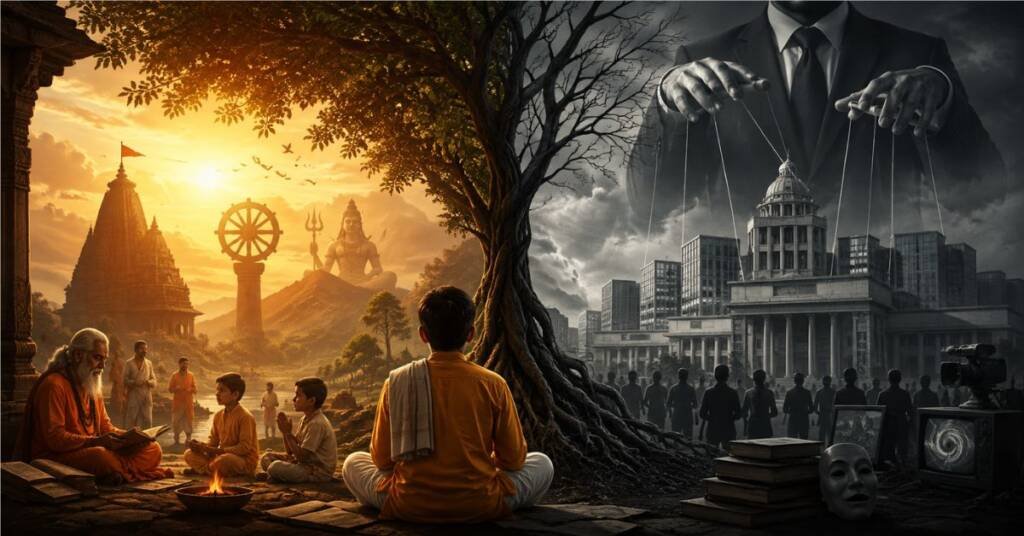
- Sanatana Dharma is not merely a collection of religious beliefs, but an eternal way of life based on millennia of spiritual experience, scriptural wisdom, and a scientific outlook.
- In the modern era, the greatest threat facing this ancient culture comes less from external invasions and more from internal ideological syncretism and the aggressive proliferation of non-scriptural sects. Over the past few decades, a well-organized and heavily funded effort has emerged to bypass traditional deity worship and scriptural mandates in order to accord divine status to modern human figures.
- This detailed analysis examines the erosion of Sanatana beliefs, the rise of self-proclaimed ‘Gods’, the supremacy of the Vedas and Upanishads, the financial disparities of modern institutions, and actionable strategies to restore cultural and spiritual purity.
A Detailed Analysis from Cultural, Spiritual, and Historical Perspectives
1. Scriptural Mandates vs. The Crisis of Modern Personality Cults
The foundation of Sanatana Dharma does not rest on the personal opinions of any individual, but on the unauthored (Apaurusheya) authority of the Vedas, Upanishads, Darshanas, and Puranas. In the Sanatana tradition, ‘Divinity’ is not determined by public consensus or aggressive marketing, but is strictly defined by scriptural authority.
- Strict Conditions for Divinity and Incarnations:
- The scriptures explicitly outline the attributes, era, lineage, and cosmic purpose for divine incarnations (such as Shri Rama or Shri Krishna). Declaring a modern human figure as “God”—regardless of their social or spiritual conduct—without scriptural validation is a direct violation of Sanatana principles.
- Mantra-Syncretism and Cultural Confusion:
- Traditional Vedic and Puranic mantras—such as ‘Om Namah Shivaya’ or ‘Shri Ram Jai Ram Jai Jai Ram’—possess specific sound vibrations (acoustics) and spiritual resonance. Prefixing or suffixing modern human names to these ancient mantras (e.g., ‘Om Sai Ram’) violates the principles of Mantra-Shastra and dilutes their spiritual potency.
- Symbolic Demotion of Traditional Deities:
- A concerning trend in several regions is the placement of eternal deities—such as Shri Hanuman, Shri Rama, or Bhagwan Shiva—at a subordinate level or at the feet of modern sect figures as ‘servants’. This systematically weakens the devotion of the Sanatana mind toward its true Ishta-Devatas (cherished deities).
2. The Threat of Self-Proclaimed ‘Gods’ and Anti-Scriptural Sects
In contemporary India, numerous organizations, maths, ashrams, and new sects have emerged whose founders presume to declare themselves as God, divine incarnations, or almighty beings, misleading trusting devotees.
- Direct Disregard for the Vedas and Upanishads:
- These self-proclaimed gurus and modern sect leaders neither study nor follow the supreme authoritative texts of Sanatana Dharma—the Vedas and Upanishads. Instead, they fabricate convenient personal theories that stand in direct opposition to the core philosophy of Sanatana Dharma (Karma, Reincarnation, Moksha, and scriptural worship).
- The Mark of a True Saint: ‘Servant of God’, Not ‘God Himself’:
- In the Sanatana tradition, true saints, acharyas, and sages have always been identified by their humility, exclusive devotion to the Divine, and adherence to scriptures. India’s greatest saints (such as Jagadguru Adi Shankaracharya, Swami Ramanujacharya, Goswami Tulsidas, Surdas, Chaitanya Mahaprabhu, or the Alwar and Nayanmar saints of the South) never claimed to be God. They consistently maintained the attitude of a ‘servant of God’ (Daas-Bhava), dedicating their lives to serving humanity and spreading the Divine Name.
- A Serious Warning for Sanatana Society:
- If any individual, institution, or guru rejects the authority of the Vedas and Upanishads, invents their own doctrines, and claims to be ‘God’, Sanatana society must exercise extreme vigilance. Rejecting the blind followership of such self-proclaimed incarnations is the first rule in safeguarding Sanatana heritage.
3. Historical Evidence and Absence in Classical Literature
The impact of any genuine spiritual movement is inevitably reflected in the literature of its era and subsequent generations. An objective review of India’s historical and literary landscape reveals an essential truth:
- Silence of Renaissance Leaders:
- The writings and speeches of key figures from India’s renaissance and spiritual revival—such as Swami Vivekananda, Maharshi Dayananda Saraswati, Swami Shraddhanand, Veer Savarkar, Lokmanya Tilak, Netaji Subhash Chandra Bose, and Mahatma Gandhi—contain no recognition of these modern sect practices as part of Sanatana Dharma.
- Absence in Iconic Literary Works:
- The works of celebrated modern Indian literary figures—such as Munshi Premchand, Suryakant Tripathi ‘Nirala’, Ramdhari Singh ‘Dinkar’, Jaishankar Prasad, Bharatendu Harishchandra, and Mahadevi Verma—extensively detail Sanatana values and the traditions of Rama and Krishna, yet make no mention of these modern sect figures.
- Manufactured History and Propaganda Networks:
- Elevating a modern figure above or alongside millennia-old Sanatana traditions in a short span of 40 to 50 years demonstrates that this phenomenon is not an organic evolution of faith, but the output of an organized, aggressive propaganda network.
4. Institutional Influence, Financial Disparities, and Encroachment Mechanisms
The administrative and financial structures of these modern sect institutions play a major role in weakening the traditional fabric of Sanatana society.
- Financial Disparities Between Traditional and Modern Institutions:
- Thousands of ancient, historic, and scripturally aligned temples across India suffer from a lack of financial resources, state takeover, and maintenance neglect. In contrast, institutions linked to modern sects have accumulated vast wealth, landholdings, and sprawling complexes in a remarkably short time.
- Unaccounted Funds and Foreign Financing:
- Social and religious analysts frequently question the origins of the vast, anonymous donations and foreign funding flowing into these modern institutions. In the absence of transparent auditing, concerns grow that these resources are utilized to penetrate traditional Sanatana centers and build a parallel religious ecosystem.
- Cultural and Geographic Encroachment:
- Installing modern statues inside or near traditional temple premises alters the original Sanatana identity of those spaces. Over time, traditional devotional music is replaced by adapted songs that portray modern figures as superior to eternal deities.
5. Colonial Legacy and Alienation from Vedic Roots
The spread of ideological confusion and blind faith in Indian society is not accidental; it stems from historical and educational disruption:
- Destructive Impact of Macaulay’s Education System:
- The primary objective of the education system introduced by Lord Macaulay was to alienate Indians from their culture, the Sanskrit language, and the study of the Vedas. This resulted in generations disconnected from their foundational spiritual traditions.
- Distortions by Western Translators:
- Western commentators like Max Müller presented distorted interpretations of Indian texts to suit external narratives, instilling a sense of inferiority within the Sanatana psyche regarding its own heritage.
- Exploitation of Scriptural Ignorance:
- When a society stops studying its core scriptures (Bhagavad Gita, Upanishads, Ramayana), it becomes vulnerable to synthetic sects, personality cults, and misleading narratives, as it loses the ability to distinguish between genuine Sanatana Dharma and artificial sects.
6. Actionable Steps for Cultural Awakening and Purity
To preserve the authenticity, ancient purity, and cultural dignity of Sanatana Dharma, the Sanatana community should consider the following measures:
- Restoration of Scriptural Worship Practices: Ensure that worship practices, mantras, and iconography in homes and local temples strictly adhere to those validated by the Vedas, Upanishads, and authentic scriptures.
- Discerning Genuine Gurus from False Cults: Always remember that the Vedas and Upanishads are the ultimate authority. Reject any individual who claims to be ‘God’, and revere only those who act as humble ‘servants’ of the Divine, guiding society according to scriptural truth.
- Promoting Sanskrit and Vedic Education: Introduce children and youth to the foundational teachings of the Ramayana, Bhagavad Gita, and Upanishads to develop spiritual discernment and protect them from deceptive narratives or self-proclaimed ‘Gods’.
- Support for Traditional Sanatana Temples: Direct financial support, donations, and voluntary service toward local, ancient, and scripturally aligned temples, gurukuls, gaushalas, and traditional acharyas.
- Constructive Social Dialogue: Foster clear, respectful, and firm conversations within families and communities to distinguish true devotion (Bhakti) from blind followership (Andhbhakti).
Returning to civilizational roots, upholding the supremacy of the Vedas and Upanishads, maintaining unwavering devotion to eternal deities (Rama, Krishna, Shiva, Durga), and constructively countering non-scriptural practices remain the key pathways to protecting and revitalizing Sanatana Dharma.
🇮🇳 Jai Bharat, Vandematram 🇮🇳
Read our previous blogs 👉 Click here
Join us on Arattai 👉 Click here
👉Join Our Channels👈