Executive Summary
- This comprehensive macroeconomic report focuses on India’s economic sovereignty and the primary drivers of its trade deficit.
- Amid ongoing global conflicts and supply chain disruptions, this analysis highlights how excessive expenditure on gold, crude oil, gas, foreign consumer goods, and international travel impacts the nation’s foreign exchange reserves.
- Explaining the economic principle of “Demand-Side Management,” the report contextualizes the Prime Minister’s call for strategic restraint among citizens to prevent artificial market panic or hoarding, ultimately steering the nation toward self-reliance.
A Macroeconomic Analysis of Civic Consciousness (2026)
I. The Trade Deficit: A Fundamental Challenge to the Indian Economy
The trade deficit serves as a mirror reflecting an economy’s reliance on imports. In simple terms, when a nation spends more on purchasing goods and services from abroad (imports) than it earns from selling its own globally (exports), it enters a trade deficit.
- Capital Outflow (The Dollar Drain): Since the vast majority of international trade is settled in US Dollars (USD), rising imports lead to a direct outflow of valuable foreign currency from the domestic economy.
- The Massive Burden of Gold Imports: India remains the world’s second-largest consumer of gold. According to official data for the fiscal year 2025-26, India imported a staggering 721 tonnes of gold.
- Daily Financial Drain: The total value of this imported gold reached approximately ₹6,11,830 crore. Statistically, this means India sends an average of ₹1,676 crore out of the country every single day just to fulfill its appetite for gold.
- Steep Annual Growth: Gold imports escalated from $58 billion in the previous fiscal year to approximately $72 billion in 2025-26. This sharp 24% increase has significantly widened the trade deficit gap.
II. Foreign Exchange Reserves: The Economic Immune System
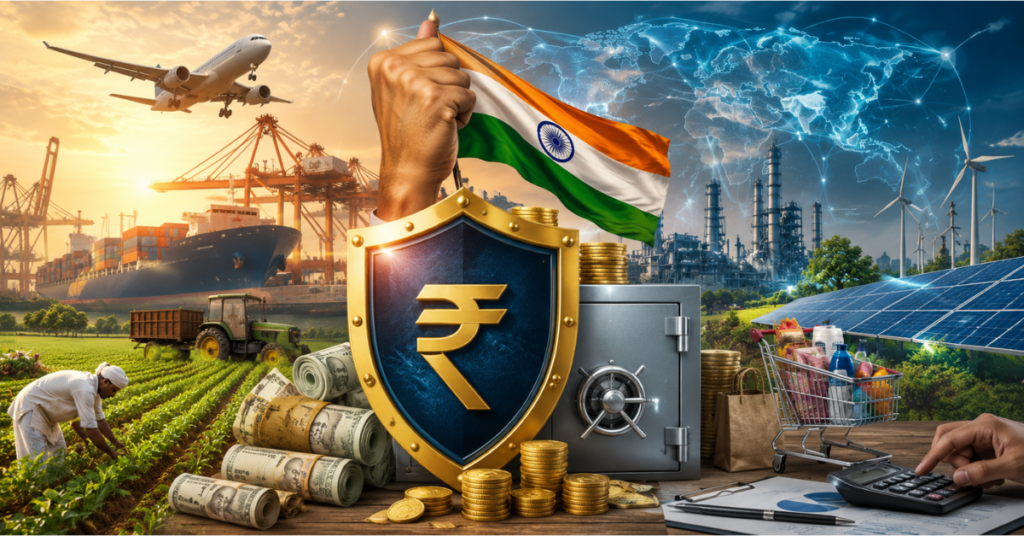
A nation’s foreign exchange reserves represent its ultimate shield for economic stability and sovereign defense. In macroeconomic terms, these reserves function like the economy’s white blood cells, protecting it against external shocks.
Guarding the Rupee
- A robust foreign exchange fortress prevents the sharp depreciation of the Indian Rupee (INR) in international markets. Keeping the currency stable directly curbs Imported Inflation, ensuring everyday commodities remain affordable in the domestic market.
Recent Depletion in Reserves
- According to data from Trading Economics, India’s foreign exchange reserves crested at a historic peak of $728 billion in February 2026.
The Two-Month Crisis
- Driven by global economic uncertainties and heavy import pressures, reserves experienced a swift drawdown of roughly $38 billion by April 2026, settling back to $690 billion.
A Direct Cause-and-Effect Relationship
- This $38 billion dip within a two-month window directly correlates with the $72 billion annualized gold import bill. The dollars drawn from the market to buy non-productive gold directly contracted the central bank’s reserve fortress.
III. The Economic Mathematics of Current Account Deficit (CAD) and ‘Dead Assets’
The International Monetary Fund (IMF) projects that India’s Current Account Deficit (CAD) could widen to $84.5 billion in 2026, accounting for nearly 2% of the nation’s Gross Domestic Product (GDP).
The Crisis of Dead Assets
- Physical gold locked away in private safes or bank lockers halts the velocity of money. It does not generate new economic activity, build factories, or create jobs. In economics, this is termed a Dead Asset.
Activating Productive Capital
- If the massive capital frozen in gold imports were redirected domestically into mutual funds, the stock market, micro, small, and medium enterprises (MSMEs), startups, or indigenous manufacturing, it would:
> Remain secure within national borders to fortify local wealth.
> Fuel large-scale employment opportunities for the youth.
> Generate a powerful Multiplier Effect across the domestic value chain.
Elevating Global Ratings
- Maintaining a controlled CAD signals fiscal discipline to international credit rating agencies. Favorable sovereign ratings lower borrowing costs, boost foreign direct investment (FDI), and solidify global investor confidence.
IV. The Scope of Imports: Energy, Utilities, and Foreign Luxury Items
The pressure on our foreign reserves extends far beyond gold; it encompasses every imported item that demands dollar settlements:
[Foreign Luxury Brands] + [Overseas Leisure Travel] + [Crude Oil & Gas Imports] = Stress on Forex Reserves- The Energy Bill: India imports roughly 80–85% of its crude oil and natural gas requirements. Every dollar spent on fuel leaves the reserve pool. While energy is an essential import, optimization and prudent domestic consumption are national priorities.
- Consumerism and Foreign Brands: The growing appetite for foreign electronics, gadgets, automobiles, and luxury goods undercuts domestic alternatives. When foreign entities repatriate these profits back to their home countries (Profit Repatriation), it drains net liquidity from the Indian ecosystem.
- Overseas Tourism: Capital spent on international vacations represents a net outward leakage of foreign currency. Conversely, channeling those funds into Domestic Tourism enriches local economies, supports regional heritage, and creates native jobs.
V. Demand-Side Management: The Democratic Weapon of Civic Consciousness
Central banks (like the RBI) and governments typically manage fiscal stress through supply-side interventions, tariff adjustments, or interest rate hikes. However, when economic leakage stems from deeply ingrained cultural habits, Demand-Side Management becomes the most precise tool available.
The Mechanics of Demand and Exchange Rates
- When citizens collectively choose to moderate their consumption of non-essential imported goods (like gold and foreign luxury products), the market demand for USD naturally cools down. As a direct mathematical consequence, the Rupee strengthens against the Dollar.
Moral Suasion over Statutory Mandates
- This approach avoids draconian legal bans or import restrictions. Instead, it relies on economic patriotism and voluntary civic alignment. If the citizens of India collectively paused non-essential gold purchases for just a single year, $72 billion in vital capital would remain within the country to fund national development.
VI. Global Volatility, Strategic Restraint, and Panic Management
The global landscape of 2026 is defined by severe geopolitical friction, fractured supply chains, and sweeping international trade sanctions. Managing an economy during such volatile times requires immense strategic foresight.
The Prime Minister’s Call for Strategic Restraint
- To shield the nation from potential supply shocks and inflation triggered by overseas wars, the Prime Minister has called upon citizens to practice Strategic Restraint. The objective is to navigate this challenging external phase smoothly through Gracious Management without triggering domestic market distortions.
The Historical Lesson of COVID-19
- History proves that during the unprecedented shock of the COVID-19 pandemic, the collective discipline, patience, and unified resolve of Indian citizens allowed the government to protect both lives and livelihoods, leading the country out of the crisis with minimal long-term damage.
Geopolitical Warfare and Civic Cooperation
- The current economic environment resembles an indirect global trade war. If citizens exhibit the same high level of responsibility, fiscal discipline, and patience today, India will navigate these global headwinds seamlessly. While the government implements macro guards, grassroots civic cooperation ensures the stability of daily markets.
Combating Rumors and Hoarding
- During critical economic junctures, speculative elements often manufacture artificial scarcities to trigger panic buying and hoarding. While the state maintains robust buffer stocks, citizens must actively reject rumors, avoid panic-driven consumption, and practice financial discipline.
VII. Economic Patriotism is the Need of the Hour
- The year 2026 demands more than just infrastructural and industrial growth; it calls for the active preservation of India’s financial sovereignty.
- Defending the nation is no longer the exclusive duty of soldiers on the borders; it is a daily responsibility for every citizen navigating the marketplace.
- Conserving energy, moderating the traditional obsession with physical gold, prioritizing domestic travel destinations, and championing local manufacturing (Make in India) define modern Economic Patriotism.
- When national capital circulates within national borders, India’s foreign exchange reserves become an unassailable fortress, the Rupee stabilizes, and the nation stands fully self-reliant against any global storm.
🇮🇳 Jai Bharat, Vandematram 🇮🇳
Read our previous blogs 👉 Click here
Join us on Arattai 👉 Click here
👉Join Our Channels👈