Summary
- This updated narrative provides an expanded, comprehensive analysis of the multi-layered marginalization of Sanatana culture throughout Indian history.
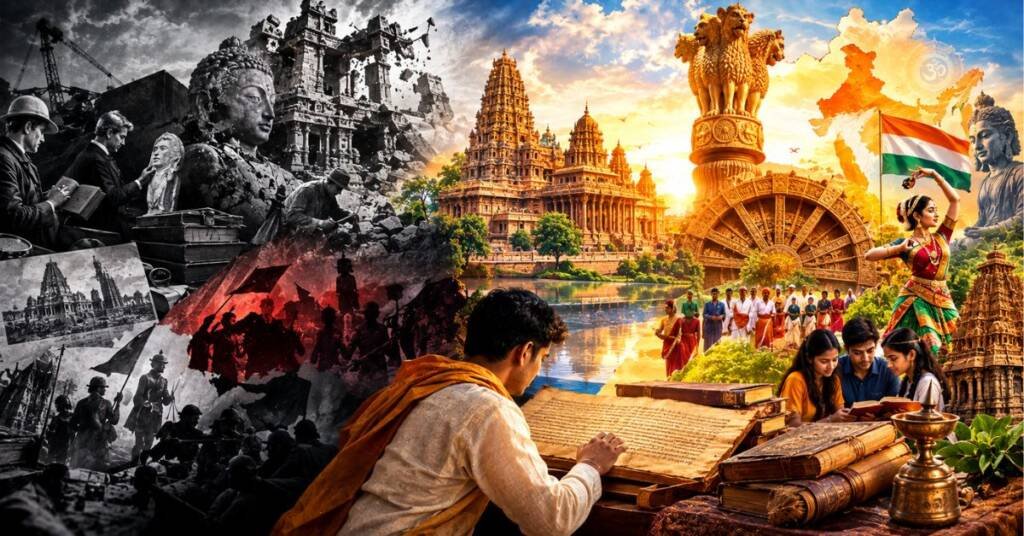
- Beginning with the systematic destruction of ancient Gurukuls, temple desecration, and forced conversions during foreign invasions, it traces how colonial British policies disrupted India’s indigenous education system to impose Western ideals.
- Furthermore, it details how post-independence Congress governments reinforced this disconnect through asymmetrical educational policies under Article 28 and 30, which restricted Sanatana education while granting minority institutions full freedom.
- The narrative highlights how textbook narratives eulogized foreign invaders while sidelining Sanatana warriors and kings, alienating generations from their roots.
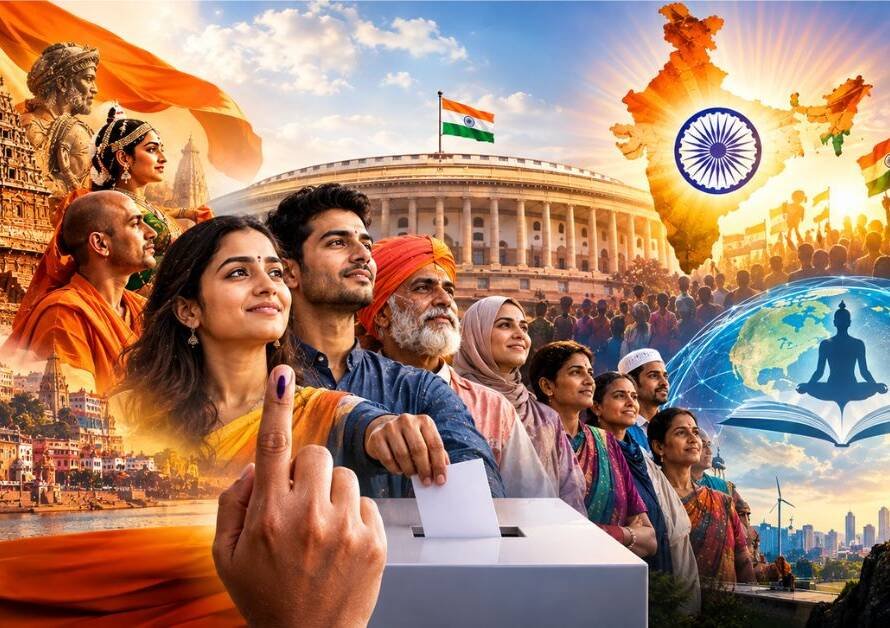
- Finally, it outlines the corrective measures initiated by the Modi government through the National Education Policy (NEP 2020) and historiographical revisions aimed at restoring pride in India’s true history, indigenous knowledge systems, and ancestral valor.
Sanatana Civilization, History & India’s Heritage
1. Historical Invasions: Destruction of Gurukuls, Temples, and Forced Displacements
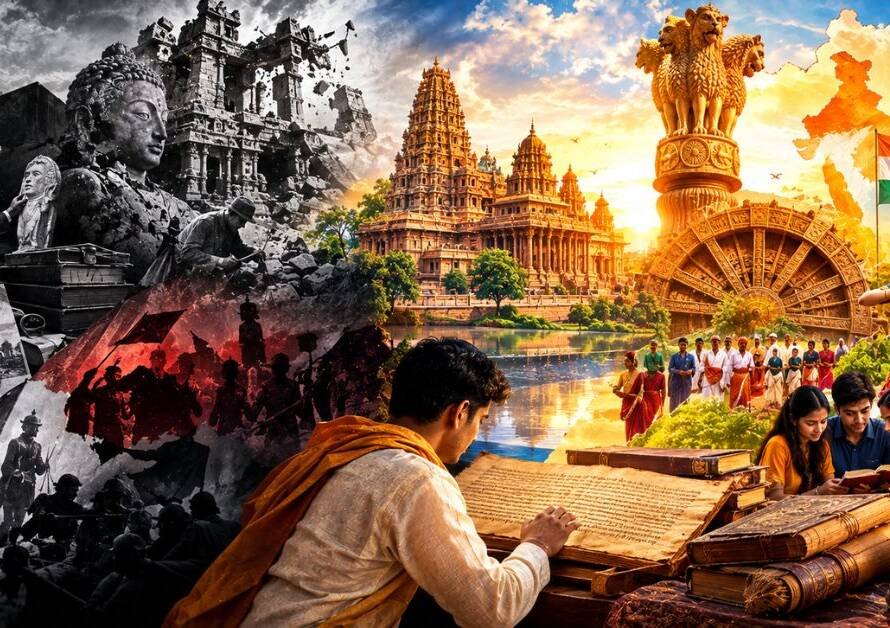
The erosion of Sanatana civilization began centuries ago through direct violent intervention aimed at dismantling the core pillars of Indian knowledge and spiritual traditions.
- Destruction of Knowledge Centers: Medieval invasions targeted premier learning institutions such as Nalanda, Vikramashila, and Taxila. The burning of Nalanda’s library destroyed priceless manuscripts on Vedic sciences, mathematics, astronomy, and philosophy, striking a fatal blow to the oral and written Gurukul tradition.
- Desecration of Temples as Cultural Hubs: Ancient temples served not merely as places of worship, but as community centers, schools, economic hubs, and patron institutions for art and music. Their widespread destruction severely disrupted local social structures and wealth generation.
- Cultural Disruption and Conversions: Waves of aggressive conquest used economic coercion, social subjugation, and forced conversions to break the continuity of local traditions, forcing communities away from their indigenous spiritual practices.
2. Colonial Subjugation: Replacement of Gurukuls with Macaulay’s Western System
The British Empire recognized that physical subjugation was insufficient without dismantling the indigenous intellectual framework of the subcontinent.
- Macaulay’s Education Act of 1835: Thomas Babington Macaulay explicitly designed a curriculum aimed at creating a class of individuals “Indian in blood and colour, but English in taste, in opinions, in morals, and in intellect.”
- Systematic Dismantling of Gurukuls: British policies revoked land grants and traditional funding that supported village Gurukuls, replacing a decentralized, universal indigenous schooling network with an English-medium bureaucratic system.
- Inculcation of Inferiority Complex: The Western educational paradigm portrayed Indian philosophy, Sanskrit literature, and traditional sciences as superstitious, forcing educated Indians to view their own heritage through a lens of shame and skepticism.
3. Post-Independence Policy: Constitutional Asymmetry and Disconnect from Roots
Following 1947, instead of restoring India’s ancient knowledge systems, post-independence administrations entrenched policy frameworks that further alienated students from Sanatana values.
- Constitutional Disparities (Articles 28 & 30): Constitutional interpretations restricted state-funded or state-aided schools from imparting Sanatana scriptures and moral values, classifying them as “religious instruction.” Simultaneously, minority communities retained constitutional rights to establish and administer religious institutions with government aid.
- Institutional Marginalization: While Christian seminaries and Islamic Madrasas maintained autonomy to teach their faith and culture, mainstream public education systematically scrubbed classical Indian texts, Sanskrit literature, and spiritual philosophy from the core syllabus.
- Generational Disconnect: Decades of this policy severed urban and educated generations from basic familiarity with the Upanishads, Bhagavad Gita, Ramayana, Mahabharata, and classical scientific treatises.
4. Falsified Historiography: Glorification of Invaders and Erasure of Sanatana Warriors
The narrative constructed in school textbooks by post-independence historians distorted historical memory, promoting a selective view of India’s past.
- Eulogizing Invaders: Textbooks dedicated extensive chapters to the Delhi Sultanate and Mughal Empire, framing harsh rulers as benevolent administrators while downplaying religious violence and destruction.
- Sidelining Native Empires and Warriors: Great dynasties such as the Cholas, Chalukyas, Vijayanagara Empire, Ahoms, and Rashtrakutas received minimal representation. National heroes like Chhatrapati Shivaji Maharaj, Maharana Pratap, Lachit Borphukan, and Raja Suheldev were reduced to regional footnotes.
- Suppression of Civilizational Achievements: Achievements in ancient metallurgy, maritime trade, architecture, mathematics (such as the zero and calculus foundations), and medicine (Sushruta and Charaka) were omitted or attributed to foreign origins.
5. Emperor Ashoka & The Maurya Dynasty: Institutional Neglect of Indigenous Glory
The paradox of modern Indian statecraft lies in adopting Maurya symbols while neglecting the ruler who built one of the greatest empires in world history.
- Emblematic Adoption vs. Historical Memory: India adopted the Ashoka Chakra on the National Flag, the Lion Capital as the State Emblem, and the ‘Ashoqa Chakra’ as the highest peacetime military bravery award. Yet, Emperor Ashoka’s birth anniversary remains unrecognized as a national holiday or major state event.
- The Model of Unbroken Sovereignty: Under the Mauryas, Akhand Bharat spanned from modern-day Afghanistan to Bangladesh. Emperor Ashoka’s administration established 23 universities, built extensive highways (such as the Grand Trunk Road), and created the world’s first veterinary hospitals and wildlife sanctuaries.
- Distorted Idioms (” सिकंदर vs. चंद्रगुप्त “): Popular culture popularized phrases like “Jo Jeeta Wohi Sikandar”, despite Alexander’s army retreating in fear of the Nanda and Maurya forces, while Chandragupta Maurya decisively defeated Seleucus Nicator to secure India’s western frontiers.
6. The Reclaiming Process: NEP 2020 and Historiographical Corrections
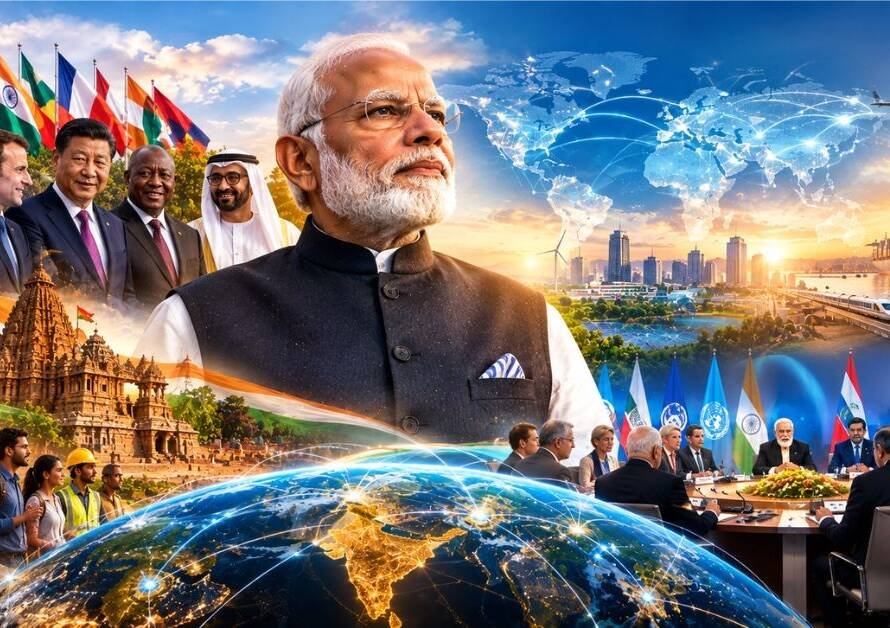
Under the leadership of Prime Minister Narendra Modi, systematic reforms have been initiated to decolonize Indian education and restore pride in native heritage.
- National Education Policy (NEP 2020): NEP 2020 integrates Indian Knowledge Systems (IKS) across school and higher education curricula, emphasizing mother-tongue instruction, Sanskrit literature, tribal heritage, and traditional sciences alongside modern technology.
- Revision of Textbooks and True History: Educational boards (including NCERT) have begun revising history curricula to remove disproportionate focus on medieval invaders, providing balanced coverage of regional dynasties, Sanatana warriors, and ancient scientific breakthroughs.
- Cultural Resurgence & Pride: Government initiatives, research grants, and national commemorations now celebrate overlooked historical icons (such as Lachit Borphukan’s 400th birth anniversary and Veer Baal Diwas), rebuilding civilizational confidence among youth.
7. Conclusion: Path Toward Civilizational Resurgence
A nation that forgets its history and devalues its ancestors cannot build a confident future.
- Overcoming Decades of Self-Doubt: Undoing centuries of structural erasure requires an active effort by society, educators, and institutions to study, teach, and preserve Sanatana history without bias.
- Restoring Honor to Ancestors: From Emperor Ashoka and Chandragupta Maurya to the ancient Gurukul Acharyas, recognizing our true icons ensures that future generations feel pride rather than unearned shame in their heritage.
- Nation-Building Through Rootedness: True modernization does not require westernization. By anchoring progress in the ethos of Sanatana Dharma and historical truth, India advances toward its goal of becoming a secure, self-reliant, and culturally vibrant Vishwaguru.
🇮🇳Jai Bharat, Vandematram 🇮🇳
Read our previous blogs 👉 Click here
Join us on Arattai 👉 Click here
👉Join Our Channels👈