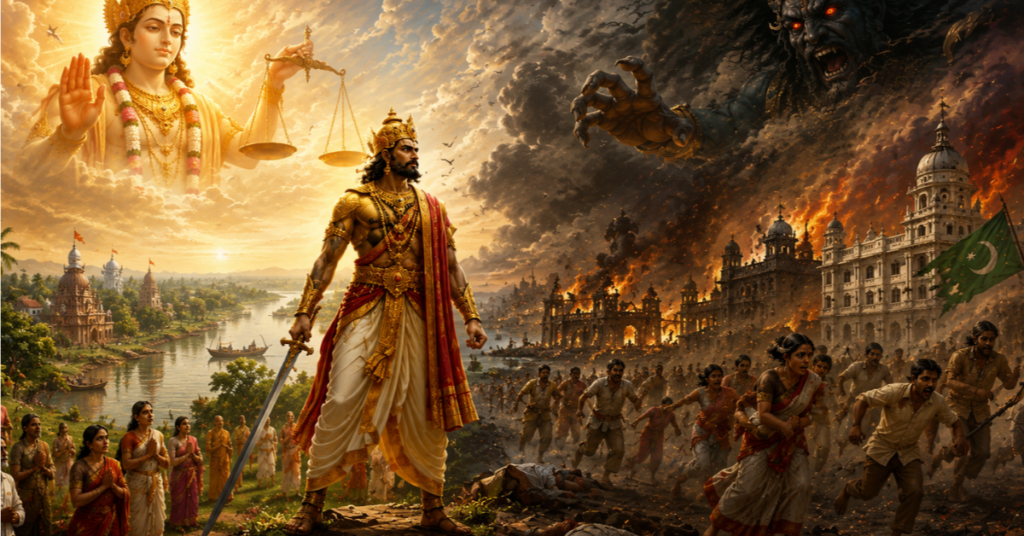
Summary
- This extensive discourse explores the inevitable intersection of political excess and spiritual retribution.
- It centers on the decline of the TMC regime in West Bengal as a modern-day manifestation of Karmic justice. By analyzing the systemic abuse of power, the targeted suppression of the Hindu majority, and the blatant disregard for Rajadharma (the duty of a ruler).
- This narrative posits that the current state of anarchy is not merely a political crisis but a spiritual one.
- The text serves as a roadmap for civilizational awakening, urging a transition from a state of fear to one of strategic righteousness (Krishna Neeti), ensuring that India’s sovereignty and the dignity of its people are never again sacrificed at the altar of appeasement.
The Eternal Principle of Karma and Divine Justice
1. The Metaphysics of Power: A Sacred Trust Betrayed
In the Indian civilizational ethos, power is never seen as an absolute right but as a temporary loan from the Divine, intended for the protection of Dharma. When a regime begins to believe that the seat of power is a throne of personal ego, it triggers a cosmic countdown toward its own demise.
- The Law of Eternal Return: The Bhagavad Gita establishes that every action (Karma) carries an inherent seed of its consequence. In politics, this means that every instance of voter intimidation, every sanctioned act of violence, and every insult to the administrative uniform is a debt that must be paid with interest.
- The Perversion of Rajadharma: Rajadharma mandates that a ruler must treat all citizens with equity, yet prioritize the protection of the righteous. When a state becomes a patron of “bomb-making culture” and a protector of criminals like Jahangir while threatening officers like ADG Ajay Sharma, it has officially abdicated its Dharma.
- The Burden of Ahankara (Arrogance): History is littered with the ruins of leaders who mistook the silence of a fearful public for consent. Arrogance is a veil that prevents a regime from seeing the “writing on the wall” until the wall itself collapses.
2. The Anatomy of Adharma: Systemic Decay in West Bengal
The political situation in West Bengal has evolved into a textbook case of Adharma—unrighteousness codified into governance. This decay is visible in the specific strategies used to maintain a stranglehold on power.
- The Weaponization of Fear: The “4th May” threats and the “we will see you after the results” rhetoric are not just political slogans; they are psychological warfare. By threatening the very officers meant to uphold the law, the regime attempts to decapitate the state’s moral authority.
- The Sanctuary of the Bomb: The discovery of 100 live bombs in Bhangar is a physical manifestation of a deeper rot. It proves that the “infrastructure of violence” has replaced the “infrastructure of development.” These bombs are meant to silence the majority and ensure that the “vote bank” remains the only voice that matters.
- The Politics of Displacement: Systematic atrocities against the Hindu majority—ranging from land grabbing to the suppression of religious festivals—are designed to create a sense of “second-class citizenship.” This is the highest form of Adharma, as it seeks to uproot the very culture that defines the land.
3. The “Thugbandhan” and the Betrayal of Ambedkar’s India
The current political alliances, often termed as “Thugbandhan,” represent a convergence of interests that seek to fragment India for short-term electoral gains.
- Ignoring the Visionary: Dr. B.R. Ambedkar warned of the dangers of communal appeasement and the erosion of constitutional values. The modern “Thugbandhan” has discarded Ambedkar’s warnings to embrace a radicalized vote bank that threatens the very secular fabric they claim to protect.
- Institutional Erosion: By bending the judiciary, the police, and the local administration to its will, the regime has created a vacuum where justice cannot breathe. When an IPS officer is told he will be “hunted down,” the message is clear: the Constitution is dead in Bengal, replaced by the whims of the powerful.
4. The Supt (Dormant) Hindu Society: A Call to Action
Regimes of Adharma thrive only as long as the majority remains in a state of “Karmic Hibernation.” The current crisis in Bengal is a direct result of this long-standing passivity.
- The Illusion of Personal Safety: Many in the middle class believe they can avoid the fire by staying indoors. But as history shows, when the house of your neighbor is burning with “100 bombs,” your own walls offer no protection.
- The Transition to Krishna Neeti: The time for silent tolerance (Ram Neeti) has passed. The current era demands Krishna Neeti—the use of strategic wisdom, collective organization, and the courage to call out evil. Lord Krishna did not tell Arjuna to “forgive” the Kauravas’ crimes against the state; He commanded him to fight to restore the balance of the world.
- The Power of Collective Will: Democracy provides a non-violent mechanism for Karmic correction. When the “Supt” society wakes up, the math of appeasement fails, and the “invincibility” of the oppressor vanishes like smoke.
5. India’s Sovereignty: The High Stakes of the Bengal Crisis
Bengal is not just a state; it is a gateway. The anarchy within its borders has direct implications for the sovereignty and safety of the entire Indian Union.
- The Infiltration Threat: A regime that prioritizes a radicalized vote bank often turns a blind eye to illegal infiltration. This creates a “fifth column” that can be exploited by foreign adversaries to destabilize India from within.
- The Challenge to Federalism: When a state government openly defies and threatens central observers and security forces, it challenges the very concept of a “Union of States.” If this behavior is normalized, it sets a precedent for the balkanization of India.
- Urgency of Correction: The correction must be urgent. Every day this “Karmic Debt” grows, the cost of the eventual settlement becomes higher. The nationalist leadership must be supported in its quest to bring “Rule of Law” back to a land currently ruled by “Rule of the Bomb.”
6. The Wheel Turns: The Inevitability of Downfall
The laws of the universe are more patient than the laws of men, but they are far more absolute. The wheel of Karma is currently turning, and its path is leading toward a total reckoning.
- The Echo of History: From the fall of the arrogant Kansa to the modern-day collapse of dictators, the lesson remains: Power divorced from Dharma is a suicide mission. The TMC’s reliance on intimidation is a sign of weakness, not strength. It is the frantic thrashing of a regime that knows its foundation is rotting.
- The Manifestation of Justice: The “ignominious defeat” is already written in the hearts of the people. It manifests the moment the common man loses his fear. When the ADG Ajay Sharmas of the world stand their ground and the people stand behind them, the “Jahangirs” have already lost.
7. The Dawn of Bharat Reborn
The struggle in West Bengal is a microcosm of the larger struggle for the soul of India. It is a choice between a future of fragmented, appeasement-driven anarchy and a “Bharat Reborn” that is strong, unified, and anchored in Dharma.
- A New Resolve: We must move forward with the understanding that our safety is tied to our sovereignty, and our sovereignty is tied to our Dharma.
- The Final Word: To those who abuse power: remember that the wheel is turning. To those who suffer: remember that Dharma never fails those who protect it. The correction is coming, and it will be as thorough as it is inevitable.
Where there is Dharma, there is Victory.
🇮🇳Jai Bharat, Vandematram 🇮🇳
Read our previous blogs 👉 Click here
Join us on Arattai 👉 Click here
👉Join Our Channels👈