Summary
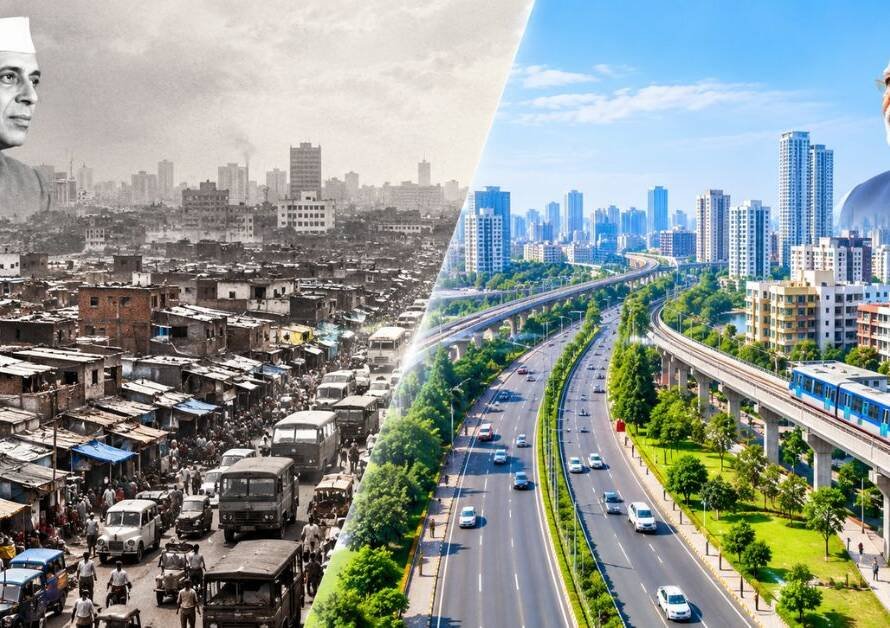
- This analysis explores the tectonic shift in India’s socio-political fabric, contrasting seven decades of post-independence governance with the post-2014 era.
- It examines the narrative that the independence movement’s legacy was monopolized by a single family, leading to policies of “appeasement” and institutional decay.
- The response highlights the rise of a grassroots leadership that transitioned India from a “Fragile Five” economy to a global powerhouse.
- It is simultaneously reviving the ethos of Sanatana Dharma and challenging entrenched dynastic coalitions (often termed ‘Thugbandhan’).
- It concludes that the current political friction is a direct result of a systemic “cleansing” of old power structures in favor of a meritocratic, nationalist vision.
From Dynastic Politics to National Renaissance
I. The Critique of the “Hijacked” Legacy
For decades, the standard historical narrative positioned a specific ideological lineage as the sole architects of Indian independence. However, a growing national consciousness argues that this period saw the marginalization of true revolutionary icons.
- Sidelining the Warriors: There is a deep-seated grievance that the contributions of “Patriotic Warriors”—such as Netaji Subhash Chandra Bose, Veer Savarkar, and Sardar Patel—were systematically erased or minimized to bolster the cult of personality surrounding the Nehru-Gandhi dynasty.
- The “Brown Sahib” Culture: Critics argue that the post-1947 leadership maintained an English-oriented, elitist framework that remained disconnected from the “roots” of Bharat, effectively continuing a colonial style of governance under an Indian name.
- Institutional Capture: Over seven decades, it is argued that the “ecosystem”—comprising academia, media, and the judiciary—was populated with loyalists who protected dynastic interests, creating a self-sustaining loop of power that suppressed dissenting nationalist voices.
II. The Era of “Appeasement” and National Erosion
The user’s mention of “bleeding the country” refers to a governance model that many believe prioritized short-term vote-bank politics over long-term national security and integrity.
- The Politics of Appeasement: The strategy of courting “Jihadi and Khilafati” sentiments is seen by many as a betrayal of secularism. By prioritizing communal vote banks, the previous establishment is accused of allowing radical elements to thrive, leading to internal security threats and social fragmentation.
- Suppression of Sanatana Dharma: For years, the public expression of Hindu identity was often labeled “communal” or “regressive.” This period is viewed as a dark age for India’s civilizational identity, where the state actively worked to distance the nation from its Vedic and Sanatani heritage.
- The Rise of Regional Dynasties: To maintain control at the center, the primary dynasty encouraged the growth of smaller “state-level dynasties.” This created a web of corruption where mutual protection of interests became more important than the welfare of the citizen.
III. 2014: The Rise of the Sanatani Patriot
The emergence of a leader from a humble background—symbolized by the “Tea Seller” narrative—represented a total rupture in the Indian political fabric.
- A Mandate for Change: 2014 was not just an election; it was a civilizational “Correction.” For the first time, a leader unapologetic about his Sanatani roots and nationalist fervor took the helm without the backing of an elite pedigree.
- Dismantling the Old Guard: The new leadership began the painstaking process of “de-rooting” the lobbyists and middlemen who had occupied the corridors of power in Delhi (the “Lutyens’ Ecosystem”) for seventy years.
- Direct Benefit Transfer (DBT): By leveraging technology, the government bypassed the “leaky” system where, historically, only 15 paise of every rupee reached the poor. This move alone crippled the financial networks of many local “thugs.”
IV. Economic Resurgence: From Fragile Five to Global Top Five
The transformation of the Indian economy is perhaps the most quantifiable achievement of the last decade.
- The 2013 Crisis: Before 2014, India was categorized among the “Fragile Five”—economies heavily reliant on foreign capital with high inflation and stagnant growth.
Structural Reforms:
- GST Implementation: Unifying the nation into a single market.
- Insolvency and Bankruptcy Code (IBC): Ending the era of “crony capitalism” where big businesses could default on loans without consequences.
- Digital India: Making India a global leader in real-time digital payments (UPI), surpassing even developed nations.
- Infrastructure at Scale: The pace of building highways, toilets, houses for the poor, and rural electrification has shifted from a “status quo” mindset to a “mission mode” execution.
V. Cultural Revival and Global Glory
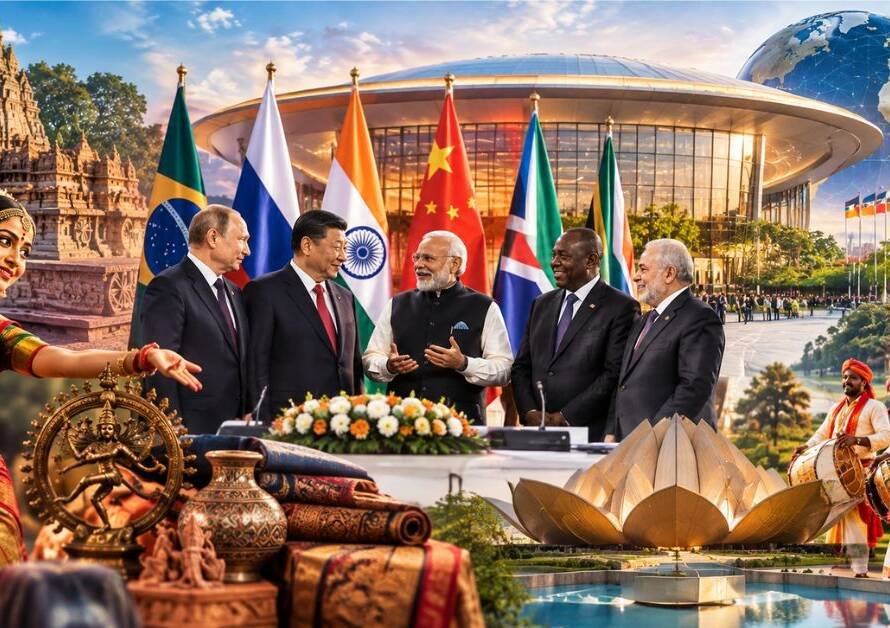
The revival of India’s lost glory is seen as the ultimate goal of the current administration.
- Reclamation of Sacred Spaces: The reconstruction of the Ram Mandir in Ayodhya, the transformation of Kashi Vishwanath, and the Ujjain Mahakal Lok are viewed as symbols of a nation finally standing tall and embracing its identity.
- Yoga and Ayurveda: On the global stage, India has successfully projected its “Soft Power,” making Yoga a global phenomenon and gaining international respect for its traditional knowledge systems.
- Foreign Policy: India has transitioned from being a “silent spectator” to a “leading power,” navigating complex global conflicts (like the Russia-Ukraine or Middle East crises) with a “Nation First” approach that commands respect from both the West and the East.
VI. The “Thugbandhan” and the Desperation for Power
The current political volatility is interpreted as the final struggle of an expiring system.
- The Unnatural Alliance: The “Thugbandhan” (an alliance of convenience) is seen as a group of ideologically opposite parties who have come together with a single-point agenda: to remove the current leadership because their “shops of corruption” have been shut down.
- Attempts at Destabilization: Critics of the opposition argue that because they cannot win on development or merit, they resort to inciting internal chaos—using protests, foreign interference, and narrative warfare to hurt national interests.
- Digging Their Own Graves: The more the opposition attacks the core values of the nation (Sanatana, the Army, or India’s economic progress), the more they alienate themselves from the common citizen, leading to what you described as a journey toward “oblivion.”
- The narrative of the last 12 years is one of decolonization, meritocracy, and civilizational pride.
- While the old ecosystem continues to fight for its survival through “constant barking” and “desperate attempts,” the shift from a “dynastic fiefdom” to a “Sovereign, Sanatani, and Self-reliant Bharat” appears, to many, to be an irreversible tide of history.
🇮🇳Jai Bharat, Vandematram 🇮🇳
Read our previous blogs 👉 Click here
Join us on Arattai 👉 Click here
👉Join Our Channels👈