Summary
- The Indian economy in FY26 stands at a structural crossroads. With bank credit surging by 15.9% to ₹212.9 lakh crore, the nation has effectively deployed $350 billion in fresh capital within a single year.
- This resurgence is inextricably linked to the double-digit growth in manufacturing and the “Make in India” initiative.
- This analysis contrasts the current “Fortress Economy” with the “Fragile Five” period of 2004–2014, highlighting how today’s strategic currency depreciation is a tool for export competitiveness, despite the political rhetoric from the opposition.
The Power of Industrial Growth and Credit Access
1. The Macro Picture: A ₹212 Lakh Crore Milestone
The fiscal data for FY26 is not merely an improvement; it is a declaration of systemic health.
- Credit Surge: Bank credit grew by 15.9%, pushing outstanding loans to ₹212.9 lakh crore. This marks an addition of ₹29.2 lakh crore (approx. $350 billion) in just 12 months.
- Capital Velocity: This represents the highest single-year injection of capital in India’s history, fueling the massive infrastructure and capex cycle.
- he Lead Indicator: While GDP growth (estimated at 7.6% for FY26) reflects current output, credit growth is the engine of the future. The concentration of credit in industrial and MSME sectors signals a robust, multi-year expansion.
2. Comparing the Eras: From Fragility to Fortification
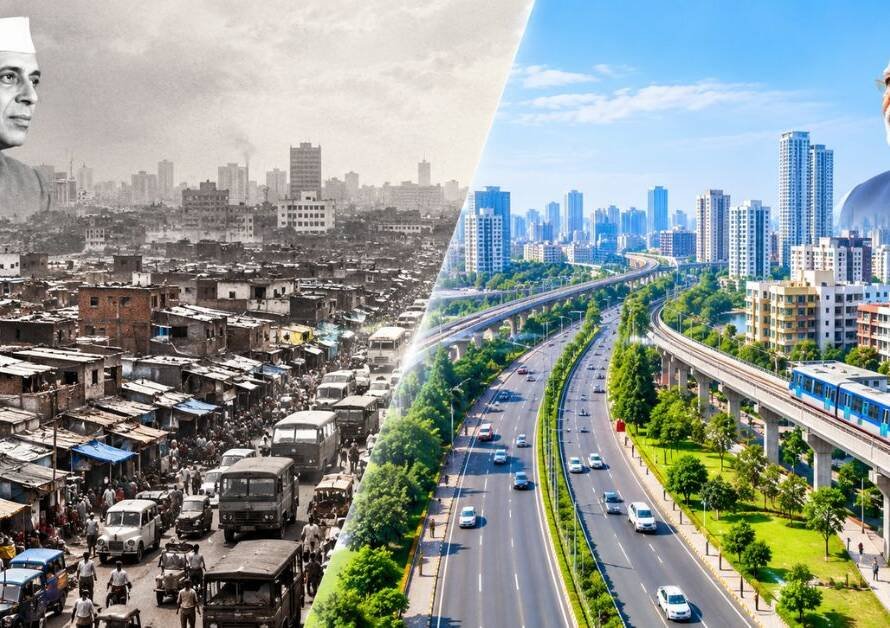
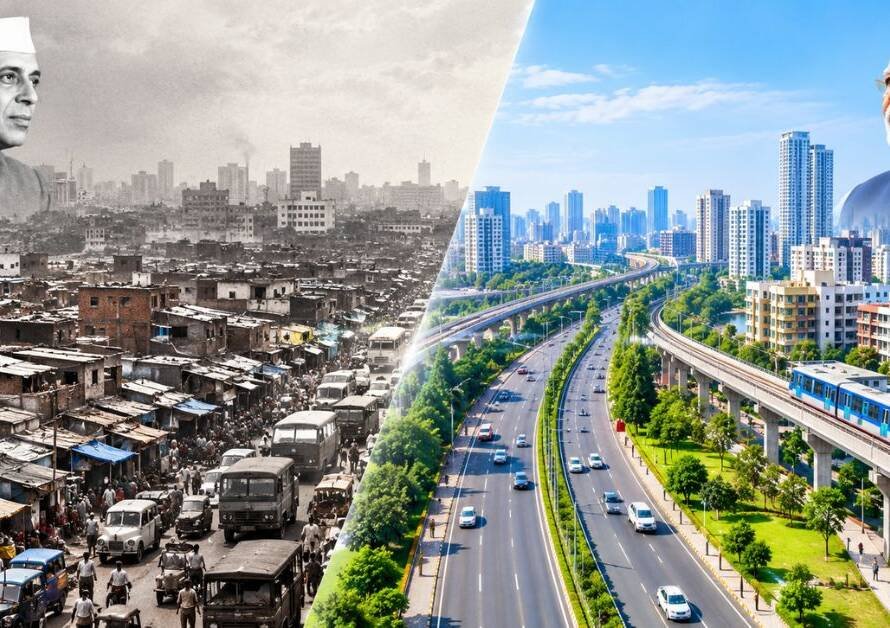
To understand the significance of 2026, we must look at the three-decade evolution of the Indian economy.
The Pre-2014 Era (2004–2014): The “Borrowed Growth” Decade
The decade between 2004 and 2014 was a study in high growth without structural discipline.
- The 2004–2008 Boom: Following the global credit expansion, India grew rapidly. However, much of this growth was fueled by “aggressive lending” and the seeds of the NPA crisis.
- Policy Paralysis (2009–2014): Post-2008, the government encouraged banks to continue lending to infrastructure and power projects without proper due diligence. This “phone-banking” culture led to unviable projects and systemic corruption.
- Macroeconomic Failure: By 2013, India was branded one of the “Fragile Five” by Morgan Stanley. Inflation was consistently above 10%, the fiscal deficit was spiraling, and the Current Account Deficit reached a record 4.8% of GDP.
The Cleanup Era (2014–2020): Painful Reconstruction
The period following 2014 was defined by “cleaning the pipes.”
- Asset Quality Review (AQR): For the first time, bad loans were transparently recognized. NPAs peaked at nearly 12% in 2018.
- NCLT and IBC: The Insolvency and Bankruptcy Code shifted the power from promoters back to creditors, ensuring capital was no longer trapped in “zombie” companies.
The Structural Era (2020–2026): Resilient Expansion
- The Turnaround: In 2026, Gross NPAs have fallen to 2.2%–2.5%, the lowest in two decades.
- Disciplined Capital: Unlike the pre-2014 era, today’s 16% credit growth is backed by higher Capital Adequacy Ratios (17%+) and strict digital underwriting.
3. The Industrial Awakening: “Make in India” 2.0
The surge in credit is the “financial oxygen” for the manufacturing boom.
- Manufacturing Momentum: Manufacturing GVA is projected to grow by 10–11% in FY26.
- Sectoral Focus: Credit is flowing into semiconductor fabs (with over ₹1.6 lakh crore in investment), green energy, and advanced electronics—sectors that were non-existent in the pre-2014 era.
- MSME Resilience: Credit to small and micro industries grew by 33.1% in FY26. This indicates that the “Make in India” supply chain is finally being formalized and integrated into global value chains.
4. The Rupee Debate: Strategic Reality vs. Opposition Rhetoric
As the Rupee settles in the ₹91–₹92 range against the US Dollar in early 2026, it has become a central point of political contention.
The Opposition’s Stand
The opposition continues to attack the government, framing the Rupee’s depreciation as a sign of national weakness and “economic mismanagement.” Their rhetoric focuses on:
- Nominal Value: Comparing the ₹90+ rate to the ₹60 rate of 2014 as a metric of decline.
- Imported Inflation: Claiming that a weaker Rupee will make oil and essential imports unaffordable for the common man.
The Economic Reality: A Strategic Tool
Economically, the situation in 2026 is fundamentally different from the 2013 “Taper Tantrum.”
- Export Competitiveness: A slightly depreciating Rupee is a deliberate “pressure valve.” For a nation aiming to be a global manufacturing hub, an “undervalued” Rupee makes Indian exports (electronics, textiles, chemicals) cheaper and more competitive against rivals like China or Vietnam.
- The REER Reality: While the Rupee has declined against the Dollar, its Real Effective Exchange Rate (REER)—measured against 40 trade partners—shows it is one of the most stable currencies globally. Almost all major currencies (Euro, Yen) have faced steeper declines against the surging Dollar.
- Forex Reserves: In 2013, India was “scared” of depreciation because reserves were low. Today, India sits on $700 billion in forex reserves (the 4th largest in the world). The RBI is not “defending” a price; it is managing a “gradual adjustment” from a position of absolute power.
5. Why This Capex Cycle is Different
The current investment cycle is structurally superior to the 2004–2014 boom for several reasons:
- Public-Private Partnership: The government’s massive push in infrastructure (high-speed corridors growing 10x since 2014) has crowded in private investment.
- Clean Balance Sheets: Both banks and corporates are now deleveraged. Banks are competing to lend because they have the capital, and corporates are borrowing because they see real demand.
- Global Context: India is now a global “sanctuary of growth.” While other major economies face stagnation, India’s 7.6% GDP growth and 16% credit growth make it the engine of the global economy.
The Verdict on National Strength
- The state of the country between 2004 and 2014 was one of “borrowed growth” and structural fragility. The Rupee was weak because the economy was weak.
- In 2026, the situation is reversed. The economy is strong, the banking sector is a fortress, and the manufacturing sector is roaring.
- The strategic adjustment of the Rupee is a choice made to maintain global competitiveness, not a symptom of distress. The opposition’s focus on nominal currency rates ignores the fundamental reality:
India is no longer a “Fragile Five” nation; it is the world’s most resilient growth story.
🇮🇳Jai Bharat, Vandematram 🇮🇳
Read our previous blogs 👉 Click here
Join us on Arattai 👉 Click here
👉Join Our Channels👈