Summary:
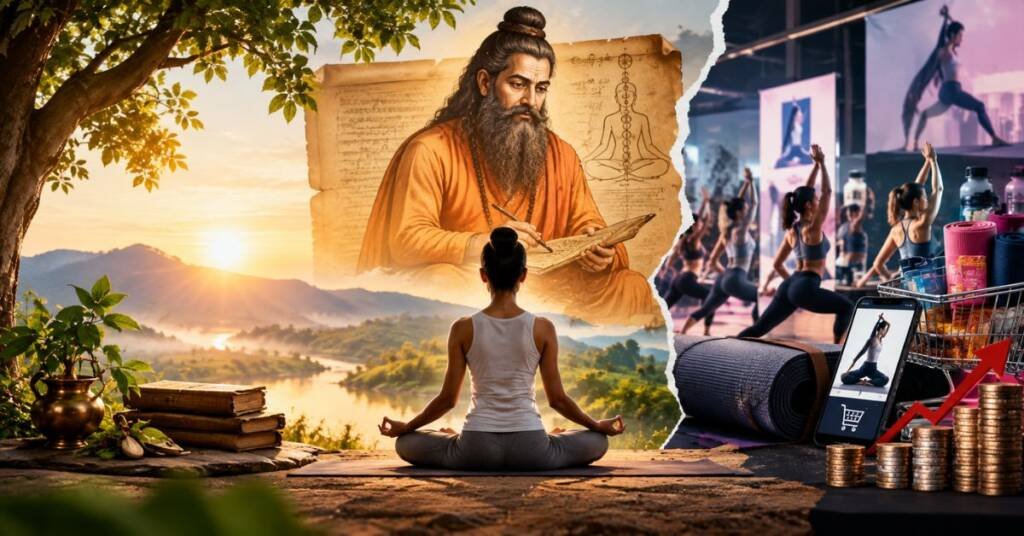
- In Sanatana philosophy, ‘Yoga’ is neither a physical exercise nor a commercial package for stress relief; it is the eternal and scientific path for the complete union of the Jeevatma (individual consciousness) into the Paramatma (supreme consciousness).
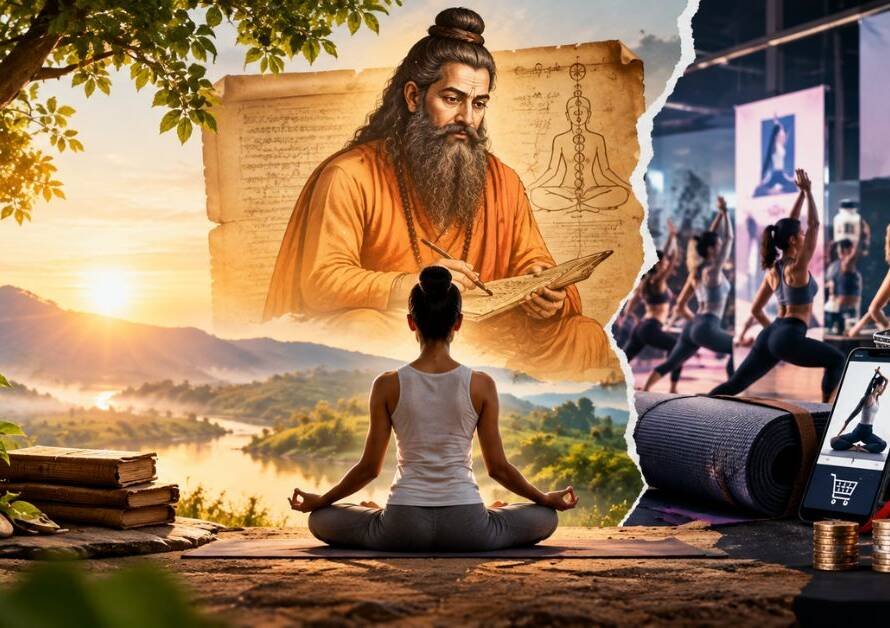
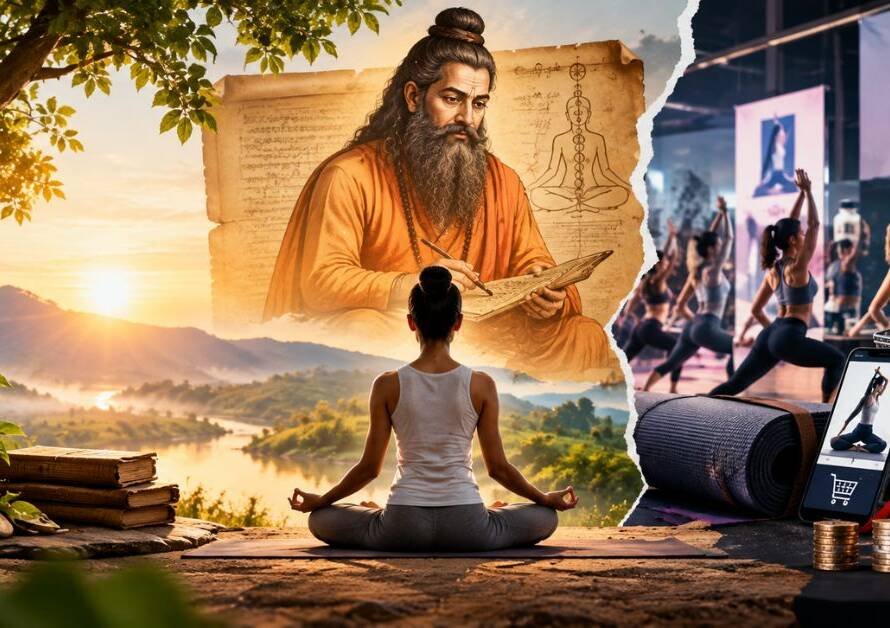
- Unfortunately, modern commercialization and market-driven mindsets have fragmented this profound science, turning it into a salable commodity under the guise of postures (asanas), breathwork (pranayama), and meditation (dhyana).
- By disregarding the essential ethical foundation of yama and niyama, and bypassing the stages of pratyahara and dharana, misleading claims are being made to sell samadhi and moksha (liberation).
- This article presents a detailed, step-by-step, and scripture-based analysis of the Ashtanga Yoga outlined by Maharishi Patanjali in his Yoga Sutras.
- Unmasking the fallacies of the modern yoga industry, this piece clarifies how, by adhering to all eight limbs, the Jeevatma can achieve its ultimate goal: union with the Paramatma.
Authentic Yoga & Patanjali’s Eternal Path
1. The True Meaning of Yoga and the Ultimate Goal of Sanatana Philosophy
- Etymology of the Word ‘Yoga’: The word Yoga is derived from the Sanskrit root ‘Yuj’, which means to join, unite, or become one.
- Union of Jeevatma and Paramatma: In the Sanatana tradition, the singular ultimate objective of Yoga is the integration of our individual consciousness (Jeevatma) with the all-pervading supreme consciousness (Paramatma).
- Tragedy of Modern Commercialization: Consumerist culture has reduced this grand science of liberation (Moksha-Shastra) into a mere commercial product for body shaping, weight loss, and stress management.
- Fragmented Teaching System: Modern yoga centers completely omit the mandatory spiritual disciplines of yama, niyama, and dharana, selling yoga practice purely through the lure of physical benefits.
2. The First Limb: Yama (Social and Ethical Discipline)
Yama is the first step toward purifying the conduct of the Jeevatma, without which the elevation of consciousness is impossible. It consists of five sub-disciplines:
- Ahimsa (Non-Violence):
- Prevalent Misconception: Under the name of non-violence, society has been taught cowardice, impotence, and submission before unrighteousness (adharma).
- Scriptural Truth: Ahimsa means not causing unprovoked harm to any innocent being through mind, speech, or action. Fighting for Dharma, justice, and self-defense is not a violation of ahimsa, but a supreme duty.
- Satya (Truthfulness):
- True Nature: Satya is not merely speaking sweet words. Accepting the ultimate truth without bias, fear, or attachment, and remaining grounded in reality, constitutes satya.
- Asteya (Non-Stealing):
- Broader Meaning: Beyond refraining from stealing wealth, asteya means not usurping another’s time, rights, ideas, or credit.
- Brahmacharya (Continence / Energy Alignment):
- Spiritual Definition: Restraining one’s sensual desires and directing energy away from worldly indulgence toward the contemplation of the Supreme (Brahma).
- Aparigraha (Non-Possessiveness):
- Mental Purity: Abstaining from hoarding objects, wealth, thoughts, and emotional attachments beyond one’s actual needs.
3. The Second Limb: Niyama (Personal Discipline and Internal Eligibility)
Niyama strengthens the internal conduct, mental balance, and spiritual eligibility of the practitioner:
- Shaucha (Internal and External Purity): External purity of the body through clean water and food, along with internal purity of the mind through the elimination of lust, anger, greed, and delusion.
- Santosha (Contentment): Absence of irrational craving for unobtained objects and maintaining a peaceful mind by wisely utilizing present resources.
- Tapa (Austerity / Endurance): Remaining steadfast on one’s spiritual path despite life’s struggles and dualities (pleasure-pain, heat-cold, honor-dishonor).
- Svadhyaya (Self-Study): Not just reading scriptures, but continuously performing unbiased self-introspection of one’s thoughts and conduct.
- Ishvarapranidhana (Surrender to the Divine): Renouncing the finite ego and the sense of “I”, and surrendering the fruits of all actions at the feet of the Supreme Consciousness.
4. The Third Limb: Asana (The Science of Body Stability)
- Maharishi Patanjali’s Authentic Sutra: “Sthira-sukham-asanam” (Yoga Sutras 2.46)
- The Difference Between Truth and Misconception:
- Misconception: In modern yoga, gym-like workouts, excessive sweating, and contorting the body into difficult poses are viewed as the ultimate form of yoga.
- Truth: That posture in which the body remains completely motionlessly stable and the mind remains pleasantly tranquil is an asana.
- The Primary Purpose of Asana: The goal of asana is not merely physical fitness, but mastering the body so that the spine remains erect during meditation, preventing physical pain or fatigue from distracting the mind.
5. The Fourth Limb: Pranayama (Regulation and Cessation of Pranic Energy)
- Maharishi Patanjali’s Authentic Sutra: “Tasmin sati shvasa-prashvasayor gati-vicchedah pranayamah” (Yoga Sutras 2.49)
- The True Nature of Pranayama:
- The qualification for pranayama is attained only after achieving mastery over asana.
- Pranayama is the automatic cessation (kumbhaka/retention) of the natural flow of inhalation (puraka) and exhalation (rechaka).
- Dispelling Commercial Misconceptions:
- Rapid inhalation and exhalation (such as Kapalbhati or Bhastrika) are not the ultimate form of pranayama. These are actually part of Shatkarma (cleansing techniques) in Hatha Yoga.
- Making the breath extremely subtle and calm to quiet the restlessness of the mind is the true objective of pranayama.
6. The Fifth Limb: Pratyahara (Interiorization of the Senses)
- Maharishi Patanjali’s Authentic Sutra: “Sva-vishaya-asamprayoge chittasya svarupanukara ivendriyanam pratyaharah” (Yoga Sutras 2.54)
- The Invisible Yet Mandatory Rung:
- Just as a tortoise withdraws its limbs inside its shell, when the sense organs (eyes, ears, nose, tongue, skin) detach from external objects and merge into the nature of the mind, it is called pratyahara.
- Modern Deception: Commercial gurus attempt to teach ‘meditation’ directly without yama, niyama, asana, or pranayama. Unless the senses are turned inward through pratyahara, any attempt at meditation remains a mere distraction of thoughts and daydreams.
7. The Sixth Limb: Dharana (Concentration / Mind Fixation)
- Maharishi Patanjali’s Authentic Sutra: “Desha-bandhash chittasya dharana” (Yoga Sutras 3.1)
- The Prerequisite for Meditation:
- Fixing and binding the restless mind to a single specific point (such as the heart chakra, ajna chakra, tip of the nose, or the form of the Divine) is called dharana.
- Scientific Progression: Dharana is the mental practice of holding focus and stopping distractions. Entering ‘meditation’ without dharana is scientifically impossible.
8. The Seventh Limb: Dhyana (Unbroken Flow of Consciousness)
- Maharishi Patanjali’s Sutra: “Tatra pratyayaikatanata dhyanam” (Yoga Sutras 3.2)
- Meditation Cannot Be ‘Done’; It ‘Happens’:
- When the stream of consciousness toward the object of focus flows continuously without interruption (like oil pouring smoothly from one vessel to another), that state is dhyana (meditation).
- The Market Illusion: Meditation is not a 10-minute commercial ‘technique’ or a relaxation package listening to music; it is an internal state that naturally arises when dharana matures.
9. The Eighth Limb: Samadhi (The Ultimate Union of Jeevatma and Paramatma)
- Maharishi Patanjali’s Sutra: “Tad evarthamatra-nirbhasam svarupa-shunyam iva samadhih” (Yoga Sutras 3.3)
- The Supreme Attainment of Yoga:
- Samadhi is the culmination of meditation where the meditator (Jeevatma) and the process of meditating dissolve, and only the object of meditation (Paramatma) remains.
- Here, the practitioner’s limited ego dissolves, unifying them with the Supreme Consciousness. This is the true union of the Jeevatma with the Paramatma.
- Condemnation of Commercialization:
- In today’s money-driven era, charging fees in the name of samadhi, handing out certificates for ‘enlightenment’, and claiming realization in weekend retreats is a grave insult to Sanatana Dharma, the traditions of the Rishis, and the science of Yoga.
10. Conclusion: A Call to Restore Authentic Sanatana Yoga
- The time has come for society to recognize the commercial distortions being spread under the banner of yoga. Yoga is not a gym substitute or merely a medicine to keep the physical body fit. Physical and mental health are simply minor initial by-products along this path.
- The true soul of Yoga is uniting the Jeevatma with the Paramatma. To achieve this, we must adopt Maharishi Patanjali’s eightfold path—Yama, Niyama, Asana, Pranayama, Pratyahara, Dharana, Dhyana, and Samadhi—in its original, authentic, and scientific progression. Only then can we free ourselves from modern misconceptions and attain the eternal truth of Sanatana Yoga.
🇮🇳Jai Bharat, Vandematram 🇮🇳
Reads & Views: 54