Summary
- In Indian political and policy debates, the question has long been raised: what concrete steps have governments taken for the vast segment of society comprising the General Category and particularly the majority Middle Class?
- It is an undeniable truth that economically weaker sections within the General Category have received historic benefits from welfare schemes such as EWS reservation, PM Awas Yojana (housing), free rations, health insurance under Ayushman Bharat, and PM-KISAN Samman Nidhi.
- However, the expectations and needs of that largest segment of society falling under the “General Middle Class” (Salaried, Professional, and Business Middle Class) remain central.
- A deep evaluation of policy decisions made over recent years by the Modi government and various state governments (such as Uttar Pradesh) reveals that several unprecedented and far-reaching steps have been taken to make life for this class smoother, safer, and more prosperous.
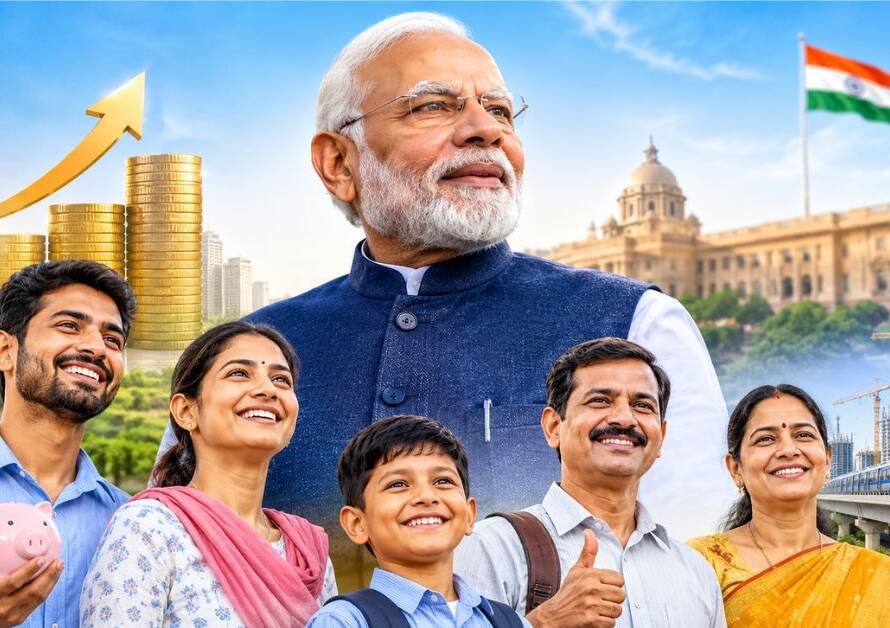
- From tax reforms and the constitution of pay commissions to modern infrastructure, record employment generation, and the expansion of education and scholarships, concrete work has been done to empower this class. This article presents a detailed analysis of this vision.
Empowerment of the General Category and Middle Class in India
1. Tax Reforms and Historic Growth in Purchasing Power
Relief on the income tax front has been the oldest, most consistent, and vocal demand of the middle class.
- Expansion of Tax Slabs and Relief: The taxable income threshold has been progressively raised, and substantial tax relief was provided to the middle class under the new tax regime. At various levels, exemptions were granted that exceeded expectations.
- Increase in Disposable Income: Reducing the tax burden has significantly boosted disposable income for this class, leading to unprecedented improvements in their standard of living, savings, and investment capacity.
- Transparency and Digitalization: Simplification of the tax system has freed the middle class from corruption and paperwork red tape, making tax compliance much easier.
2. Expansion of Healthcare Security and Social Welfare
Welfare schemes were previously considered limited to marginalized or poor strata, but the Modi government extended these safety nets to the middle class.
- Ayushman Bharat and Cashless Treatment: Expanding the scope of health schemes like Ayushman Bharat has provided middle-class families and government employees with cashless treatment options and better healthcare access, easing the sudden burden of medical expenses.
- Approval of the 8th Pay Commission: The central government’s approval of the recommendations and Terms of Reference for the 8th Pay Commission has ensured direct and long-term financial support for a vast category of central government employees, officials, and pensioners.
- Social Security Schemes: Economic security for the middle class has been assured through various insurance and pension schemes, such as the Atal Pension Yojana.
3. Urban Infrastructure and Seamless Mobility
For salaried and middle-class households, saving time and achieving smooth mobility are paramount.
- Urban Mobility Revolution: Metro rail networks, expressways, Vande Bharat trains, and modern road projects have been rapidly expanded across the country, transforming the commuting experience.
- Saving Distance and Time: The primary objective of these major infrastructure projects is to reduce the distance and travel time between homes and workplaces, improving the daily lives and work-life balance of working professionals.
- Smart Cities and Logistics: Transparency in modern urban development and the real estate sector has made it easier for the middle class to buy dream homes and lead comfortable lives.
4. Education, Scholarships, and Youth Empowerment
Governments have also made massive investments in the future of youth, higher education, and skill development.
- Scholarship Schemes: In major states like Uttar Pradesh, scholarship schemes worth approximately ₹950 crores annually are effectively administered for general category students, providing substantial financial support to meritorious youth pursuing higher, professional, and technical education.
- Transparent and Record Recruitment: In recent years, large-scale government recruitments have been conducted transparently on average, setting a new benchmark. Based entirely on merit and qualifications, general-category youth have secured fair and widespread opportunities.
Skill Development and Startup Ecosystem: Initiatives like Make in India and Startup India have enabled general-category youth to become ‘job creators’ rather than mere job seekers.
5. Conclusion: The Middle Class as the Backbone of the Nation and Architect of Progress
The notion that the general middle class has been neglected does not hold weight against the touchstone of ground-level decisions and policy shifts. Historic tax relief, the formation of pay commissions, modern transport networks, health security, and decisive steps in education have proven that the government has acted with sensitivity and foresight to strengthen the pillar of national progress. A Viksit Bharat (Developed India) cannot be envisioned without the empowerment of the general category and middle class, and government policies are proving to be milestones in this direction.
🇮🇳Jai Bharat, Vandematram 🇮🇳
Read our previous blogs 👉 Click here
Join us on Arattai 👉 Click here
👉Join Our Channels👈