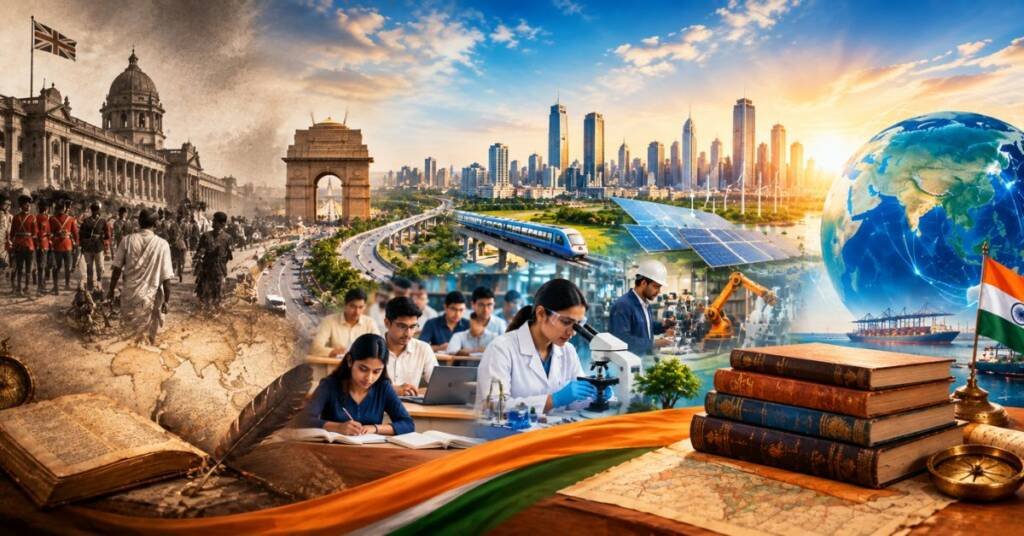
Introduction ‘Sovereign India: The Journey from a Colonial Mindset to Vishwaguru’ is an epoch-making discourse and strategic manifesto that presents a granular analysis of India’s glorious past, the deep roots of colonial subjugation, and post-independence policy priorities. This work is not merely a chronicle of an ultimate historical journey; rather, it lays down a concrete, legal, and strategic blueprint to liberate India from mental servitude and administrative paralysis, establishing it as a fully developed, self-reliant ‘Vishwaguru’ by the ‘Amrit Kaal’ of 2047. Authored by Saccha Sanatani (PhD), this treatise is divided into 7 parts and 36 chapters, published by Notion Publications.
Sovereign India: From Colonial Mindset to Vishwaguru (A Strategic Essay for 2047)
Part 1: Sanatani Chronology and Cultural Continuity
This section proves that India’s point of departure was not a backward or tribal society, but the world’s foremost economic and intellectual peak, where India held approximately one-third of global GDP from the beginning of the Common Era until the 17th century. Drawing upon legal and textual evidence from the ‘Vishnu Purana’, it delineates India’s philosophical and scientific boundaries, which were safeguarded by the protective shield of the four Peethas established by Adi Shankaracharya in all four directions. Analyzing a decentralized economic model based on autonomous merchant guilds (Shrenis), it illustrates how unprecedented prosperity was attained by aligning ‘Artha’ (wealth) with ‘Dharma’. Furthermore, it validates Maharishi Kanada’s atomic theory, Sushruta’s surgery, and the astronomical calculations of the ‘Surya Siddhanta’ as the true foundations of modern science.
Part 2: The Brutal Truth of Invaders and Sanatana’s Resistance
This section presents historical and official evidence (such as Maasir-i-Alamgiri) detailing religious fanaticism, destruction of temples, economic oppression through Jizya, and mass massacres during Mughal rule. In response, it evaluates the heroic sagas of Maharana Pratap’s indigenous guerrilla warfare, Chhatrapati Shivaji Maharaj’s ‘Hindavi Swarajya’ and naval resurgence, and the complete destruction of Mughal power by the Marathas and the Sikhs. Moving forward, it exposes the colonial trap engineered to mentally and economically paralyze India through the East India Company’s ‘Drain of Wealth’, Macaulay’s Education Policy of 1835, and the repressive Police Act of 1861. Finally, it establishes the Uprising of 1857 not as a mere ‘Sepoy Mutiny’, but as the first well-organized national and armed revolution against oppressive British policies.
Part 3: The Pseudo-Discourse of Freedom and the Heroes of Independence
Relying on evidence from Netaji Subhash Chandra Bose’s Indian National Army (INA), the Royal Indian Navy Revolt of 1946, and statements from British Prime Minister Clement Attlee, this section clarifies that independence was achieved through armed military pressure rather than non-violence alone. Alongside this, it provides an in-depth analysis of the distortion of history by Marxist historiography, the tragedies of the 1947 Partition, the emergence of the Kashmir issue, and Sardar Patel’s swift strategic integration of Hyderabad and Junagadh.
Parts 4 & 5: The Fog of 1947, Policy Paralysis, and the Surrender of Sovereignty
These segments perform a critical autopsy on the severe failures of the post-independence era. It exposes strategic lapses during the 1962 war, the dictatorial apparatus of the Emergency (1975), institutional conversions, Naxalism, and the blows dealt to national security by policies of one-sided appeasement. Furthermore, it uncovers the mechanisms that held India’s sovereignty hostage through policy paralysis, interference by unconstitutional bodies, and the economic License Raj.
Part 6: The Epochal Transformation of 2014
This section details the cultural and economic renaissance initiated after 2014, including the revitalization of the Ram Mandir and Kashi Vishwanath Dham, decolonization via the ‘Bharatiya Nyaya Sanhita’ (BNS), and India’s transition from the ‘Fragile Five’ to becoming the world’s 5th largest economy. Additionally, it authentically documents the abrogation of Article 370, indigenous defense manufacturing (such as INS Vikrant and Tejas), and India’s global leadership in digital payments (UPI).
Part 7: Capability, Sovereignty, and the Path to Vishwaguru: 2027–2047
The final part presents a 360-degree strategic vision for Amrit Kaal. It outlines an infallible roadmap to fully leverage India’s demographic dividend, eradicate the culture of freebies, and position India as a self-reliant, technologically sovereign, global ‘Vishwaguru’ by 2047.
Conclusion
This entire work is far more than a mere compilation of historical accounts; it serves as a precise surgical analysis of the machinery of colonial and mental subjugation. By reaffirming India’s glorious past and rectifying post-independence policy errors, this treatise offers a practical and strategic roadmap to transform India into a formidable, sovereign, and self-reliant ‘Vishwaguru’ by 2047.
🇮🇳Jai Bharat, Vandematram 🇮🇳
Read our previous blogs 👉 Click here
Join us on Arattai 👉 Click here
👉Join Our Channels👈