Summary
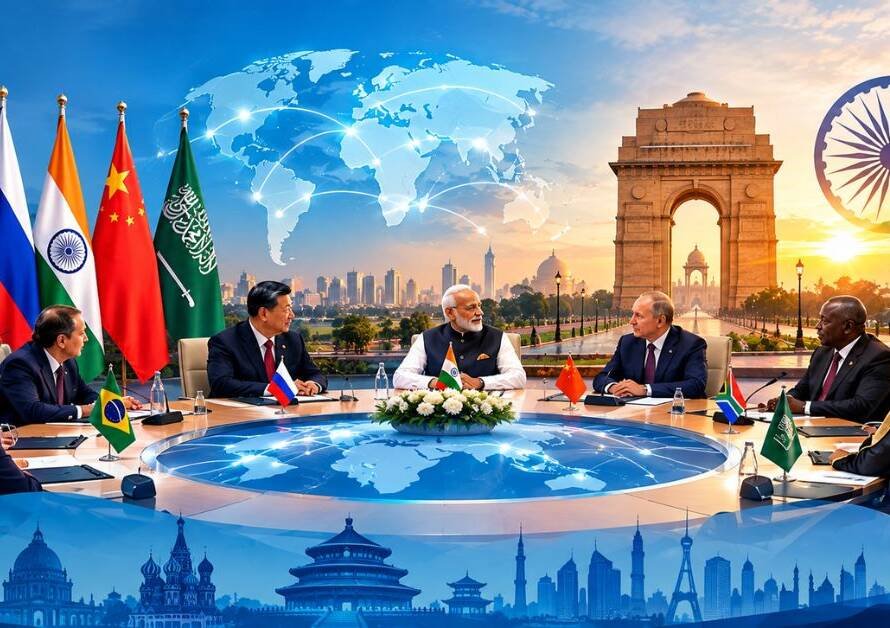
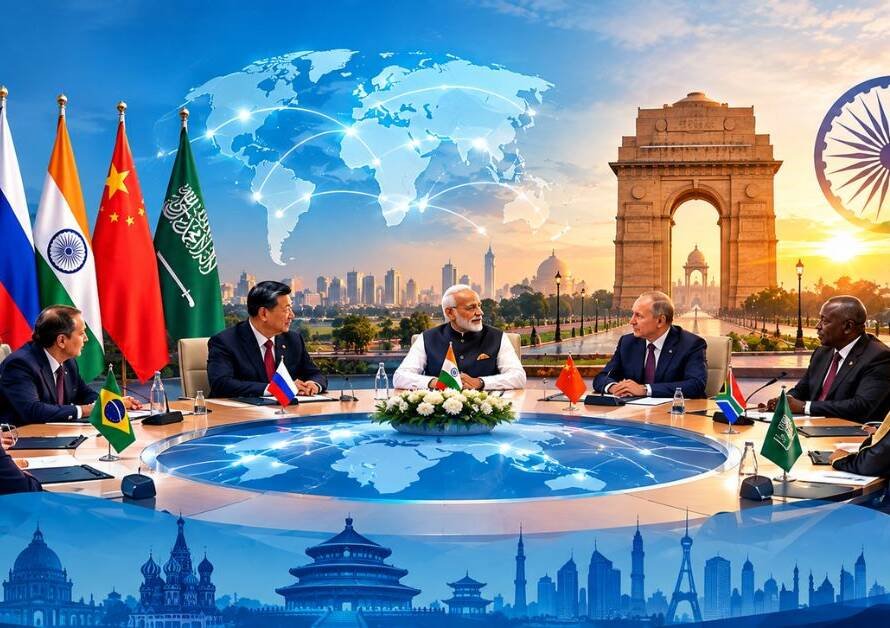
- The 18th BRICS Summit, taking place on September 12 and 13, 2026, at the prestigious Bharat Mandapam in New Delhi, is not merely a routine biennial international gathering. It stands as a historic demonstration of India’s growing diplomatic footprint, strategic autonomy, and leadership capability within a rapidly evolving multipolar world order.
- Having assumed the BRICS Presidency for the fourth time on January 1, 2026, India has successfully steered the platform away from serving the geopolitical priorities of any single nation or bloc. Instead, India has aligned the group with a pragmatic agenda focused on trade, digital technology, Micro, Small, and Medium Enterprises (MSMEs), energy security, supply chain resilience, and the voice of the ‘Global South.’
- By hosting over 350 high-level meetings across more than 25 major cities throughout 2026, India has demonstrated to the world that it is the most reliable and influential global power balancing the East and West, as well as the North and South.
- Today, the entire world acknowledges India’s capabilities. In such a historic moment, it is deeply unfortunate that certain political elements within the country choose to oppose India’s global achievements and the visionary leadership of Prime Minister Shri Narendra Modi. The people of the nation will certainly respond to such attitudes at the appropriate time.
Equations, India’s Rising Diplomatic Influence, and the National Perspective
1. BRICS 2026 and India’s Ideological Vision: ‘Humanity First’
The official motto of India’s BRICS Presidency is “Building for Resilience, Innovation, Cooperation and Sustainability,” which India has integrated with its inclusive cultural and diplomatic philosophy of “Humanity First.” This approach is not a collection of empty promises, but a core pillar of India’s foreign policy.
- A Pragmatic and People-Centric Agenda: Rather than limiting BRICS discussions to abstract political rhetoric, India has firmly anchored the dialogue in grounded issues such as strengthening global supply chains, encouraging the MSME sector, fostering financial inclusion, and building inclusive digital infrastructure.
- A Clear Distinction from China’s Multilateral Model: While nations like China seek to develop BRICS into an anti-Western political bloc to assert their dominance, India views it as a ‘non-Western’ platform. India believes that this forum should be utilized to address and resolve the legitimate concerns of developing countries, rather than dividing the world into new opposing poles.
- A Comprehensive Roadmap for 2026: Since assuming the presidency on January 1, 2026, India has successfully organized over 350 meetings across more than 25 historical and cultural cities. These events showcased India’s cultural diversity, economic capabilities, and administrative efficiency on a multilateral stage.
2. The Historical Journey of BRICS: From a 4-Nation Concept to an 11-Nation Global Powerhouse
The origin and growth of BRICS demonstrate how an economic concept evolved over time into the world’s most powerful multilateral platform in global politics and economics.
- Origin and Initial Framework: The acronym ‘BRIC’ was first coined in 2001 by Goldman Sachs economist Jim O’Neill to highlight the emerging economic potential of Brazil, Russia, India, and China. Formal intergovernmental cooperation began in 2006 on the sidelines of the UN General Assembly in New York, followed by the first official summit in 2009 in Yekaterinburg, Russia.
- Entry of South Africa (2011): South Africa was invited to join the grouping in late 2010, and with its participation at the 2011 Sanya Summit, the group was officially renamed from ‘BRIC’ to ‘BRICS.’
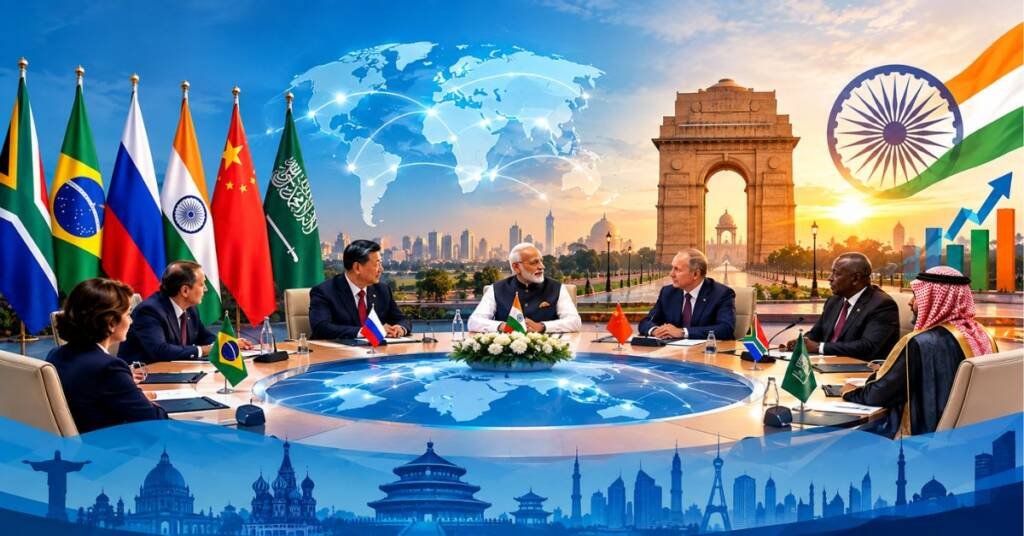
- Historic Expansion of 2024 and Current Structure: In 2024, BRICS underwent a historic expansion, admitting Egypt, Ethiopia, Iran, Saudi Arabia, the United Arab Emirates, and Indonesia as full members. Today, BRICS stands as a formidable group of 11 nations.
- A Powerhouse of Global Resources and Demographics: Today’s BRICS represents nearly 45% of the global population, over 35% of world GDP, and approximately 43% of global crude oil production. It brings together the strongest economies across Asia, Africa, West Asia, and Latin America.
3. Strategic Autonomy in a Multipolar World and Balancing the US
The BRICS platform offers India a powerful mechanism to maintain its Strategic Autonomy without aligning with any rigid power blocs, while strengthening its bargaining power in bilateral negotiations with Western powers, particularly the United States.
- Multi-Aligned Foreign Policy: India maintains strong strategic, technological, and defense partnerships with the US (such as through QUAD and iCET); preserves its traditional defense and energy ties with Russia; balances both competition and diplomatic engagement with China; and fosters deep economic and energy relationships with Gulf nations.
- Enhanced Negotiating Power: India does not use BRICS as an anti-American or anti-Western tool. However, the alternative economic networks, local currency trade arrangements, and resilient supply chains that India strengthens within BRICS indirectly enhance its negotiating leverage with Washington. India remains fully independent in making decisions driven strictly by its national interests.
4. Key Practical Achievements Under India’s Presidency
During its 2026 presidency, India has delivered concrete, far-reaching results through BRICS, revitalizing the economic framework of the grouping:
- Jaipur Commerce Ministers’ Meeting (Empowering MSMEs): India ensured that the economic benefits of BRICS extend beyond multinational corporations (MNCs) to small and medium enterprises by establishing the ‘MSME Financing Guiding Principles.’ This initiative prioritizes credit access, bridging the trade finance gap, and advancing fintech solutions.
- Digital Public Infrastructure (DPI) and the UPI Model: India shared its successful experiences with UPI, Aadhaar, and open-source digital infrastructure across BRICS member states. At the BRICS Communications Ministers’ Meeting in August 2026, priority was given to digital transformation, ICT cooperation, and resilient digital public infrastructure.
- Gurugram Energy Ministers’ Meeting (Energy Security and Critical Minerals): In June 2026 in Gurugram, consensus was reached on energy security, diversifying energy sources, modernizing power grids, energy storage, and securing supply chains for critical minerals. Bringing major energy producers like Russia, Saudi Arabia, the UAE, Iran, and Brazil to the same table is vital for India’s long-term energy security.
- Chennai Science and Innovation Summit (AI and Young Scientists): In August 2026 in Chennai, senior officials drafted a roadmap to enhance cooperation in Artificial Intelligence (AI), advanced technologies, joint scientific research, and exchange programs for young innovators.
5. The New Delhi Summit: The Epicenter of Global Diplomacy
Bharat Mandapam in New Delhi is once again becoming the premier epicenter of global diplomacy. The timing and background of this summit have significantly elevated its diplomatic weight.
- Historic Presence of Xi Jinping and Vladimir Putin: The anticipated visit of Chinese President Xi Jinping to India right before the summit—his first visit in seven years—alongside the personal attendance of Russian President Vladimir Putin, highlights the success of India’s diplomatic standing. This is also viewed as a major step forward in diplomatic reconciliation following border tensions between India and China.
- From G20 to BRICS: The Most Trusted Leader of the ‘Global South’: By securing permanent membership for the African Union during the historic G20 Summit in New Delhi in 2023, India proved itself to be the most vocal and responsible voice for the Global South. Through the 2026 BRICS Summit, India is further solidifying this leadership role.
- Unprecedented Convening Power: The seamless execution of over 350 meetings across 25+ cities proves that India is not just a massive economic market, but a global power capable of bringing competing international forces together at a single table.
6. Political Perspective: National Pride vs. Narrow Opposition Politics
As this historic and grand BRICS Summit unfolds in New Delhi with the eyes of the world fixed on India’s rising capabilities, the conduct of the primary opposition party and its leaders at such a proud moment is deeply disappointing.
- Negative and Irresponsible Opposition Stance: As the nation elevates its diplomatic stature, economic prowess, and global credibility, statements from Congress leaders reflect a regrettable attempt to trivialize these national achievements. While the world eagerly steps forward to partner with India, Congress leaders appear unable to accept the country’s unprecedented progress and global respect.
- Demeaning the Nation on Foreign Soil: This is not an isolated instance. Whether on foreign soil or domestically, Rahul Gandhi and other Congress leaders have repeatedly sought to criticize India’s democratic framework and international image. Even during an event of such international magnitude, their frustration remains evident.
- Strong Leadership and the Verdict of the People: Congress leaders must recognize that the people of India will respond to this political frustration at the appropriate time. Whenever national growth, progress, and pride are celebrated, the opposition expresses discomfort. However, narrow political agendas cannot halt the nation’s journey, because India is led today by a resolute, firm, and visionary leader in Shri Narendra Modi. In upcoming elections, the public will once again deliver a clear verdict against this obstructionist mindset.
7. India’s Golden Future in a Multipolar World
- The 18th BRICS Summit conclusively proves that 21st-century India is no longer a passive observer following global policies, but an empowered nation shaping the global agenda.
- India has demonstrated that it can engage with equal confidence, mutual respect, and dignity across Washington, Moscow, Beijing, Riyadh, and Brasília simultaneously.
- India stands as the strongest advocate for the legitimate aspirations of the ‘Global South’ and a trusted partner to major economic powers.
- Under the visionary leadership of Prime Minister Shri Narendra Modi, India has reaffirmed its commitment to lead a just, balanced, and multipolar world order—without making a single compromise on its national interests, sovereignty, or cultural heritage.
🇮🇳 Jai Bharat, Vandematram 🇮🇳
Read our previous blogs 👉 Click here
Join us on Arattai 👉 Click here
👉Join Our Channels👈