Executive Summary
- This article provides a comprehensive analysis of the unprecedented economic, structural, and political transformation unfolding in the historic Bundelkhand region, spanning across Uttar Pradesh and Madhya Pradesh.
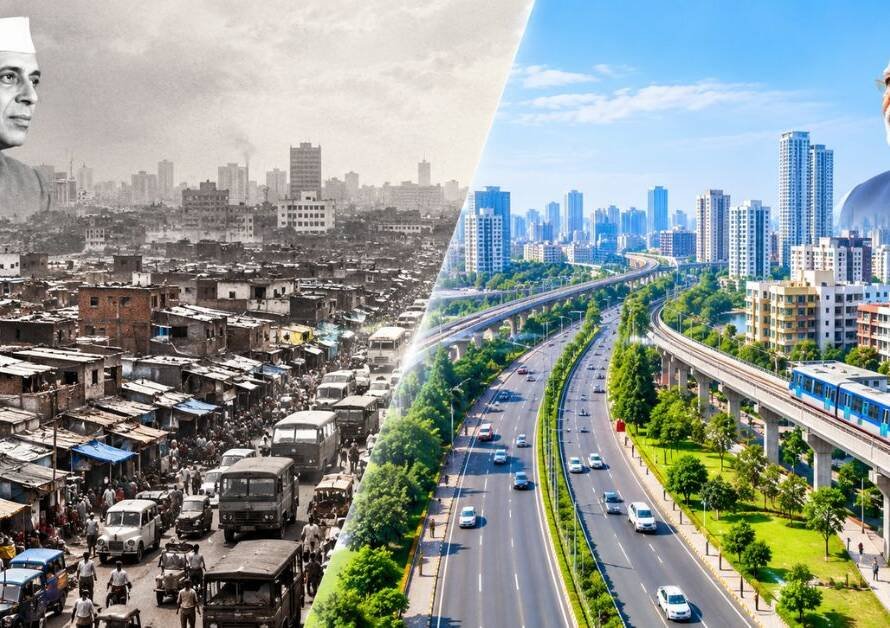
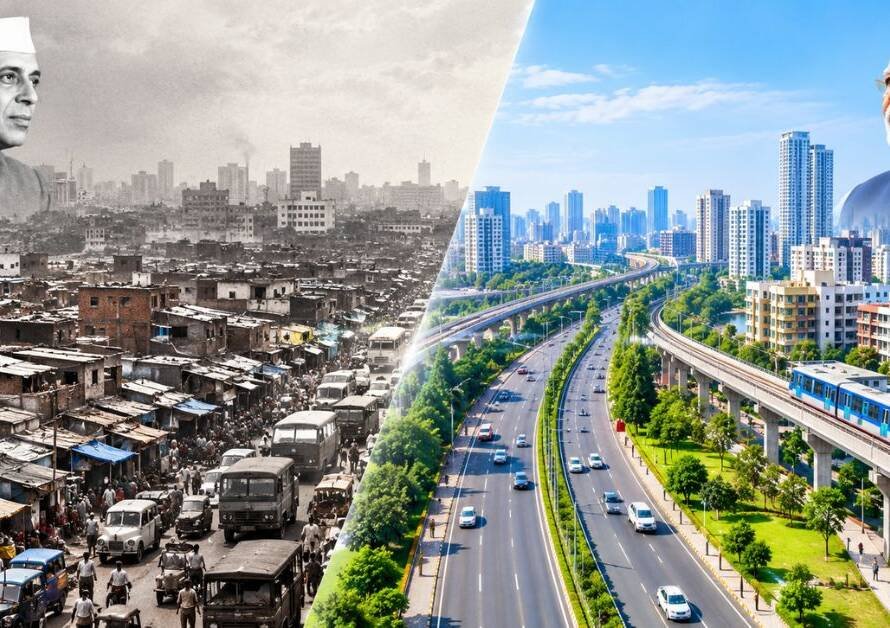
- Once notorious for its history of drought, large-scale migration, debt, and severe water crises, the region is now on the path to becoming one of India’s largest solar energy hubs.
- Driven by the long-term, strategic policies of the Narendra Modi government at the Centre and the Yogi Adityanath administration in Uttar Pradesh, the region’s 47-degree heat and thousands of acres of once-barren, rocky land are being transformed into a massive “Green Energy Corridor.”
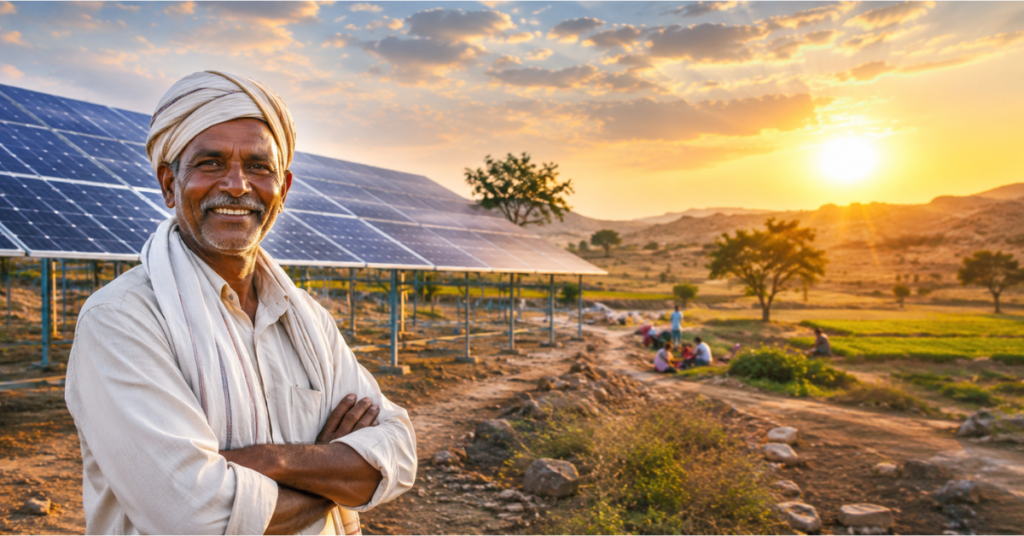
- With 8 mega solar parks boasting a total capacity of 4,995 MW and the development of solar corridors along the Bundelkhand Expressway, the region is not only becoming energy self-reliant but is also guaranteeing a stable, risk-free, and permanent income for local farmers through a “Land Lease Model.”
How Sunbeams Became a Blessing for Farmers
1. Historical Perspective: From the Curse of Neglect to an Industrial Boon
The geographical and socioeconomic landscape of Bundelkhand remained a formidable challenge for Indian policymakers for decades. However, strategic technical intervention and strong political willpower have turned the region’s greatest natural struggle into its most significant asset.
- Geographical Challenges and Extreme Heat: A vast portion of Bundelkhand is characterized by rocky granite terrain with a severely depleted water table. From March to June, temperatures frequently soar above 47°C. Due to erratic rainfall and a lack of traditional irrigation, farming here was long viewed as a high-risk gamble.
- Ending Migration and Social Crises: Historically, the failure of agriculture forced the youth and labor force to migrate to metropolises like Delhi, Mumbai, and Surat, leading to the systemic emptying of entire villages.
- Turning a Natural Curse into a Boon: Solar experts note that Bundelkhand experiences clear skies for over 300 days a year, providing the high-intensity solar radiation required for optimal photovoltaic (PV) power generation—arguably some of the best conditions in India.
- Policy Shift: The same scorching sun that once withered crops and forced migration has now become the backbone of billions in corporate investment, the arrival of global industry, and the creation of local technical employment.
2. Policy Perspective: National Interest vs. Dynastic Governance
The solar and wind revolution in Bundelkhand is more than an industrial project; it is a vivid demonstration of how a “Nation First” government utilizes natural resources for national building.
- Centuries of Neglect: While solar and wind resources were always available, successive administrations focused on corruption and systemic looting rather than national development.
- The Era of Corruption: Development schemes under previous regimes were often designed to benefit private interests and dynastic agendas.
- Reliance on Imports: Previous administrations avoided domestic manufacturing to facilitate expensive imports of coal, oil, and equipment, favoring systems that allowed for kickbacks and hefty commissions.
- The Public Mandate: The informed Indian electorate has recognized this contrast, consistently rejecting dynastic and anti-development parties. Today, the absence of these corrupt elements is allowing the nation to take giant leaps toward progress.
3. Mega Infrastructure: The 4,995 MW Solar Park Cluster
Under the central government’s “Ultra Mega Renewable Energy Power Park” (UMREPP) scheme, solar development in Bundelkhand has gained historic momentum. A massive cluster is being formed across border districts:
- Jalaun Solar Park (1,200 MW): The most ambitious solar park in the region, centered in the Dakor area, serving as a primary economic anchor.
- Chhatarpur Solar Park (950 MW): Located in the Madhya Pradesh region of Bundelkhand, this park is a major contributor to the national grid’s clean energy supply.
- Chitrakoot Solar Park (800 MW): The historic and spiritual city of Chitrakoot is now emerging as a key player on the industrial map through this 800 MW project.
- Barethi Solar Project (630 MW): Being developed by NTPC, this represents one of the most technologically advanced solar installations in the country.
- Jhansi and Lalitpur Solar Parks (600 MW each): Targeting severely drought-affected areas like Garautha and Madawara, these projects are reclaiming barren lands for energy generation.
- Kalpi Solar Project (65 MW): A grid-connected plant designed to supply seamless power to local industries and the regional railway network.
4. Bundelkhand Expressway: A Model of “Green Energy Corridor”
The Uttar Pradesh government and UPNEDA are building an integrated “Solar Economic Corridor” that goes beyond mere electricity generation.
- Strategic Importance of Kabrai (Mahoba): Once known primarily for stone crushing and concrete industries, Kabrai is becoming the primary junction for integrating power from various solar parks into the main transmission lines.
- The Solar Expressway Model: Plans to utilize the “Right of Way” along the 296-km Bundelkhand Expressway to install solar panels with a capacity of 450-500 MW are underway. This will be India’s first “Solar Expressway,” powering its own lighting and charging infrastructure while feeding surplus energy to nearby industrial zones.
- Grid Integration: The UPPTCL has operationalized new substations under “Green Energy Corridor-2” (GEC-II) to ensure the efficient evacuation of power. Substations in Charkhari, Dakor, Bangra, Bamour, Birdha, Jaitpur, Hamirpur, Banda, and Madawara are being synchronized to the grid, marking a historic technical milestone for the state’s power sector.
5. Economic Empowerment: The “Land Lease Model”
The most humanitarian aspect of this revolution is the shift toward securing the livelihoods of small and marginal farmers.
- Compensating for Agricultural Loss: By leasing land to solar companies for 25–30 years, farmers are moving away from the debt cycle caused by crop failures, stray cattle, and erratic weather.
- Guaranteed Income: Farmers receive a fixed, guaranteed annual rent per acre with built-in escalation clauses, ensuring predictable income regardless of harvest conditions.
- Ownership Security: The “Land Lease Model” is unique because the farmer retains full ownership of their land. Once the lease term expires, the land is returned to the farmer.
- Local Employment: The development, maintenance, security, and cleaning of solar plants are providing localized training and technical jobs for rural youth, effectively curbing the need for migration to major cities.
6. The संकल्प (Resolve) of a New India
- The transformation in Bundelkhand is not merely about solar panels; it is the story of a region’s rebirth.
- A territory that once made headlines for its misery is now the cornerstone of making Uttar Pradesh a $1 trillion economy and positioning India as a global leader in clean energy.
- This convergence of self-reliance, environmental protection, and farmer welfare is the most vivid example of a rising “New India.”
🇮🇳Jai Bharat, Vandematram 🇮🇳
Read our previous blogs 👉 Click here
Join us on Arattai 👉 Click here
👉Join Our Channels👈