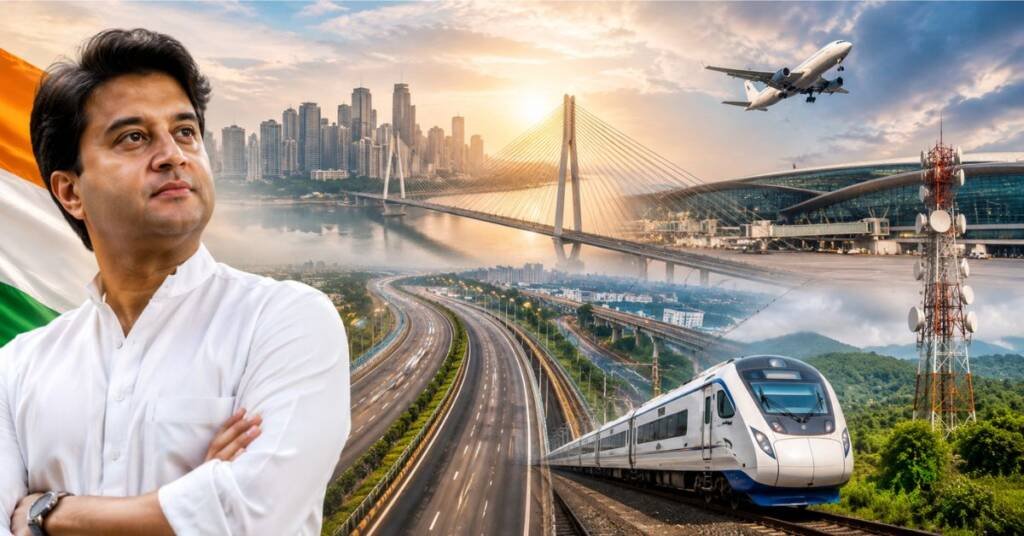
Summary:
- This comprehensive analytical report card evaluates the tenure of Union Minister Maharaj Jyotiraditya Scindia from July 2021 to 2026, demonstrating how ‘connectivity’ was expanded beyond physical roads and flights to integrate digital, postal, financial, and holistic development across the North East.
- Revenue saved by curbing corruption, scams, and systemic leaks since 2014 was directly channeled into national infrastructure, exponentially accelerating India’s growth trajectory.
- From Civil Aviation (2021–2024) to Communications, Postal Services, and the Ministry of Development of North Eastern Region (DoNER) (2024–2026), this period marks a historic effort to connect every corner of India to mainstream technology, logistics, and economic progress.
One Vision, One Goal—’Empowered and Connected India’
- When Jyotiraditya Scindia assumed charge as the Union Minister of Civil Aviation in July 2021, and subsequently took over the Ministry of Communications and the Ministry of Development of North Eastern Region (DoNER) in 2024, his primary focus remained on making the country’s infrastructure modern, transparent, and universally accessible.
- This 2021 to 2026 tenure is not merely an accounting of individual ministerial operations; it is a well-planned saga of unifying India “from the skies to the ground, and from metros to the most remote villages.”
1. Unprecedented Pace of Infrastructure: Nation Building Through War on Corruption
The unprecedented leap in India’s pace of progress is anchored in the expansion of nationwide connectivity networks and transparent budgetary management.
- A Complete End to Leaks and Scams: Prior to 2014, a massive portion of national revenue was lost to plunder, corruption, and systemic scams. While this enriched politicians of the Congress and their alliance partners, ordinary citizens were pushed deeper into poverty, and basic infrastructure remained in disrepair.
- Direct Utilization of Budget: Post-2014, all systemic leaks were plugged through transparent policies and digital governance. The substantial revenue saved by putting a firm check on scams was directly allocated toward national infrastructure, connectivity, and public welfare development projects.
- Historic Rate of Development: This financial discipline enabled a revolution across aviation, digital, postal, and border connectivity over the past 5 to 10 years that remains unmatched by the preceding seven decades. The citizens of India clearly recognize this stark contrast and remain committed to never returning to the misrule of the past.
2. Civil Aviation (2021–2024): Democratizing Air Travel
During his tenure at the Ministry of Civil Aviation, the priority was not confined to busy metropolitan airports, but extended to putting Tier-2 and Tier-3 cities, hill regions, and remote areas onto the country’s aviation map.
- Unprecedented Expansion of the UDAN Scheme: Accelerating regional air connectivity, a total of 619 routes and 88 airports/water aerodromes/heliports were successfully made operational under the UDAN scheme by the end of 2024.
- Mass Participation of Citizens: Over 1.48 crore citizens availed affordable regional flights for the first time through UDAN, with approximately 2.94 lakh RCS (Regional Connectivity Scheme) flights operated safely.
- Focused Efforts on Small Towns and Remote Areas: In 2024 alone, 102 new RCS routes were launched, 20 of which were specifically dedicated to connecting the hilly and geographically challenging terrain of the North Eastern states.
- Boosting Regional Economies: India’s aviation sector evolved beyond metro routes like Delhi-Mumbai to become the primary engine for commercial and tourism activity in smaller towns.
3. Ministry of Communications (2024–2026): Digital Revolution and Indigenous 4G/5G
Upon taking charge of the Communications Ministry in 2024, Scindia’s vision extended beyond providing high-speed internet in urban centers to delivering indigenous network technology to the last village of India.
- Nationwide 5G Rollout: According to official government data, seamless 5G network coverage was ensured across 99.9% of districts in the country by February 2026.
- Rural Transformation via Digital Bharat Nidhi (DBN): To connect unserved areas, 26,972 new 4G BTS towers were installed across 32,041 villages/locations under DBN by January 2026.
- Indigenous 4G Overhaul of BSNL: Rapid progress was made on deploying 1 lakh BSNL towers equipped with fully indigenous 4G technology developed in India. By January 2026, 97,672 sites were installed, with 95,511 sites went live on-air.
- Growing Consumer Trust: Driven by these technical upgrades and network expansion, BSNL’s subscriber base expanded from 8.86 crore in March 2024 to 9.28 crore by December 2025.
4. Postal Services (2024–2026): Reimagining Post Offices as ‘Digital Logistics Hubs’
The traditional perception of India Post as a mere letter-delivery department was systematically dismantled, transforming it into a modern digital, financial, and logistics network.
- Massive Network Digitization and IT 2.0: By December 2025, a network of 1.64 lakh post offices and 2.78 lakh Gramin Dak Sevaks (GDS) was connected to digital platforms. In August 2025, ‘IT 2.0 – Advanced Postal Technology’ was rolled out across 1.65 lakh post offices.
- Time-Definite Delivery and Modern Logistics: March 2026 marked the launch of time-definite delivery services including 24 Speed Post, 24 Speed Post Parcel, and 48 Speed Post. These services featured real-time tracking, SMS alerts, OTP-based delivery, money-back guarantees, and Sunday/holiday deliveries.
- Financial Growth and Modernization (Jan Sewa Connect): The Department of Posts recorded a 16% revenue growth in FY 2025–26. Under the ‘Jan Sewa Connect’ initiative, work commenced to transform over 120 post offices, including Nehru Place in Delhi, into modern citizen service hubs.
5. Development of North Eastern Region (DoNER) (2024–2026): Integrating the ‘Ashtalakshmi’
Under the DoNER Ministry, infrastructure, tourism, healthcare, education, sports, and job creation were advanced simultaneously across the North Eastern states.
- Impact of PM-DevINE Scheme: Major infrastructure and social development projects were sanctioned and executed under the ‘Prime Minister’s Development Initiative for North East Region’ (PM-DevINE).
- Digital Reach to Border Villages: In coordination with the Telecom Ministry, 4G coverage was delivered to the most remote and border villages of the North East. By 2026, historic progress was made toward achieving 4G saturation across approximately 6.31 lakh villages nationwide.
Core Message of 2021–2026: “One Vision — ‘Empowered and Connected India'”
The guiding principle behind Jyotiraditya Scindia’s tenure from 2021 to 2026 is captured in a single word—“CONNECTIVITY”.
- In the Skies: Connecting smaller towns with affordable air travel by operationalizing 619 routes and 88 airports, benefiting 1.48 crore passengers
- In the Digital Sphere: Empowering the last village with 4G and 5G, expanding 5G to 99.9% of districts, deploying 97,672 indigenous 4G sites for BSNL, and growing its user base to 9.28 crore.
- In Postal Infrastructure: Converting traditional post offices into digital and financial hubs, equipping 1.64 lakh post offices with IT 2.0, launching 24/48-hour time-definite delivery, and driving a 16% revenue growth.
- In the North East: Bringing remote areas into the national economic mainstream through PM-DevINE projects and extending 4G coverage to 6.31 lakh villages.
This connectivity goes far beyond roads and flights—it represents budgetary strength earned through corruption-free policies, digital empowerment, financial inclusion, fast logistics, and a commitment to linking every citizen directly to India’s growth story. The journey from 2021 to 2026 stands as clear proof of realizing the vision of a “Fully Connected India.”
🇮🇳Jai Bharat, Vandematram 🇮🇳
Read our previous blogs 👉 Click here
Join us on Arattai 👉 Click here
👉Join Our Channels👈