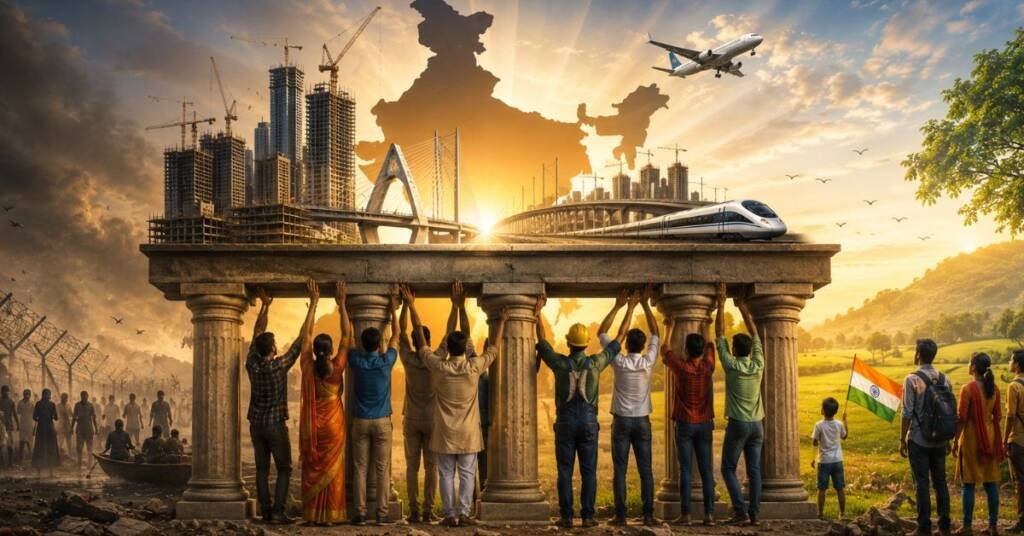
Summary:
- This narrative explores the critical disconnect between state-led progress and societal responsibility in contemporary India.
- While the government has spent the last 12 years building world-class infrastructure and economic frameworks, the majority community remains fragmented and politically passive.
- The text warns that without a unified societal effort to counter thriving anti-national ecosystems, demographic shifts, and illegal infiltration, the material success of today will be lost to the instability of tomorrow.
- It calls for a shift from a “dependency mindset” to one of “active sovereignty,” demanding legislative safeguards like the Uniform Civil Code and strict population policies to ensure the long-term survival of Indian civilization.
I. The Great Paradox: Modern Infrastructure on a Fragile Foundation
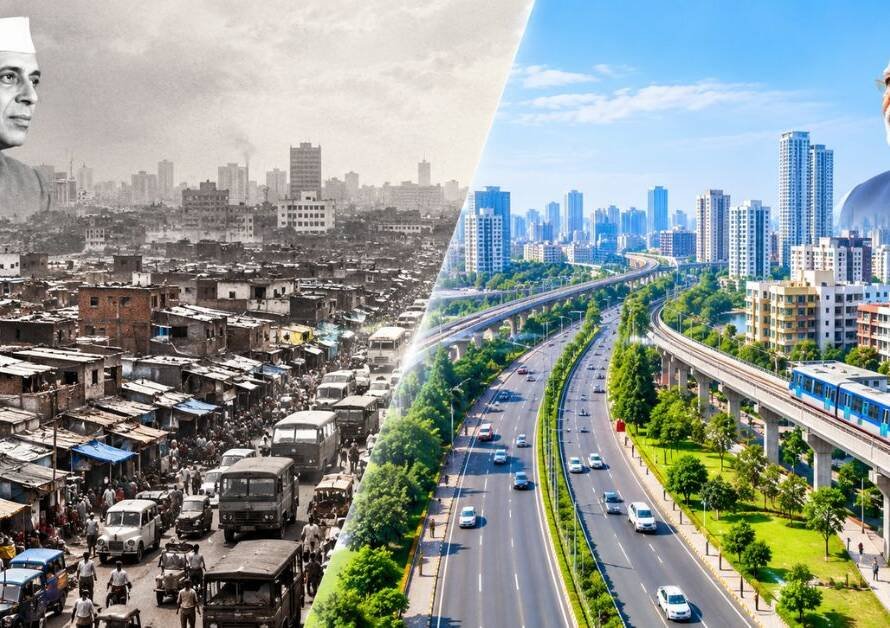
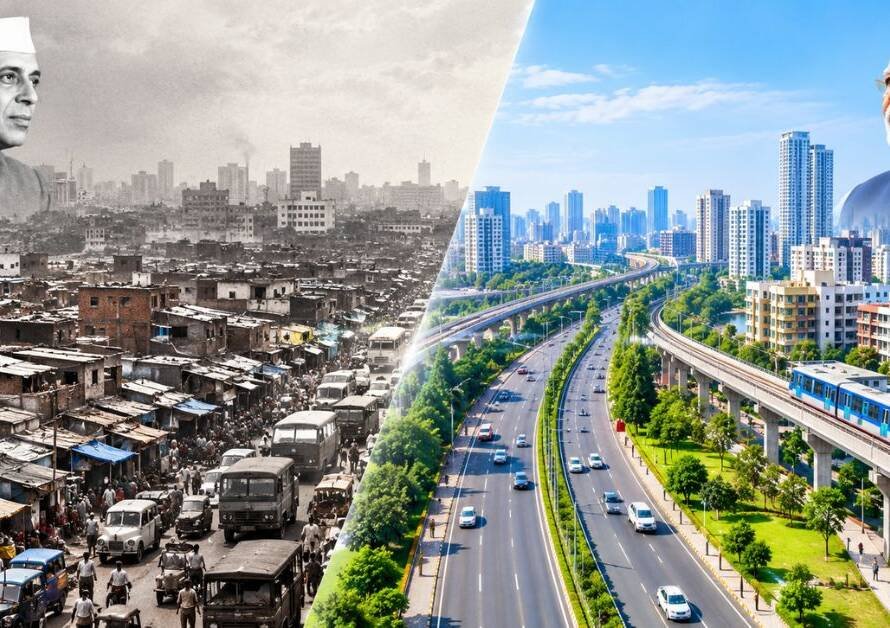
For over a decade, India has witnessed a transformation in its physical and digital landscape. From the world’s most advanced UPI system to the rapid expansion of highways and airports, the “Architect” (the State) has delivered a blueprint for a global superpower. However, a nation is not merely made of concrete and fiber-optics; it is made of people.
The Government’s Strong Progress (2014–2026):
- Economic Sovereignty: Reducing dependence on foreign supply chains and strengthening local manufacturing.
- Infrastructure Excellence: Building the “physical body” of a developed nation.
- Global Standing: Elevating India’s voice on the international stage, from the G20 to strategic alliances.
The Societal Gap:
- The Dependency Trap: Citizens have grown accustomed to expecting the government to solve every cultural and security problem while they remain on the sidelines.
- The Pillar’s Weakness: If the society (the Pillar) is hollowed out by internal division and apathy, the Architect’s masterpiece will eventually collapse under its own weight.
II. The Anatomy of the Anti-National Ecosystem
While the majority remains preoccupied with personal success, a well-funded and highly organized “Anti-National Ecosystem” has thrived for decades. This ecosystem does not sleep; it works systematically to undermine every reform intended to secure the nation’s future.
- Narrative Terrorism: Using media and academia to twist security measures into “human rights violations.”
- Legal Obstructionism: Filing endless petitions to stall projects—from border fencing to infrastructure—that are vital for national safety.
- The “Silent” Invasion: Supporting and shielding illegal infiltration from Pakistan and Bangladesh, which slowly erodes the demographic balance of sensitive border regions.
- The Result of Our Silence: Because the majority community fails to unite and provide a counter-narrative, this ecosystem operates with impunity, effectively holding the state’s progress hostage.
III. Historical Warnings: The Illusion of Permanent Success
History is a graveyard of civilizations that thought they were too successful to fail. Wealth, education, and social status offer zero protection when the demographic and legal framework of a region shifts.
The Displacement of the Elite (1947):
- Icons like Raj Kapoor, Sunil Dutt, and LK Advani belonged to families of great influence.
- When the demographic boundary shifted, their shops, fields, and ancestral homes became irrelevant overnight. They became refugees, proving that individual success cannot survive a collective failure.
The Kashmiri Exodus (1990):
- A prosperous community was uprooted from its homeland within weeks.
- This happened because the local society failed to unite politically against radicalization, expecting the distant central government to handle a localized fire that had been smoldering for years.
The Vanishing Heritage of the Subcontinent:
- Afghanistan: Once a land of grand Buddhist statues and Hindu influence; today, not a single trace remains.
- Pakistan (Multan & Gandhara): Once the heart of Jain and Shiva worship; today, those temples are replaced by madrassas or ruins.
The Lesson: Temples, schools, and businesses only exist as long as the community that built them holds the demographic and political power to protect them.
IV. The Demographic Reality: Beyond the Numbers
While official census data suggests a Muslim population of 14.2% to 15%, the reality is more nuanced and concerning in specific geographical pockets.
- Border District Shifts: In many districts bordering Bangladesh and Pakistan, the demographic balance has shifted by over 20-30% in just a few decades due to illegal infiltration and higher birth rates.
- The “Veto” Power: Demographic clusters allow for “voter-bank” politics where small groups can veto national security reforms by threatening political instability.
- Resource Strain: Illegal infiltration puts an unsustainable burden on India’s welfare schemes—healthcare, food subsidies, and land—which are meant for the rightful citizens of the country.
V. The Responsibility of the Citizen: Moving from “Jai” to “Duty”
It is a common failing to believe that voting once every five years fulfills one’s duty to the nation. If we expect the government to do everything, we are not citizens; we are subjects.
- The Need for Political Will: A government can only pass tough laws (like the NRC or Population Control) if it gets the unwavering, vocal support of a unified society.
- Hindus and the Unity Crisis: The inability of the majority to transcend caste and local politics to support national security reforms is our greatest vulnerability. The “Anti-National Ecosystem” thrives specifically because it knows we are fragmented.
Shouldering the Burden:
- Social Vigilance: Monitoring your own neighborhoods for illegal settlers and suspicious activities.
- Economic Support: Prioritizing businesses and ecosystems that align with national resurgence.
- Legislative Demand: Moving away from asking for “freebies” and instead demanding “security laws.”
VI. The Legislative Shield: Mandatory Reforms for Survival
To secure the next 50 years, India must transition from a “soft state” to a nation governed by a single, unbreakable legal code.
Uniform Civil Code (UCC):
- Ensures that no community has a demographic “advantage” through separate personal laws.
- Establishes that the Constitution is the only supreme text in civil matters.
Strict Population Policy:
- A “Two-Child Norm” or similar measures to ensure that India’s resources are shared equitably and that demographic shifts do not lead to internal conflict.
National Register of Citizens (NRC):
- A mandatory vetting process to separate citizens from illegal infiltrators. This is a standard practice for any sovereign nation (like the US or Israel) and is essential for India’s internal security.
Anti-Conversion and Love-Jihad Laws:
- Protecting the social fabric from predatory demographic tactics that target the vulnerable.
VII. Global Paradigms: The China and Israel Models
Success is not an accident; it is the result of a society deciding that its survival is non-negotiable.
- The China Model: Regardless of international pressure, the state maintains absolute administrative discipline to ensure that no sub-culture challenges the national identity or security.
- The Israel Model: Every citizen is a soldier. The society is so deeply integrated with the national security apparatus that the enemy knows the cost of aggression is total destruction.
- The Indian Path: India must find its own middle path—maintaining its democratic values while adopting the ruthlessness of these models when it comes to border security and anti-national elements.
VIII. A Warning to the Next Generation
The success we see in India today—the shiny new malls, the tech hubs, the global investments—is a “Duniya of Dhundhlahat” (a world of haze) if it is not protected by a wall of law.
- To the Youth: Your degrees and high-paying jobs will not save you if the street outside your office is controlled by those who do not value your civilization.
- To the Elders: Do not leave behind only wealth for your children; leave them a secure country.
- The Ultimate Truth: Today’s leaders will be gone in 20 years. Your favorite politicians will not be there to guard your door. Only the Katoor Kanoon (Strong Law) you demand today will stand as a silent guardian for your grandchildren.
Stop the blind praise. Start the active support. Demand the law. Secure the Bharat of tomorrow.
🇮🇳 Jai Bharat, Vandematram 🇮🇳
Read our previous blogs 👉 Click here
Join us on Arattai 👉 Click here
👉Join Our Channels👈